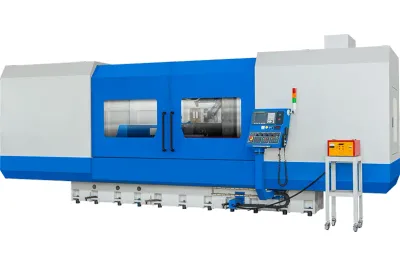
Rollomatic LaserSmart 510
Key Specifications
X Travel
Y Travel
Z Travel
machining diameter range
max overall tool length
control
How much does the Rollomatic LaserSmart 510 cost?
Estimated price range
Our best estimate for a cnc grinding machine in this class — not a quote from Rollomatic. Configuration moves it a long way.
Overview
The Rollomatic LaserSmart 510 is a five-axis laser machine for cutting tools from 2.0 to 80.0 mm (0.08 to 3.2 in) in diameter and up to 190 mm (7.5 in) in overall length. Rollomatic's table has no wheel spindle in it: the tool is machined by laser, and total power is a maximum of 5 kW.
X and Y run on oil-cooled linear motors. Y is the long axis at 400 mm (15.7 in), X travels 125 mm (5 in), and both reach 30 m/min (1180 in/min). Z is the short one, 100 mm (3.9 in) on a servo motor and ballscrew at 20 m/min (787 in/min). Linear scales read all three, at 0.00005 mm on Y and Z and 0.0001 mm on X.
The B axis swings through 260° at up to 10000°/min, read by a rotary scale at 0.0001°. The C axis turns continuously at up to 1000 rpm, with a 0.0001° encoder on its AC motor. Both are oil-cooled servo motors. Oil cooling on every drive except Z keeps motor heat out of the structure, which matters when positions are being held to scale resolutions this fine.
Two clamping systems are listed: SK 32 Nann collets and HSK63 in forms A, C, E and F, so shank tools and HSK-mounted tools are both covered. The robot is optional. It holds up to 1000 tools in 3 cassettes, clamps pneumatically and takes shanks from 2.0 to 32.0 mm (0.08 to 1.25 in). That shank limit is well below the 80.0 mm machining diameter, so for large-headed tools ask Rollomatic what the robot can carry.
The machine weighs 3200 kg (7050 lbs) and measures 2160 x 1600 x 2151 mm (85 x 63 x 84.7 in). Supply is 3 x 400 V / 25 A, and the laser product class is Class 2M.
Full Specifications
| Parameter | Value |
|---|---|
| Machining Diameter Range | 2.0 - 80.0 mm (.08" - 3.2") |
| Max Overall Tool Length | 190 mm (7.5") |
| CNC Control | FANUC 30iMB |
| Z Axis Type | Fanuc servo motor and ballscrew |
| Z-Axis Travel | 100 mm (3.9") |
| Z Axis Fast Travel | 20 m/min (787"/min) |
| Z Axis Encoder | Linear scale 0.00005 mm (.000002") |
| Y Axis Type | Linear motor, oil cooled |
| Y-Axis Travel | 400 mm (15.7") |
| Y Axis Fast Travel | 30 m/min (1180"/min) |
| Y Axis Encoder | Linear scale 0.00005 mm (.000002") |
| X Axis Type | Linear motor, oil cooled |
| X-Axis Travel | 125 mm (5") |
| X Axis Fast Travel | 30 m/min (1180"/min) |
| X Axis Encoder | Linear scale 0.0001 mm (.000004") |
| B Axis Type | Servo motor, oil cooled |
| B Axis Stroke | 260° |
| B Axis Fast Rotation | 10000°/min |
| B Axis Encoder | Rotary scale 0.0001° |
| C Axis Type | Servo motor, oil cooled |
| C Axis Stroke | Continuous |
| C Axis Fast Rotation | 1000 rpm |
| C Axis Encoder | on AC motor, 0.0001° |
| Tool Clamping Collet | SK 32, Nann |
| Tool Clamping | HSK63 (A, C, E, F) |
| Robot Number of Tools Optional | Up to 1000 (3 cassettes) |
| Robot Shank Diameter | 2.0 - 32.0 mm (.08" - 1.25") |
| Robot Clamping | Pneumatic |
| Floor Space Required | 2160 x 1600 x 2151 mm (85" x 63" x 84.7") |
| Machine Weight | 3200 kg (7050 lbs) |
| Total Power | Maximum 5 kW |
| Power Supply | 3 x 400V/25A |
| Laser Product Class | Class 2M |
Specifications sourced from rollomatic.ch — verified 2026-10-03
Strengths & Limitations
Strengths
- Machining diameter range of 2.0 to 80.0 mm (0.08 to 3.2 in)
- Oil-cooled linear motors on X and Y with 30 m/min (1180 in/min) fast travel
- Linear scales reading 0.00005 mm on Y and Z and 0.0001 mm on X
- Tool clamping by SK 32 Nann collet or HSK63 (A, C, E, F)
- Total power is a maximum of 5 kW on a 3 x 400 V / 25 A supply
- The C axis rotates continuously at up to 1000 rpm, and B covers a 260° stroke
Limitations
- The robot is optional, and its shank range of 2.0 to 32.0 mm (0.08 to 1.25 in) is narrower than the 80.0 mm machining diameter
- Overall tool length is limited to 190 mm (7.5 in)
- Z travel is 100 mm (3.9 in) and X is 125 mm (5 in); only Y, at 400 mm (15.7 in), is long
- The table gives no laser power, wavelength or pulse data, only the Class 2M product class
Best For
Frequently Asked Questions
01
Rollomatic lists a machining diameter range of 2.0 to 80.0 mm (0.08 to 3.2 in) and a maximum overall tool length of 190 mm (7.5 in). With the optional robot, shank diameters run from 2.0 to 32.0 mm (0.08 to 1.25 in).
02
X and Y use oil-cooled linear motors with 30 m/min (1180 in/min) fast travel. Z uses a servo motor and ballscrew at 20 m/min (787 in/min). B and C are oil-cooled servo motors: B has a 260° stroke at 10000°/min and C rotates continuously at up to 1000 rpm.
03
No. The table lists the robot as optional. When fitted it holds up to 1000 tools in 3 cassettes, uses pneumatic clamping and handles shank diameters of 2.0 to 32.0 mm (0.08 to 1.25 in).
04
Two systems are listed. Collet clamping uses SK 32 Nann collets, and the tool clamping row lists HSK63 in forms A, C, E and F. Check with Rollomatic which of the two is fitted to the machine as quoted.
05
A 3 x 400 V / 25 A supply, with total power of 5 kW at most. The machine weighs 3200 kg (7050 lbs) and measures 2160 x 1600 x 2151 mm (85 x 63 x 84.7 in). The laser product class is Class 2M, so follow the site's laser safety rules for that class.
Videos

Rollomatic

Rollomatic

Cutting Tool Engineering

SEGER Cutting Tools
More from Rollomatic
Rollomatic GrindSmart 629XW
Rollomatic ShapeSmart NP5
Rollomatic GrindSmart 830XW
Rollomatic NaNO 6X
Rollomatic NaNO6
Rollomatic GrindSmart 628XW
Other CNC Grinding Machines
Danobat IRDc
Junker QUICKPOINT 1000
Palmary OCD-3220P
Vollmer CB 400 / CBF 400
Mikrosa Kronos M