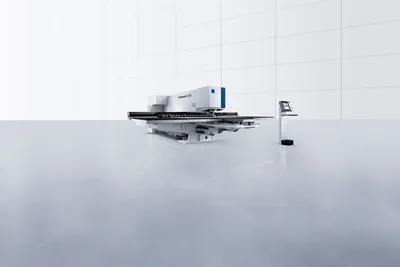
Prima Power SP30
Key Specifications
punching force
drive type
working area
sheet thickness steel
sheet thickness stainless
sheet thickness aluminum
Overview
The Prima Power SP30 is a servo-hydraulic CNC turret punch press rated at 300 kN (approximately 33 US tons) punching force, designed for heavy-duty production punching of thick sheet metal. Manufactured by Prima Power (Collegno, Italy), the SP30 targets fabricators who require higher tonnage than standard servo-electric punch presses provide — specifically for consistent punching of 6-8 mm mild steel, 5-6 mm stainless, and production applications where maximum punching force is a primary requirement.
The SP30 uses a servo-hydraulic drive system: the hydraulic pump is driven by a variable-speed servo motor rather than a fixed-speed induction motor. This hybrid approach provides the high force output of a hydraulic system with improved energy efficiency compared to traditional constant-speed hydraulic punch presses. The servo motor adjusts pump speed to match the actual demand of each punch stroke — idle and low-force strokes consume substantially less energy than on a fixed-speed hydraulic machine.
The SP30 is offered in 1530 (1,500 x 3,000 mm) and 2520 (2,500 x 2,000 mm) sheet format configurations. The 40-station Thick Turret accepts A, B, C, D, and E-size tool stations. The E-station (large tool diameter up to 88.9 mm / 3.5 in) is particularly relevant for large-diameter punching and forming operations that require the full 300 kN capacity. Nibbling speed reaches up to 1,400 hits/minute in small-tool high-speed punching applications.
Control is provided by the Prima Power NC Express CNC controller. The SP30 supports all Prima Power automation options — single-table loaders, Compact Tower, Modular Sheet Tower, sorting conveyors — and integrates with Prima Power's combination laser-punch systems for shops wanting punch and laser in a single platform.
The SP30 competes with the Amada VIPROS 358, Trumpf TruPunch 5000 (300 kN configuration), and the LVD Strippit PX-2050 in the high-tonnage turret punch segment. Pricing typically ranges from $500,000 to $850,000 for the 1530 format; the 2520 format commands $650,000 to $950,000.
Full Specifications
| Parameter | Value |
|---|---|
| Punching Force | 300 kN (33.7 US tons) |
| Drive Type | Servo-hydraulic |
| Working Area | 1,500 x 3,000 mm or 2,500 x 2,000 mm (configuration-dependent) |
| Sheet Thickness Steel | Up to 8.0 mm (0.315 in) |
| Sheet Thickness Stainless | Up to 6.0 mm (0.236 in) |
| Sheet Thickness Aluminum | Up to 10.0 mm (0.394 in) |
| Turret Stations | Up to 40 stations (A/B/C/D/E tool sizes) |
| Max Stroke Rate | Up to 1,400 hits/min (nibbling, small tools) |
| Repositioning Speed X | Up to 100 m/min |
| Repositioning Speed Y | Up to 60 m/min |
| CNC Control | Prima Power NC Express |
| Machine Weight | Approx. 16,000 kg (35,274 lb) |
| Manufacturer | Prima Industrie |
| Model | Platino 1530 |
| Cutting Thickness | 1,498.6 mm |
Specifications sourced from machinio.com — verified 2026-03-28
Strengths & Limitations
Strengths
- 300 kN punching force handles 6-8 mm mild steel consistently — significantly higher capacity than 220 kN servo-electric machines for heavy-gauge production
- Servo-hydraulic drive delivers energy efficiency gains of 20-35% over fixed-speed hydraulic competitors while maintaining full hydraulic force output
- E-size tooling station (up to 88.9 mm tool diameter) enables large-diameter punching and deep forming operations not possible on machines without E-station capacity
- Available in both 1530 and 2520 sheet formats — scalable to the required sheet size for each installation
- High nibbling rate (1,400 hits/min) for small-tool high-frequency punching applications in thin-to-medium gauge material
Limitations
- Servo-hydraulic system retains hydraulic oil maintenance requirements (filter changes, oil sampling, seal inspection) that servo-electric machines eliminate
- Higher noise level than servo-electric machines — servo-hydraulic pump noise and punch impact on heavy gauge material requires standard factory noise management
- Heavy machine weight (16,000 kg) requires reinforced concrete floor — floor load calculations required before installation in older or mezzanine-level facilities
Best For
Frequently Asked Questions
01
The SP30's 300 kN capacity extends the punching envelope to: (1) Mild steel up to 8 mm — most 220 kN machines are limited to 6 mm mild steel reliably; (2) Stainless steel up to 6 mm — where a 220 kN machine may struggle on stainless above 4-5 mm due to stainless's higher tensile strength (500-700 MPa vs. 350-400 MPa for mild steel); (3) Aluminum up to 10 mm — relevant for fabricators working with 6061-T6 or 5083 structural aluminum plate; (4) High-strength steel (HSLA) grades up to approximately 4 mm — the higher yield strength of HSLA requires substantially more punch force per unit area than mild steel. Rule of thumb: required punch force per unit area increases with material tensile strength and thickness. Shops punching holes larger than 25 mm in 6 mm steel should calculate required punch force before specifying a lower-tonnage machine.
02
A conventional hydraulic punch press runs a fixed-speed induction motor driving a hydraulic pump at constant RPM regardless of demand. During idle (no punching), during sheet repositioning, and during light-duty punching, the pump runs at full speed and wastes energy maintaining hydraulic pressure in the system. The SP30's servo-hydraulic system drives the pump with a variable-speed servo motor. When the machine is idle or repositioning the sheet, the servo motor slows to near-zero speed and the pump consumes minimal power. During punching, the motor accelerates to deliver the required flow and pressure for the punch stroke. Energy savings of 20-35% are typical in production environments; some Prima Power case studies show savings up to 40% in high-mix operations with frequent idle time between hits.
03
E-station tooling is the largest tooling station size in the Thick Turret system, accommodating punch tool bodies up to 88.9 mm (3.5 in) OD in a standard E-station. Tools requiring E-station: (1) Large round punches above approximately 76 mm (3 in) diameter — e.g., 80 mm, 88 mm round holes; (2) Rectangular or oblong punches with maximum dimension above 70 mm; (3) Large louver tools and multi-directional emboss tools with wide footprint; (4) Large countersink tools; (5) Specialty large-diameter cluster tools. E-station is not needed for most common punching work — the majority of sheet metal parts use A and B station tools (small holes under 50 mm, standard features). Shops processing HVAC panels with large duct flanges and cutouts, or electrical enclosures with large round knockouts, benefit most from E-station availability.
04
A hydraulic ironworker (e.g., Scotchman, Edwards, JMTUSA) punches individual holes in plate up to 25 mm thick at high force (up to 500 kN for large models), but it is a single-station manual machine: the operator positions the plate manually for each hole, actuates the punch, and repositions. For 1-5 holes in a single thick plate, an ironworker is faster and less expensive than a CNC punch press. For 50-200 holes in a production batch of plate parts with defined bolt patterns and cutouts, the SP30 is dramatically faster — one CNC program runs all the holes automatically with positioning accuracy of ±0.1 mm, while an operator with an ironworker and a drill-punched template achieves ±1-2 mm accuracy. The SP30 also handles thin-gauge sheet (ironworkers cannot effectively punch material under 3 mm). For shops with both light-gauge sheet and medium-gauge plate production, the SP30 is the versatile choice.
05
Setup time on the SP30 depends on turret tooling changes required: (1) If all required tools are already in the turret from a previous setup: setup time is essentially zero — load the program, verify sheet format and clamp position, run the first part for inspection. This scenario applies when a shop runs a recurring job on a dedicated turret layout; (2) If 1-5 tools must be swapped: tool change time per station is approximately 2-5 minutes for a skilled setup technician — total setup 10-25 minutes; (3) Complete turret changeover (all 40 stations): 60-120 minutes. Shops that program turret layouts carefully and group jobs by tool family minimize setup frequency. Prima Power's offline programming software includes tool planning that identifies which jobs can share a turret layout, enabling tooling-change batching.
Videos

ManicBeastBoise

Something Else2LookAt

Tim Kora

SpruesNBrews Scale Modeling
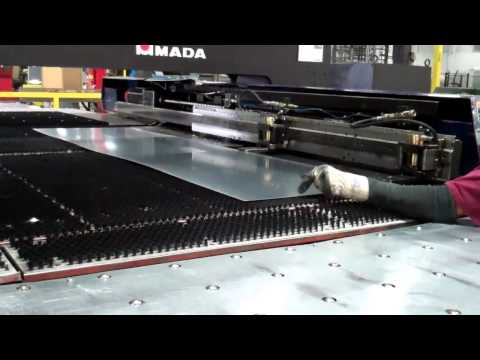
GoIndustryDoveBid
Community Discussions
Community discussion — Prima PRC Resonator Losing Power - Practical Machinist
Community discussion — Excessive Tool Wear in ... - Practical Machinist
Comparison and buying advice — Amada vs Trumpf
Community discussion — Bridgeport / Hardinge and USA Light Iron - Practical Machinist
Troubleshooting and problem-solving — Need Help! prima power platino machine issue - CNCzone
Community discussion — Prima platino 1530a manual - CNCzone
Options and configuration advice — Need Help! Compensation function locked; stima Engineering ...
Comparison and buying advice — Prima Power Platino 1530 - CNCzone
Options and configuration advice — Good CNC Mill for Pistol Slide Cutting? : r/Machinists - Reddit
Community discussion — Prototrak machines? : r/Machinists - Reddit
Community discussion — Suggestions for Cheaper Press Brakes : r/Machinists - Reddit
Owner experience and review — Water jet recommendations? : r/Machinists - Reddit
Links to community discussions. Summaries are editorial — visit the original thread for full context.
Related Machines
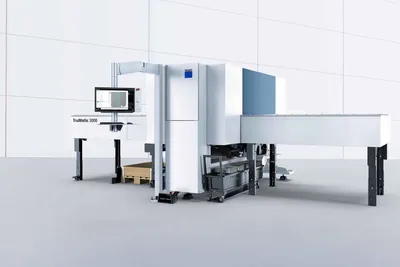
Trumpf TruMatic 3000
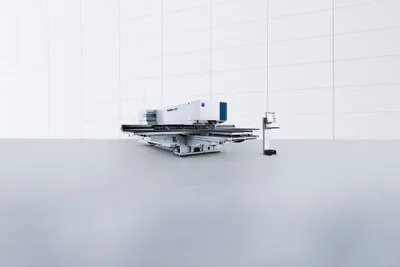
Trumpf TruMatic 7000
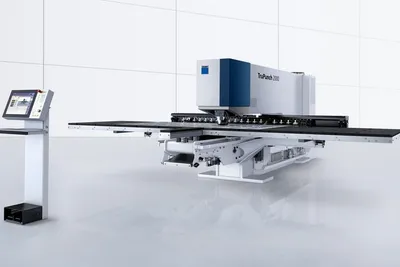
Trumpf TruPunch 2000
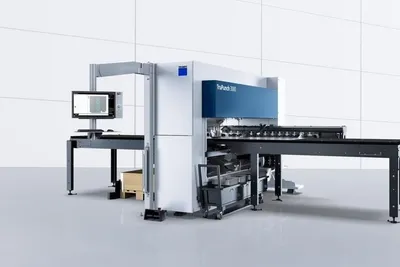
Trumpf TruPunch 3000