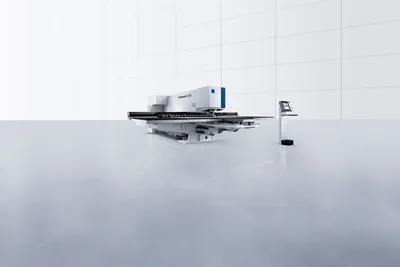
Prima Power Punch Express 2520
Key Specifications
working area
punching force
sheet thickness steel
sheet thickness aluminum
turret stations
max stroke rate
Overview
The Prima Power Punch Express 2520 is a CNC turret punch press built for high-throughput sheet metal punching in a 2,500 x 2,000 mm sheet format. Manufactured by Prima Power (formerly Prima Industrie and Finn-Power), headquartered in Collegno, Italy, the Punch Express 2520 targets medium-to-large fabrication shops processing large-format sheets where maximizing punching output per shift is the primary objective.
The '2520' designation refers to the machine's sheet working area: 2,500 mm in X and 2,000 mm in Y. This large format enables processing of full 2,500 x 1,250 mm metric sheets or 60 x 120-inch imperial sheets without repositioning, which is a significant productivity advantage over smaller 1,250 x 1,530 mm machines on large parts. The Punch Express 2520 is particularly well-suited for nesting multiple smaller parts in a single large sheet to maximize material utilization.
The turret configuration accommodates up to 40 stations (depending on tool station size configuration), accepting Thick Turret tooling in station sizes A (1.25 in), B (2.00 in), C (3.50 in), and D (4.50 in). The punching force is typically 300 kN (33 US tons), sufficient for punching steel up to 6.35 mm thick and aluminum up to 8 mm. The machine uses a servo-electric or servo-hydraulic drive depending on configuration; servo-electric variants deliver energy efficiency advantages for shops with high continuous use.
Control is provided by the Prima Power NC Express CNC controller on an industrial PC platform with a touchscreen interface. Programming is handled offline via Prima Power's nesting and programming software, which integrates with major CAD/CAM platforms including SolidWorks, AutoCAD, and Radan. Tool management, turret configuration, and hit count tracking are managed through the control software.
The Punch Express 2520 competes with the Amada EMZ-3610NT, the Trumpf TruPunch 5000 in large-format configuration, and the LVD Strippit PX-2050. Pricing typically ranges from $550,000 to $900,000 depending on turret configuration, drive type, sheet handling automation, and optional tapping or forming tools. Return on investment is typically calculated against reduced sheet handling time (fewer sheet loads for large nested jobs) and increased output from the large working envelope.
Full Specifications
| Parameter | Value |
|---|---|
| Working Area | 2,500 x 2,000 mm (98.4 x 78.7 in) |
| Punching Force | 300 kN (33.7 US tons) |
| Sheet Thickness Steel | Up to 6.35 mm (0.25 in) |
| Sheet Thickness Aluminum | Up to 8.0 mm (0.315 in) |
| Turret Stations | Up to 40 stations (A/B/C/D/E tool sizes) |
| Max Stroke Rate | Up to 1,400 hits/min (nibbling) |
| Sheet Size Max | 2,500 x 2,000 mm (98.4 x 78.7 in) |
| Repositioning Speed X | Up to 100 m/min |
| Repositioning Speed Y | Up to 60 m/min |
| CNC Control | Prima Power NC Express |
| Machine Weight | Approx. 14,500 kg (31,967 lb) |
Specifications compiled from manufacturer literature and industry references. Not independently verified against a published spec sheet — confirm with the manufacturer or an authorised dealer before making a purchasing decision.
Strengths & Limitations
Strengths
- 2,500 x 2,000 mm working area processes full large-format sheets without repositioning, enabling efficient nesting of large or multiple parts per sheet
- Up to 40 turret stations provide extensive tooling capacity for complex parts requiring many different punch geometries in a single setup
- High repositioning speed (100 m/min X-axis) minimizes non-cutting travel time on large sheets with widely-spaced feature clusters
- Compatible with Prima Power automation — sheet tower loaders, conveyor links, and sorting systems for lights-out large-format punching
- Prima Power NC Express control integrates with standard nesting CAD/CAM software for streamlined offline programming workflow
Limitations
- Large footprint and high capital cost — suitable for shops with consistent large-format sheet volume, not occasional large-part production
- Turret punch inherent limitation: minimum inside corner radius equals punch radius — cannot achieve true sharp inside corners that laser cutting provides
- Tool changeover and turret setup time for new part families requires planning; very high-mix low-volume production may favor a laser cutter over this platform
Best For
Frequently Asked Questions
01
The primary advantage is the ability to process a full 2,500 x 2,000 mm (roughly 8 x 6.5 ft) sheet in a single clamp without repositioning. On a standard 1530 machine (1,500 x 3,000 mm working area), a 2,500 mm sheet requires a repositioning step to punch features beyond the machine's Y-axis travel. Repositioning takes 15-30 seconds plus adds potential registration error at the reposition seam. For a shop running 200 large sheets per day, eliminating repositioning saves 50-100 minutes per day and eliminates the defect risk from misregistration. Additionally, the large format enables nesting more small parts per sheet hit — a 2,500 x 2,000 mm sheet has twice the area of a 1,250 x 1,250 mm sheet, doubling part count per sheet load for small nested parts.
02
Yes. The Punch Express 2520 supports a full range of forming operations using Thick Turret forming tools: louvers (single or multi-directional), embosses, dimples, countersinks, offsets, bridge lances, and thread-forming (tapping tools). Forming tool stations must be assigned in the turret during setup and programmed as forming hits in the CAM software. Maximum forming depth varies by tool type — typical louver height 5-7 mm, dimple height 3-5 mm, countersink diameter up to 25 mm. Heavy forming operations (deep offsets, large-diameter embosses) may require reduced punch speed to stay within tonnage limits. Tapping heads for in-process thread forming are available as an optional turret station for M3-M10 thread sizes.
03
Prima Power offers several automation levels for the 2520: (1) Manual load — operator places sheets one at a time on the machine table; (2) Single-table automatic loader — suction cup sheet loader lifts sheets from a pallet and places them on the machine table, with automatic double-sheet detection; (3) Compact Tower (CT) — integrated sheet tower stores 4-8 sheet pallets and feeds the machine unmanned; (4) Large Tower (LT) — expanded tower with greater sheet pallet capacity for extended unmanned runs; (5) Modular Sheet Tower (MST) — fully automated multi-format sheet storage integrated with the Prima Power automation system. For 24-hour unmanned operation, the CT or LT option with a part sorter conveyor is the standard recommendation.
04
The 2520 processes aluminum sheet from 0.8 mm to 8.0 mm. Thin aluminum (under 1.5 mm) requires attention to punch-to-die clearance: aluminum needs approximately 10-12% of material thickness as die clearance vs. 20-25% for mild steel. Using steel-optimized dies on thin aluminum produces rough cut edges and increased burr height. Prima Power provides aluminum-specific die sets with appropriate clearances. Sheet feeding: aluminum's lower surface friction coefficient compared to steel means the sheet positioning brushes and hold-down roller settings may need adjustment to prevent aluminum sheets from drifting during repositioning. Thick aluminum (4-8 mm) requires slug retention consideration as thick aluminum slugs can stick in the die and cause slug-pulling defects.
05
The Prima Power NC Express control accepts part programs generated by any CAD/CAM software that outputs Prima Power (formerly Finn-Power) NC code format. Certified CAM packages include: Prima Power's own SG software suite (nesting and programming); Radan (industry-standard sheet metal CAM); Metalix cncKad; Lantek Expert; Alma; and NC Express programming via DXF import for simpler parts. SolidWorks and Inventor users typically use Radan or Metalix as the bridge between 3D CAD and NC code generation. For shops standardized on Trumpf or Amada code from a previous machine, post-processor conversion is required — Prima Power's application engineering team provides post-processor support for migration from other platforms.
Videos

IMTS Machinery

Prima Power

GINDUMAC GmbH

GINDUMAC GmbH

Matthew Morganelli
Community Discussions
Pricing and buying discussion — A good spring loaded center punch? - Practical Machinist
Community discussion — Manufacturing in America and Europe | help diagnose punch ...
Community discussion — Excessive Tool Wear in ... - Practical Machinist
Community discussion — Hefty ATW with 25 Cycle motor - Practical Machinist
Links to community discussions. Summaries are editorial — visit the original thread for full context.
Related Machines
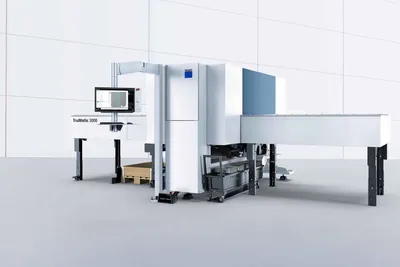
Trumpf TruMatic 3000
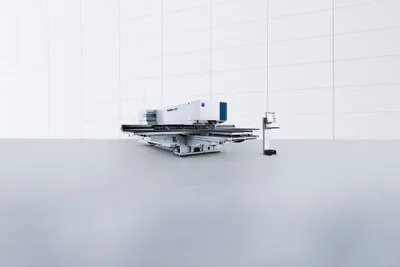
Trumpf TruMatic 7000
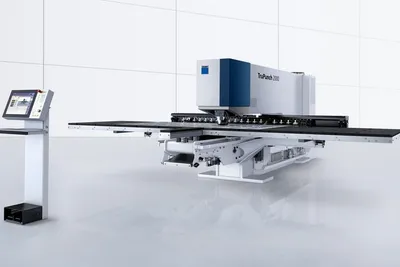
Trumpf TruPunch 2000
Trumpf TruPunch 3000