Industrial CNC Machine Directory

Prima Power E5 1530

$380,000 - $650,000 Updated 2026-03-17
01

Key Specifications

working area

1,500 x 3,000 mm (59 x 118 in)

punching force

220 kN (24.7 US tons)

drive type

Servo-electric

sheet thickness steel

Up to 6.0 mm (0.236 in)

sheet thickness aluminum

Up to 8.0 mm (0.315 in)

turret stations

Up to 40 stations (A/B/C/D tool sizes)

02

Overview

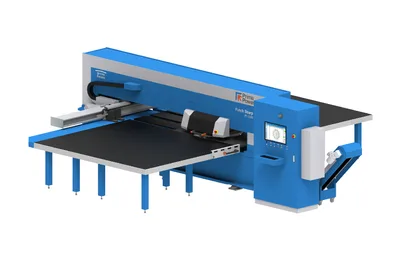
The Prima Power E5 1530 is a servo-electric CNC turret punch press in the 1,500 x 3,000 mm sheet format, representing Prima Power's mid-range servo-electric punching platform. Manufactured by Prima Power (Collegno, Italy), the E5 1530 targets shops seeking the energy efficiency and low maintenance advantages of servo-electric drive technology in a full-featured, production-capable punch press platform.

The E5 designation indicates the machine's servo-electric drive system, which replaces the hydraulic power unit of traditional hydraulic punch presses with a servo motor and flywheel-free mechanical drive. Servo-electric drives deliver punching force only during the actual punch stroke — no continuously running hydraulic pump — resulting in energy consumption reductions of 30-50% compared to equivalent hydraulic machines. The E5 also produces significantly lower noise levels (typically below 75 dB during punching versus 85-95 dB for hydraulic machines), which is relevant for shops located near offices or in residential-adjacent industrial zones.

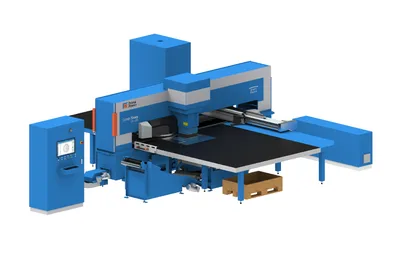
The 1530 format processes sheets up to 1,500 x 3,000 mm (approximately 60 x 120 inches), which is the standard full-sheet size for North American 5 x 10 ft sheets and European 1,500 x 3,000 mm metric sheets. The turret accepts up to 40 tool stations in Thick Turret sizing (A, B, C, D stations), supporting the full range of punching, forming, and tapping operations available on the Prima Power platform. Punching force is 220 kN (24.7 US tons) — sufficient for steels up to 6 mm and aluminum up to 8 mm in the standard sheet format.

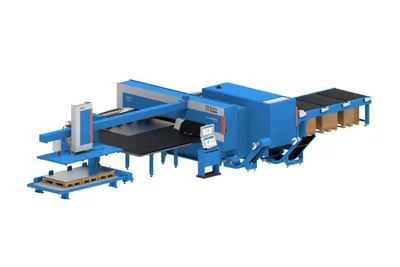
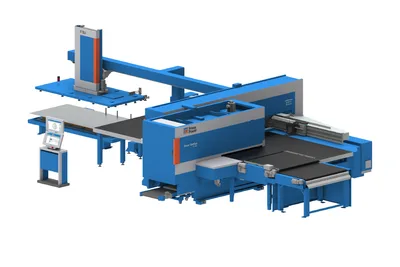
The E5 1530 uses the Prima Power NC Express CNC controller with an intuitive touchscreen interface and full offline programming compatibility with Radan, Metalix, Lantek, and Prima Power's own SG nesting software. The machine supports Prima Power's standard automation interfaces including single-table loaders, Compact Tower (CT) sheet storage, and sorting conveyor links for automated unmanned operation.

Competitors include the Trumpf TruPunch 3000 servo-electric, the Amada EMZ 3610 NT, and the LVD Strippit PX-1530. The E5 1530 is often compared to the S5 1530 (servo-hydraulic) within the Prima Power lineup — the E5 offers lower energy cost and noise, while the S5 offers higher punching speed for specialized high-volume applications. Pricing typically ranges from $380,000 to $650,000 depending on turret configuration and automation.

03

Full Specifications

Parameter Value
Working Area 1,500 x 3,000 mm (59 x 118 in)
Punching Force 220 kN (24.7 US tons)
Drive Type Servo-electric
Sheet Thickness Steel Up to 6.0 mm (0.236 in)
Sheet Thickness Aluminum Up to 8.0 mm (0.315 in)
Turret Stations Up to 40 stations (A/B/C/D tool sizes)
Max Stroke Rate Up to 1,200 hits/min (nibbling)
Repositioning Speed X Up to 100 m/min
Repositioning Speed Y Up to 60 m/min
Noise Level < 75 dB during operation
CNC Control Prima Power NC Express
Machine Weight Approx. 11,000 kg (24,251 lb)
04

Strengths & Limitations

Strengths

  • Servo-electric drive reduces energy consumption 30-50% compared to equivalent hydraulic punch presses — significant operating cost savings over machine lifetime
  • Low noise operation (under 75 dB) enables installation adjacent to office space or in noise-sensitive environments without additional acoustic enclosure
  • No hydraulic oil system means lower maintenance cost, no oil leak risk, and cleaner shop environment — no hydraulic fluid disposal required
  • Full 40-station turret capacity supports complex mixed-tool setups with minimal tool change interruptions on multi-feature parts
  • Compatible with Prima Power automation ecosystem — Compact Tower, sheet loaders, and sorting conveyors for lights-out punching

Limitations

  • Servo-electric drive systems have higher upfront repair cost than hydraulic if the servo motor or drive electronics require replacement outside warranty
  • 220 kN punching force is adequate for standard applications but lower than some hydraulic competitors at equivalent price — shops punching 6+ mm steel frequently may prefer a higher-tonnage hydraulic machine
  • Maximum stroke rate slightly lower than servo-hydraulic competitors on very high-speed nibbling applications (though difference is marginal for most production scenarios)
05

Best For

Mid-volume fabricators processing 1,500 x 3,000 mm sheets in 1-4 mm steel and aluminum who want to reduce electricity and maintenance costs versus hydraulic punch press Shops in commercial or mixed-use industrial buildings where noise ordinances or neighbor proximity make low-noise operation a site requirement Job shops running multiple shifts who value the reduced daily maintenance requirement of servo-electric versus hydraulic machine (no hydraulic oil checks, filter changes, temperature management) Fabricators integrating Prima Power punch presses with Prima Power laser cutters and panel benders in a unified Prima Power automation cell
06

Frequently Asked Questions

01 What is the difference between the E5 1530 and the S5 1530 in the Prima Power lineup?

The E5 and S5 are both 1530-format Prima Power punch presses but use different drive technologies. The E5 is servo-electric: the punching ram is driven by a servo motor through a mechanical drive mechanism with no hydraulic system. The S5 is servo-hydraulic: the ram is driven by a hydraulic cylinder, but the hydraulic pump is a variable-speed servo-driven unit rather than a fixed-speed constant-running pump. Energy efficiency: E5 wins — servo-electric systems consume power only during the punch stroke. Noise: E5 wins — no hydraulic pump running. Maintenance: E5 wins — no hydraulic oil, filters, seals. Punching speed: S5 may have an edge in sustained high-speed nibbling for specific applications. For most shops, the E5 total cost of ownership over 10+ years is lower than the S5 due to energy and maintenance savings.

02 Does servo-electric punching affect part quality compared to hydraulic?

Servo-electric punching produces equivalent or better part quality compared to hydraulic in most applications. Key quality parameters: punch-to-die clearance is maintained identically regardless of drive type. Cut edge quality on a properly maintained servo-electric machine equals hydraulic. Burr height and blanking quality are equivalent. One area where servo-electric provides an advantage: programmable punch stroke depth and speed. Because the servo motor speed and position is software-controlled, the operator can program a slower approach speed for thin materials (reducing microfracture at cut edge), faster retract speed for clearance, and partial strokes for forming operations. Hydraulic systems have less granular stroke control, particularly at low punch force settings.

03 What tapping capability does the E5 1530 offer?

The E5 1530 supports in-process thread tapping via Prima Power's tapping head tool stations. Tapping heads are mounted in a standard turret station (typically a C or D station) and use a motor-driven tap that extends from the turret during the tapping cycle. Thread sizes M3 to M10 (or imperial #10-32 to 3/8-16) are available depending on the tapping head model. In-process tapping eliminates the secondary operation of drilling and tapping on a drill press or tapping machine — for parts with 10-50 tapped holes, in-process tapping on the punch press can save 2-5 minutes per part. The E5 CNC control sequences tapping hits within the punch program automatically, including dwell time and reverse rotation for tap extraction.

04 How does the E5 1530 handle sheet repositioning for sheets longer than 3,000 mm?

The E5 1530 is designed for sheets up to 3,000 mm in the X-axis (the longer sheet dimension). For sheets longer than 3,000 mm, the machine supports an automatic reposition cycle: the clamp releases the sheet, the sheet is repositioned by a controlled X-axis move (repositioning distance is programmed in the NC code), the clamp re-engages, and punching continues. Reposition accuracy is typically ±0.1 mm or better. For sheets up to 4,000 mm long, a single repositioning step is usually sufficient. For very long sheets (4,000-6,000 mm), two repositioning steps may be needed. Reposition time adds approximately 10-20 seconds per cycle depending on the X-axis travel distance.

05 What is the typical consumable cost for the E5 1530 compared to a laser?

Consumable cost comparison between turret punch press and fiber laser: Turret punch press (E5 1530) consumables: punch and die sets (hardened tool steel, re-sharpenable 10-40 times before replacement), costing $50-$500 per tool set depending on size and configuration; strippers; turret bearing lubrication (minimal). A typical punch press tool library for a job shop runs $15,000-$50,000 initial investment with annual replacement cost of $3,000-$8,000 depending on volume. Fiber laser consumables: nozzles ($5-$15 each, replaced every 4-20 hours of cutting depending on material and quality requirements), protective windows ($50-$150 each), focus lens. Annual laser consumable cost for a comparable volume shop runs $8,000-$20,000. For heavy-gauge (4-6 mm) steel punching at high volume, punch wear increases consumable cost. For thin-gauge (0.8-2.5 mm) mixed-material work, punch consumables are economical.

07

Videos

Prima-Power® Combi Genius 1530

Prima-Power® Combi Genius 1530

Famm srl

Prima Power Punch Sharp

Prima Power Punch Sharp

IMTS Machinery

Prima Power Punch Sharp

Prima Power Punch Sharp

Helmsman Lockers

Prima Power - Multithread Tapping Tool

Prima Power - Multithread Tapping Tool

Prima Power North America

Prima Power Punch Genius

Prima Power Punch Genius

IMTS Machinery

08

Community Discussions

09

Related Machines