Prima Power Combi Genius
Key Specifications
models
max sheet size
max sheet thickness
turret
laser power
max ram force
How much does the Prima Power Combi Genius cost?
Estimated price range
Our best estimate for a cnc punch presse in this class — not a quote from Prima Power. Configuration moves it a long way.
Overview
The Prima Power Combi Genius is a combined punching and laser cutting machine, built in two sizes and two performance levels. The CG1530 takes sheets up to 3,000 x 1,500 mm (118 x 59 in) and the CG1540 up to 4,300 x 1,500 mm (169 x 59 in). Laser power is 3 kW, 4 kW or 6 kW.
Sheet thickness is the limit to plan around. Prima Power gives 8 mm (0.31 in) as the maximum for both punch and laser, in aluminium, mild steel and stainless steel. Since the ceiling is the same whichever laser is fitted, the step from 3 kW to 6 kW shows up as cutting speed inside that 8 mm, not as heavier plate.
The performance level changes every punching figure. CG Pure has a maximum ram force of 230 kN (25 US tons), hits at up to 700 hpm, positions at 127 m/min and rotates index tools at 180 rpm. CG Dynamic raises those to 300 kN (33 US tons), 1,000 hpm, 150 m/min and 250 rpm. Sheets dense with small holes or formed features are paced by hit rate and positioning, which is where Dynamic earns its place. Parts that are mostly laser contour with a few punched forms ask far less of the punch side.
The turret is customized, with a maximum of 400 tools in the turret and a maximum of 384 index tools. That allows standing tooling for several jobs to stay mounted while the laser cuts the contours no punch tool matches.
Full Specifications
| Parameter | Value |
|---|---|
| Models | CG1530 and CG1540; two performance levels, Pure and Dynamic |
| Max Sheet Size | CG1530: 3,000 x 1,500 mm (118 x 59 in); CG1540: 4,300 x 1,500 mm (169 x 59 in) |
| Max Sheet Thickness | 8 mm (0.31 in), punch and laser (aluminium, mild steel, stainless steel) |
| Turret | Customized; max. 400 tools in turret, max. 384 index tools |
| Laser Power | 3 kW, 4 kW or 6 kW |
| Max Ram Force | CG Pure: 230 kN (25 US tons); CG Dynamic: 300 kN (33 US tons) |
| Max Hit Speed | CG Pure: 700 hpm; CG Dynamic: 1,000 hpm |
| Positioning Speed | CG Pure: 127 m/min; CG Dynamic: 150 m/min |
| Index Tool Rotation Speed | CG Pure: 180 rpm; CG Dynamic: 250 rpm |
Specifications sourced from primapower.com — verified 2026-10-03
Strengths & Limitations
Strengths
- Punching and laser cutting on one machine, with a 3 kW, 4 kW or 6 kW laser
- CG Dynamic reaches 300 kN (33 US tons) of ram force, 1,000 hpm and 150 m/min positioning
- Customized turret with a maximum of 400 tools, of which a maximum of 384 can be index tools
- Two sheet sizes: 3,000 x 1,500 mm (118 x 59 in) on the CG1530 and 4,300 x 1,500 mm (169 x 59 in) on the CG1540
Limitations
- Maximum sheet thickness is 8 mm (0.31 in) for both punch and laser, whichever laser power is chosen
- CG Pure is limited to 230 kN (25 US tons) and 700 hpm; the higher figures belong to CG Dynamic only
- Both sizes share the 1,500 mm (59 in) sheet width, so the CG1540 adds length but no width
Best For
Frequently Asked Questions
01
The punching performance. CG Pure has a maximum ram force of 230 kN (25 US tons), a maximum hit speed of 700 hpm, a positioning speed of 127 m/min and an index tool rotation speed of 180 rpm. CG Dynamic is rated 300 kN (33 US tons), 1,000 hpm, 150 m/min and 250 rpm.
02
The CG1530 takes sheets up to 3,000 x 1,500 mm (118 x 59 in). The CG1540 takes sheets up to 4,300 x 1,500 mm (169 x 59 in). Maximum sheet thickness is 8 mm (0.31 in) on both, for punching and for laser cutting.
03
Prima Power lists 3 kW, 4 kW or 6 kW. The maximum sheet thickness of 8 mm (0.31 in) is given for punch and laser in aluminium, mild steel and stainless steel, so the choice of laser power is about cutting speed within that thickness.
04
The turret is customized to the order. Prima Power gives a maximum of 400 tools in the turret and a maximum of 384 index tools. Index tools rotate at 180 rpm on CG Pure and 250 rpm on CG Dynamic.
Videos

Prima Power North America

Prima Power

Prima Power North America

IMTS Machinery
More from Prima Power
Other CNC Punch Presses
Yawei HPE-3078
TRUMPF TruPunch 2000
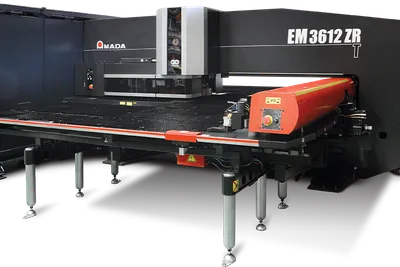
Amada EM 3612 ZRTe