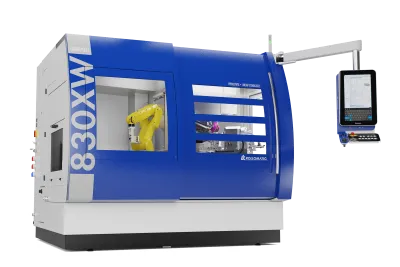
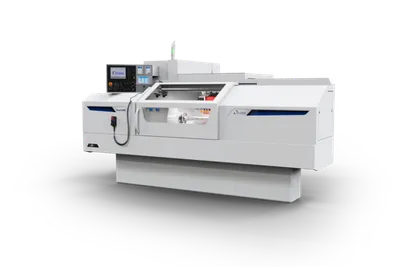
Palmary UCG-500
Key Specifications
Rapid Traverse
Max Workpiece ⌀
Accuracy
max grinding length
max workpiece weight
center height
Overview
The Palmary UCG-500 is a CNC universal cylindrical grinding machine from Taiwan's Palmary Machinery Co., Ltd., designed for OD, ID, and face grinding of shafts, spindles, rollers, and precision bores in a single setup using a swiveling wheelhead configuration. Palmary, headquartered in Taichung City, is one of Taiwan's leading cylindrical grinding machine manufacturers, competing in the mid-price universal cylindrical grinder market against European brands at a cost-effective Taiwanese price point.
The UCG-500 provides a 500 mm (19.7 in) maximum grinding length between centers and a 250 mm (9.8 in) maximum workpiece diameter. The B-axis wheelhead swivels ±45 degrees (manual or CNC option) to accommodate angular plunge grinding, face grinding, and shoulder grinding. The machine incorporates linear guideways on the X (cross-slide) axis and Z (table) axis, with a Fanuc 0i-TF or Mitsubishi M80 CNC control managing automatic grinding cycles.
The main OD grinding spindle runs at up to 35 m/s wheel peripheral speed, and an optional ID grinding spindle can be mounted for internal bore grinding without workpiece re-chucking. Positioning accuracy of ±0.003 mm and roundness of 0.5 µm positions the UCG-500 for general precision cylindrical grinding rather than the ultra-precision tier of Swiss machines.
The UCG-500 competes with the Kellenberger KEL-VERA 75 and the Okuma GP-27N in the universal cylindrical grinder class. Palmary's competitive advantage is 30–40% lower pricing than European and Japanese equivalents, backed by Taiwan's established machine tool service network. Pricing typically runs $80,000–$160,000.
Full Specifications
| Parameter | Value |
|---|---|
| Max Grinding Length | 500 mm (19.7 in) between centers |
| Max Workpiece Diameter | 250 mm (9.8 in) |
| Max Workpiece Weight | 80 kg (176 lb) between centers |
| Center Height | 125 mm (4.9 in) |
| Wheelhead Swivel | ±45 degrees (manual or CNC B-axis option) |
| Od Wheel Peripheral Speed | up to 35 m/s (6,890 ft/min) |
| Id Spindle | Optional (high-speed internal grinding spindle) |
| Guideway System | Linear guideways (X and Z axes) |
| Positioning Accuracy | ±0.003 mm |
| Roundness Achievable | 0.5 µm (0.0005 mm) |
| Surface Finish Od | Ra 0.20 µm |
| Rapid Traverse Rate | 8 m/min X; 12 m/min Z |
| Machine Weight | 4,200 kg (9,259 lb) |
| CNC Control | Fanuc 0i-TF or Mitsubishi M80 (configuration dependent) |
| Coolant Capacity | 200 L (53 gal) |
| Electrical | 380/440 VAC 3-phase 50/60 Hz |
Specifications compiled from manufacturer literature and industry references. Not independently verified against a published spec sheet — confirm with the manufacturer or an authorised dealer before making a purchasing decision.
Strengths & Limitations
Strengths
- 500 mm grinding length covers the majority of shaft, spindle, and roller workpieces found in automotive, machine tool, and industrial production without requiring a larger, more expensive machine
- ±45 degree wheelhead swivel provides the angular flexibility for face, shoulder, and taper grinding that single-angle cylindrical grinders cannot achieve
- Fanuc 0i-TF control provides familiar, easy-to-operate CNC interface with standard canned grinding cycles supported by most CAM post-processors
- 30–40% price advantage over European (Kellenberger) and Japanese (Okuma) equivalents with comparable specifications makes the UCG-500 accessible to cost-conscious shops
- Palmary's established export infrastructure and North American distributor support provides reasonable service and parts availability compared to less-known Taiwanese brands
Limitations
- Linear guideways lack the damping of hydrostatic guideways (used by Studer StuderGuide) — surface finish and low-speed feed consistency may be slightly inferior to premium Swiss machines
- 35 m/s maximum wheel speed limits CBN grinding capability — European premium machines typically support 45–80 m/s for high-speed CBN
- Roundness of 0.5 µm is adequate for general production grinding but is exceeded by Swiss machines (Studer: 0.3 µm) for ultra-precision aerospace and medical work
Best For
Frequently Asked Questions
01
Manual cylindrical grinders require an operator to control all axes manually — infeed rate, table traverse, depth of cut — using handwheels. CNC cylindrical grinding automates all axis movements via programmed cycles: the operator sets up the workpiece, enters the program, and the machine executes roughing, semi-finishing, finishing, and spark-out passes automatically. CNC grinding improves part-to-part consistency, enables lights-out production, and reduces operator skill requirements for basic grinding operations. Complex programs (multiple diameters, tapers, shoulders) are dramatically easier to produce reliably on CNC than manual machines.
02
Universal cylindrical grinding uses two primary workholding methods: between centers (a center in the headstock and tailstock supports the workpiece on its center holes) and chuck workholding (a three-jaw chuck or collet chuck grips the workpiece). Between-center grinding is preferred for shafts because it provides the most accurate reference — the centers define the workpiece axis regardless of outside diameter variation. Chuck workholding is used for workpieces without center holes (short components, small-batch parts). The UCG-500 supports both; the workhead spindle accepts both a center and a chuck.
03
For general steel shaft OD grinding (carbon steel, alloy steel, 30–55 HRC): Aluminum oxide wheel, 46–60 grit, J–K hardness grade (medium-soft bond), ceramic bond or vitrified bond. For hardened tool steel (55–65 HRC): CBN (cubic boron nitride) superabrasive wheel or aluminum oxide 46 grit, I hardness. For finishing to Ra 0.20 µm: follow the roughing pass with an 80–120 grit aluminum oxide wheel at reduced infeed. Specific wheel recommendations depend on the material, hardness, and required finish — wheel suppliers (Saint-Gobain, 3M, Noritake) can provide application-specific recommendations.
04
Yes. The UCG-500 can grind tapers using two methods: (1) wheelhead swivel: the wheelhead is swiveled to the taper half-angle and the workpiece is traversed past the wheel, producing a conical surface; (2) table swivel (if equipped): the table swivels to the taper angle. For short, steep tapers (Morse, Jacobs, ISO tapers) the wheelhead swivel method is standard. CNC taper grinding programs use the swivel angle and feed rate to produce consistent taper angle and diameter — more repeatable than manual taper setups.
05
Palmary Machinery has operated since 1975 and exports to over 60 countries, with an established reputation in the Taiwanese machine tool industry for reliable, serviceable cylindrical grinding machines. They maintain parts inventories for machines going back many years. In North America, Palmary works through authorized distributors who stock common wear parts. The machine's Fanuc control is independently supported by Fanuc service worldwide, separating control reliability from the machine manufacturer's support network. For shops concerned about long-term support, the Fanuc control choice is an important risk mitigator.
Videos

Grinding Machine (DEVCO INDUSTRIES)

tornerong kamay vlog

JUNKER Group
HENKO Singapore

Delta Electronics Thailand
Community Discussions
Pricing and buying discussion — Centerless Grinder Recomendations ...
Pricing and buying discussion — Chevalier or Palmary OD ... - Practical Machinist
Community discussion — Replacement ID/OD grinder needed - Practical Machinist
Community discussion — Confused on Mobil oil for grinder | Practical ...
Community discussion — Manuals and Useful Documentation List - CNCzone
Troubleshooting and problem-solving — Check Carriage Sensor or VC Motor - CNCzone
Community discussion — UCcnc / UC300 with ATCs - CNCzone
Community discussion — UCCNC Control Software - CNCzone
Owner experience and review — Opinions on this brand of mills? : r/Machinists - Reddit
Community discussion — You guys use portable CMM's? : r/Machinists - Reddit
Community discussion — Accusize : r/Machinists - Reddit
Troubleshooting and problem-solving — Endmill Recommendations : r/Machinists - Reddit
Links to community discussions. Summaries are editorial — visit the original thread for full context.