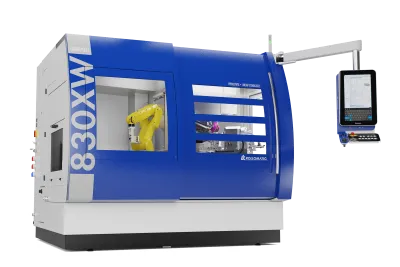
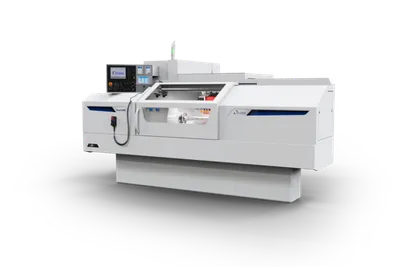
Palmary IGM-25
Key Specifications
Accuracy
max bore diameter grinding
min bore diameter grinding
max bore depth
max workpiece od
max workpiece length
Overview
The Palmary IGM-25 is a CNC internal grinding machine from Palmary Machinery Co., Ltd. (Taichung, Taiwan), designed specifically for precision bore grinding (internal diameter grinding) of rings, sleeves, bushings, and housings. While Palmary's CGC series addresses external cylindrical grinding, the IGM-25 is purpose-built for ID (internal diameter) grinding — a distinct machine type with a high-speed internal grinding spindle capable of reaching inside bores to grind them to precise diameter, roundness, and surface finish. The 25 designation reflects the machine's maximum 250 mm bore diameter grinding capacity.
ID grinding presents unique engineering challenges versus OD grinding: the grinding spindle must fit inside the bore being ground, limiting spindle diameter and therefore spindle stiffness. The Palmary IGM-25 addresses this with a precision high-speed internal grinding spindle (typically 60,000–100,000 RPM air-turbine or 10,000–20,000 RPM electro-spindle depending on bore size) that compensates for reduced spindle diameter through high rotational speed to maintain adequate wheel peripheral speed. The machine's workhead holds the workpiece (ring, sleeve, housing) and rotates it in the same direction as the grinding wheel (co-rotation), which is the standard internal grinding setup for bore concentricity with OD reference.
The IGM-25 uses a CNC infeed (X axis) and plunge grinding strategy for bore diameter control, with optional traverse grinding for longer bores. Palmary equips the machine with Fanuc 0i-TF CNC control managing the automatic grinding cycle, wheel dressing, and optional in-process bore gauging (post-process measurement is also available). The machine's workholding uses a 3-jaw chuck or collet chuck to hold the workpiece, with the workhead speed variable to match optimal peripheral speed for the workpiece OD diameter being rotated.
Priced at $80,000–$160,000, the Palmary IGM-25 competes with the Okamoto IGM-250, Studer S121 (higher end), and various Taiwanese and Korean internal grinder brands. For shops requiring dedicated bore grinding of rings, bearing housings, and hydraulic sleeves at a significantly lower capital cost than European internal grinders, the IGM-25 represents practical value with genuine precision capability.
Full Specifications
| Parameter | Value |
|---|---|
| Max Bore Diameter Grinding | 250 mm (9.8 in) |
| Min Bore Diameter Grinding | 10 mm (0.4 in) |
| Max Bore Depth | 200 mm (7.9 in) |
| Max Workpiece Od | 400 mm (15.7 in) |
| Max Workpiece Length | 300 mm (11.8 in) |
| Internal Spindle Speed | 3,000 - 100,000 RPM (air turbine) or 3,000 - 20,000 RPM (electro-spindle) |
| Workhead Speed | 50 - 500 RPM |
| X Axis Resolution | 0.0001 mm |
| Z Axis Resolution | 0.001 mm |
| Positioning Accuracy | ±0.002 mm |
| Bore Roundness | < 0.002 mm |
| Surface Finish Achievable | Ra 0.1 - 0.4 µm |
| CNC Control | Fanuc 0i-TF |
| Machine Weight | ~2,800 kg (6,173 lb) |
Specifications compiled from manufacturer literature and industry references. Not independently verified against a published spec sheet — confirm with the manufacturer or an authorised dealer before making a purchasing decision.
Strengths & Limitations
Strengths
- Purpose-built ID grinding architecture with high-speed internal spindle and proper workhead rotation — more effective than internal grinding attachments on universal cylindrical grinders
- 10 mm minimum bore diameter capability covers small hydraulic valve bores, precision bushings, and bearing inner rings across a wide range of precision engineering applications
- Fanuc 0i-TF CNC control provides familiar, proven grinding cycle management compatible with most precision shop operators' existing Fanuc experience
- Taiwan-built pricing at 40–55% below European ID grinder brands (Studer S121, Danobat-Overbeck) makes dedicated ID grinding capability financially accessible for job shops
- Chuck workholding and variable workhead speed accommodate a broad range of ring and sleeve geometries in a single machine configuration
Limitations
- The small grinding wheel required for ID grinding (sized to fit inside the bore) wears faster than large OD grinding wheels — wheel change frequency is higher, particularly for small bores
- Internal grinding spindle reach limits the practical bore depth-to-diameter ratio — deep bores with high L/D ratio require careful setup to avoid spindle deflection affecting diameter
- Palmary's application engineering support for complex ID grinding applications (interrupted bores, thin-wall rings) may be less deep than European ID grinding specialists
Best For
Frequently Asked Questions
01
Universal cylindrical grinders with internal grinding attachments can perform ID grinding, but purpose-built internal grinders like the IGM-25 are typically more productive and easier to use for dedicated bore grinding work. A purpose-built internal grinder is optimized for the specific setup requirements of ID grinding: the workhead is designed for chuck holding (ring and sleeve workpieces, not shafts between centers), the machine layout provides better access for loading and unloading bore workpieces, and the internal spindle mounting and speed range are optimized for the ID grinding wheel sizes and speeds required. For shops where ID grinding is the primary operation, a dedicated internal grinder is more efficient than a universal machine used primarily for OD work.
02
ID grinding requires very high wheel RPM because the grinding wheel must be small enough to fit inside the bore being ground — typically 50–80% of bore diameter as a maximum wheel size rule of thumb. A small wheel diameter means the wheel must spin at very high RPM to achieve the required peripheral speed (30–45 m/s for conventional abrasive, higher for CBN). For example, a 10 mm bore requires a grinding wheel of 6–8 mm diameter — to achieve 45 m/s peripheral speed on an 8 mm wheel requires approximately 107,000 RPM. This is why ID grinding spindles are either air turbine (very high RPM, lower torque, for small bores) or high-frequency electro-spindle (10,000–20,000 RPM for medium bores). Larger bores allow larger wheels and lower RPM spindles.
03
As a general rule, the maximum practical bore depth for ID grinding is 1.5–2x the bore diameter before spindle deflection becomes problematic. For a 25 mm bore, this means practical grinding depth up to about 40–50 mm. Beyond this, the grinding spindle (which must fit inside the bore — smaller than the bore diameter) becomes a long, thin cantilever that deflects under grinding forces, causing diameter taper, roundness error, and vibration. The IGM-25's 200 mm maximum bore depth is achievable for larger bore diameters (100 mm+) but not for minimum bore sizes. Palmary applications engineers can advise on specific bore depth-to-diameter combinations and the appropriate spindle configuration.
04
In ID grinding of rings and sleeves, the workpiece is held by its OD in a 3-jaw chuck, and the bore (ID) is ground concentric to the OD datum established by the chuck jaws. This achieves OD-to-ID concentricity within the chuck runout — typically 0.005–0.020 mm for a standard self-centering chuck. For tighter concentricity requirements (bearing rings, precision sleeves), a precision collet or soft-jaw chuck bored in situ achieves better concentricity. The best concentricity between OD and ID is achieved by grinding both in the same chucking (on a universal OD/ID grinder) — the IGM-25 is an ID-only machine, so OD-to-ID concentricity depends on the chuck accuracy.
05
Air turbine spindles use compressed air to drive a turbine wheel at very high speed (30,000–100,000+ RPM) — they are compact, light, and achieve the RPM needed for very small bore grinding, but have limited torque and cannot be used for aggressive stock removal. Electro-spindles are direct-drive motor spindles that integrate a motor rotor inside the spindle housing, driving at 3,000–20,000 RPM with higher torque — better for larger bores with more stock to remove. The Palmary IGM-25 typically offers both options: air turbine for small bores (10–50 mm) where very high RPM is needed, and electro-spindle for medium to larger bores (50–250 mm) where torque and stock removal rate are more important than maximum RPM.
Videos
MARUZEN MACHINE Studio

Goodwill Machinery

YuHelen1124

機械中古

xyun gmcet
Community Discussions
Pricing and buying discussion — Centerless Grinder Recomendations ...
Pricing and buying discussion — Chevalier or Palmary OD ... - Practical Machinist
Community discussion — Replacement ID/OD grinder needed - Practical Machinist
Pricing and buying discussion — Differences in surface grinders, Kent/Acer/etc. vs. Okamoto
Community discussion — Which one of y’all did this? : r/Machinists - Reddit
Community discussion — PM-25MV - Is it enough? : r/Machinists - Reddit
Community discussion — Beginning question : r/machining - Reddit
Community discussion — Plastic injection mold for hard hats : r/Machinists - Reddit
Links to community discussions. Summaries are editorial — visit the original thread for full context.