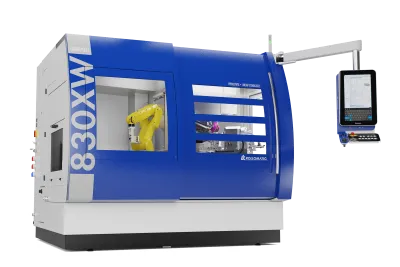
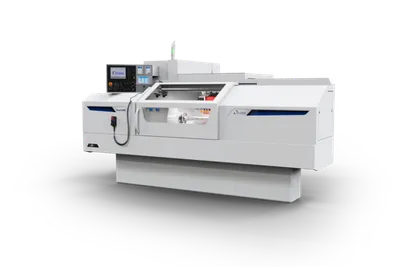
Nagel CH 36
Key Specifications
bore diameter range
max bore length
standard bore length
max workpiece weight
honing spindle speed
stroking speed
Overview
The Nagel CH 36 is a CNC horizontal honing machine from Nagel Maschinen- und Werkzeugfabrik GmbH (Nürtingen, Germany), designed for high-productivity bore finishing of large, heavy workpieces that are impractical to position vertically on a single-spindle vertical honing machine. The CH designation stands for horizontal (Chorizontal in German), and the 36 reflects the machine's 360 mm maximum bore diameter capacity — making the CH 36 suitable for large engine cylinder bores, hydraulic cylinder tubes, compressor cylinders, and heavy industrial gear housings that appear in commercial vehicle, construction equipment, agricultural machinery, and industrial power generation sectors.
The horizontal configuration of the CH 36 allows heavy, long workpieces (engine blocks, hydraulic cylinder tubes, compressor housings) to be supported on V-blocks or fixtures at table height and honed horizontally without requiring overhead lifting or complex vertical fixturing. This is particularly significant for cylinder tube honing, where tubes of 300–2,000 mm length and 50–360 mm bore diameter would be cumbersome to handle and align vertically. The horizontal spindle strokes into the bore as the workpiece remains stationary, with the honing head rotating and expanding stones against the bore wall in the same crosshatch-generating motion as vertical honing, but optimized for horizontal bore access.
Nagel's CH 36 uses servo-controlled honing stone expansion under CNC management, with in-process air or contact gauging maintaining bore diameter control through automatic closed-loop feedback. The machine's Siemens 840D sl (or Nagel NCU) control programs multi-phase honing cycles (rough, intermediate, plateau finish) with programmable stroking speed, rotation, stroke length, and expansion rate for each phase. For long hydraulic cylinder tube honing, the CH 36 can be configured with workpiece support rollers and steady rests to support the tube during honing without deflection affecting bore straightness.
At $300,000–$600,000, the Nagel CH 36 serves the hydraulic cylinder manufacturing, large diesel engine production, and heavy industrial bore finishing markets. It competes with Gehring horizontal honing machines, Sunnen CH series, and Kadia horizontal honing systems. Nagel's engineering depth in horizontal honing for commercial vehicle and construction equipment manufacturers gives the CH 36 application credibility in demanding large-bore industrial honing applications.
Full Specifications
| Parameter | Value |
|---|---|
| Bore Diameter Range | 50 - 360 mm (1.97 - 14.2 in) |
| Max Bore Length | 2,000 mm (78.7 in) with extended table |
| Standard Bore Length | 600 mm (23.6 in) |
| Max Workpiece Weight | 1,500 kg (3,307 lb) on table |
| Honing Spindle Speed | 5 - 200 RPM (stepless) |
| Stroking Speed | 1 - 20 m/min |
| Stroke Length | Up to 600 mm programmable (extended table: up to 2,000 mm) |
| Controlled Expansion | Servo-controlled (CNC), 0.001 mm resolution |
| In Process Gauging | Air gauge or contact gauge (standard) |
| Bore Roundness | < 0.005 mm |
| Bore Cylindricity | < 0.010 mm over 1,000 mm length |
| Surface Finish Achievable | Ra 0.1 - 1.6 µm |
| Crosshatch Angle | 20° - 60° (programmable) |
| CNC Control | Siemens 840D sl or Nagel NCU |
| Machine Weight | ~8,000 kg (17,637 lb) |
| Manufacturer | Nagel |
| Model | 2VS 10-60 |
Specifications sourced from machinio.com — verified 2026-03-28
Strengths & Limitations
Strengths
- Horizontal spindle configuration enables honing of large, heavy workpieces (engine blocks, cylinder tubes) that cannot be practically positioned for vertical honing
- 360 mm maximum bore diameter covers large diesel engine cylinders, hydraulic cylinders, compressor bores, and industrial gear housings in a single machine platform
- Up to 2,000 mm bore length capability (extended table) covers hydraulic cylinder tube honing for agricultural and construction equipment in a single setup
- Servo-controlled stone expansion with closed-loop air gauging achieves automatic bore diameter control without operator intervention between parts in production honing
- Nagel's 80+ year horizontal honing application experience in commercial vehicle and industrial markets provides proven tooling recommendations and application engineering support
Limitations
- High capital cost ($300,000–$600,000) and large machine footprint make the CH 36 a significant investment suited to dedicated bore finishing operations or high-volume production
- Horizontal honing requires adequate floor space for workpiece loading along the machine's long axis — long tube honing setups can require 5–8 meters of machine plus workpiece clearance
- Honing tool setup and stone selection for each new bore size and material requires applications engineering knowledge — not a machine that can be put into production without proper tooling engineering
Best For
Frequently Asked Questions
01
Horizontal honing is preferred for heavy, long, or tubular workpieces that are difficult to fixture vertically: hydraulic cylinder tubes (long, heavy, cylindrical — naturally rest horizontally), large engine blocks (heavy cast iron, easier to stabilize on a horizontal table), and industrial housings (large flanged components that sit stably on a horizontal table surface). Vertical honing is preferred for smaller, lighter workpieces (individual cylinders, bushings, short sleeves) where the operator can place the workpiece on the table and index between bores quickly. Engine builders typically use vertical honing for car engines (lighter, compact blocks) and horizontal honing for large diesel truck and industrial engines (heavy, bulky blocks with large bores). Hydraulic cylinder tube honing almost always uses horizontal machines because of tube length.
02
For long bore honing (e.g., a 2,000 mm hydraulic cylinder tube), bore straightness (cylindricity over length) depends on the honing tool floating freely to follow the bore axis rather than being rigidly driven straight by the machine spindle. The CH 36 uses a floating honing joint (universal joint or Cardan joint) between the machine spindle and the honing mandrel, allowing the mandrel to self-align with the bore axis rather than being forced into alignment by the rigid spindle. The honing stones then correct roundness as they expand to the bore wall. Steady rests and support rollers along the tube length prevent tube deflection (bowing) under its own weight — uncorrected tube bow would be mistaken by the honing head as bore taper and would produce a non-cylindrical bore. Nagel supplies steady rest configurations and tube support systems as part of the CH 36 tooling package for long tube honing.
03
Large bore honing on the CH 36 typically uses silicon carbide (SiC) stones for roughing in cast iron and steel, with aluminum oxide or CBN for finishing. For hydraulic cylinder tube honing (hardened or induction-hardened cylinder steel), CBN honing stones provide longest life and most consistent stock removal in production. For aluminum diesel engine cylinders (increasingly common in modern truck engines), silicon carbide stones with appropriate bond formulations prevent loading and provide good crosshatch on aluminum. Stone dimensions for large bore applications (200–360 mm) are significantly larger than those for small bores — the honing head carries 6, 8, or 12 stones arranged around the bore circumference, each stone having substantial face width for the abrasive contact area needed for large bore production honing.
04
The CH 36 can correct out-of-round (lobing) and taper in existing bores more effectively than internal grinding because of honing's self-conforming multi-stone contact around the full bore circumference. Common bore errors the CH 36 corrects include: ovality (2-lobe out-of-round from previous turning or rough boring), three-lobe and multi-lobe conditions from previous cylindrical grinding, taper (bore larger at one end), and barrel or hourglass shape from thermal or cutting force distortion. Internal grinding corrects these conditions through the grinding wheel's geometry, but is limited by the single-point contact of the wheel — a three-lobe bore ground by a single-point wheel tends to remain three-lobe. Honing's simultaneous multi-stone contact forces the bore toward true circularity with each stroke cycle.
05
Yes — the CH 36 is designed with automation interfaces for integration into continuous manufacturing lines for hydraulic cylinder or engine block production. Automated workpiece loading can use overhead crane with auto-engagement (for very heavy workpieces), roller conveyor with fixture transfer, or gantry robot systems. The Siemens 840D sl or Nagel NCU control provides standard PLC I/O signals for loading station ready, cycle start, cycle complete, and fault status. In-line gauging (post-hone bore measurement at an integrated gauging station) can be networked with the honing machine control for SPC data collection and automatic process adjustment. Nagel's systems engineering group designs complete automated honing systems for automotive and hydraulic cylinder manufacturers — the CH 36 is available as a standalone machine or as part of a turnkey automated honing cell.
Videos

Offshore Club

CrashCourse

PizzaFlix

The Trial Channel

The Trial Channel
Community Discussions
Community discussion — Machining Thick A36 Plate - Practical Machinist
Community discussion — Help with chuck open ... - Practical Machinist
Pricing and buying discussion — Acceptable grind tolerance for a swiss ...
Community discussion — A36 c-channel beams, is there a calculator or chart showing ...
Community discussion — Offering help with Emmegi CamPlus, Drill, and Shape - CNCzone
Community discussion — Incremental circle milling sub program - CNCzone
Community discussion — Need Help! G CODEfor knurling! - CNCzone
Community discussion — Something wrong with my G02 command and cant see what it is...
Links to community discussions. Summaries are editorial — visit the original thread for full context.