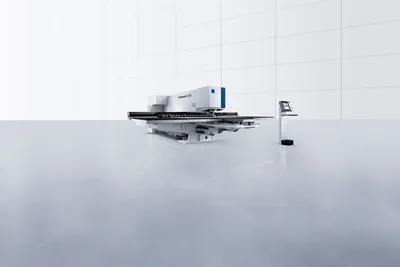
Murata Wiedemann Optipunch 360NT
Key Specifications
punching force
sheet size capacity
number of tool stations
repositioning speed
punching speed
control system
Overview
The Murata Wiedemann Optipunch 360NT is a CNC turret punch press from the Murata Wiedemann brand, which represents the combination of Japanese precision manufacturing from Murata Machinery (Muratec) with the legacy of the Wiedemann punching machine tradition. The Optipunch 360NT features a 360 kN punching force — one of the higher force ratings in the mid-range turret punch class — making it capable of punching thicker mild steel and stainless steel gauges than lighter 200-250 kN machines. The NT designation indicates the next-generation platform, featuring a servo-controlled punch drive and updated CNC control architecture.
The turret configuration on the Optipunch 360NT includes 44 indexable tool stations in the standard layout — a notably high station count that allows operators to load a comprehensive tool complement covering the vast majority of a job shop's standard hole patterns, forms, and shapes without tool changes during a production run. The full 44-station turret is particularly advantageous for job shops processing diverse parts where minimizing tool changes between jobs reduces setup time. Repositioning speed is 90 m/min on both axes, and the machine processes sheets up to 2,500 x 1,250 mm in the standard configuration with optional larger sheet extension.
The servo punch drive provides programmable stroke control, enabling the machine to perform partial-depth forming operations — embosses, lances, countersinks, and offsets — with precise depth control. This forming capability extends the machine's usefulness beyond simple punching into light fabricated form production. The CNC controller is a current-generation touchscreen-based unit with 2D graphical programming, DXF import, and integration with popular CAM systems including Radan, SigmaNEST, and Murata's own offline programming package.
Murata Wiedemann has a history of supplying turret punch presses to North American job shops and enclosure manufacturers. The Optipunch 360NT's high station count, 360 kN force, and servo drive position it as a capable production workhorse. It competes with the Amada VIPROS series, Trumpf TruPunch 5000, and the Strippit VX series. Pricing typically ranges from $320,000 to $480,000 depending on configuration, automation, and tooling packages.
Full Specifications
| Parameter | Value |
|---|---|
| Punching Force | 360 kN (40.5 tons) |
| Sheet Size Capacity | 2,500 x 1,250 mm (98.4 x 49.2 in) |
| Number Of Tool Stations | 44 indexable tool stations |
| Repositioning Speed | 90 m/min (X and Y axes) |
| Punching Speed | 750 hits/min (at 25mm pitch) |
| Control System | Murata NT CNC with DXF import and CAM integration |
| Throat Depth | 1,250 mm (49.2 in) |
| Machine Weight | 10,200 kg (22,490 lb) |
Specifications compiled from manufacturer literature and industry references. Not independently verified against a published spec sheet — confirm with the manufacturer or an authorised dealer before making a purchasing decision.
Strengths & Limitations
Strengths
- 44 fully indexable tool stations — one of the highest station counts in the mid-range turret punch class — allows comprehensive tool loading for diverse job shop work without mid-run tool changes
- 360 kN punching force handles thicker mild steel (up to 6mm) and stainless steel (up to 4mm) that lighter 200-250 kN machines cannot process reliably
- Servo punch drive with programmable stroke enables forming operations — embosses, lances, offsets, countersinks — with precise depth control, extending capability beyond simple punching
- Compatibility with major CAM systems (Radan, SigmaNEST, Murata's own package) enables integration into existing shop programming workflows
- High station count minimizes job changeover time — most jobs can run without modifying the standard tool load, reducing setup to program loading only
Limitations
- Higher acquisition cost than lighter-tonnage turret punch presses — shops that rarely exceed 4mm mild steel may find 360 kN force more capacity than their work requires
- Murata Wiedemann's North American dealer network has contracted in recent years compared to Amada and Trumpf — service and parts availability may vary by region
- 750 hits/min punching speed is mid-range — newer Amada and Trumpf servo punch platforms achieve higher speeds on thin sheet applications
Best For
Frequently Asked Questions
01
More indexable tool stations mean more tools can be loaded in the turret simultaneously, reducing how often operators need to stop production to change tools between jobs. With 44 stations, a shop can typically load a comprehensive set of standard punches — round holes in multiple sizes, oblong slots, square punches, forming tools, and special shapes — and run many different jobs without touching the turret. This is particularly valuable in job shops with diverse work where setup time reduction has a direct impact on cost and lead time.
02
The 360 kN punching force allows processing of mild steel up to 6mm thick, stainless steel up to 4mm, and aluminum up to 6mm, depending on the punch diameter and material grade. Punching capacity decreases as hole size increases — smaller holes can be punched in thicker material than larger holes with the same force. The machine's servo drive also enables slug-free micro-joint cutting and forming operations in lighter gauges where precise depth control matters.
03
The Optipunch 360NT's NT CNC controller accepts programs from major punch press CAM systems including Radan (Hexagon), SigmaNEST (SigmaTEK), and Murata's own offline programming software. Programs can be created on a PC using imported DXF or STEP geometry, then transferred to the machine via network or USB. The CAM software handles nesting, tool assignment, punch sequence optimization, and NC code generation. For shops already running Radan or SigmaNEST for other machines, the Optipunch integrates into the existing workflow.
Community Discussions
Community discussion — OT:Looking for Wiedemann turret press owners-need info
Pricing and buying discussion — Wiedemann manual turret punch - Practical Machinist
Owner experience and review — Does anyone have experience or opinions of Murata aka Muratec ...
Community discussion — Wiedemann Turret punch tooling - Practical Machinist
Community discussion — Vise recommendations? Best for the money : r/Machinists - Reddit
Community discussion — Benchtop drill presses with low runout? : r/Machinists - Reddit
Community discussion — What’s the best/most comfortable eye protection you’ve had ...
Owner experience and review — Water jet recommendations? : r/Machinists - Reddit
Links to community discussions. Summaries are editorial — visit the original thread for full context.
Related Machines
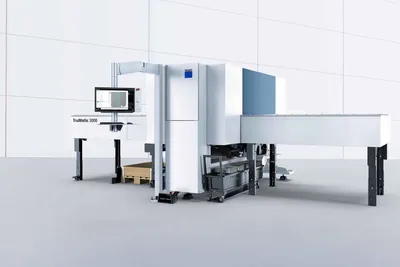
Trumpf TruMatic 3000
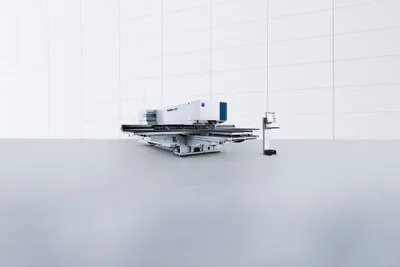
Trumpf TruMatic 7000
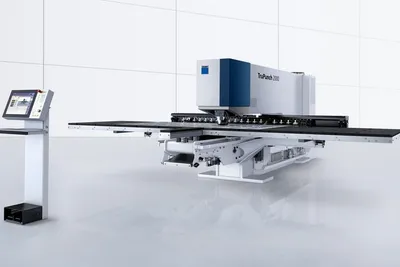
Trumpf TruPunch 2000
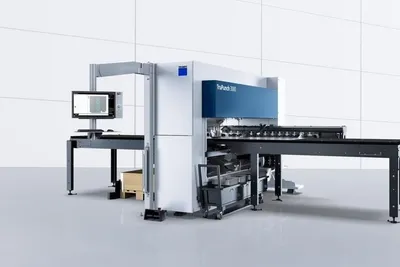
Trumpf TruPunch 3000