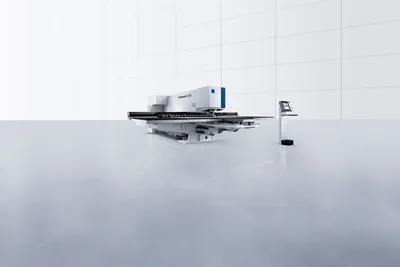
Murata Wiedemann Centrum 2550
Key Specifications
Accuracy
punching force
laser power
turret stations
working area
max punch hit rate
Overview
The Murata Wiedemann Centrum 2550 is a CNC punch-and-laser combination machine from Muratec (Murata Machinery), sold under the Wiedemann brand in North America. The Centrum series represents Murata Wiedemann's combination machine platform — integrating a turret punch press with a fiber laser cutting head in a single machine — and the 2550 designation indicates the 2,500 x 5,000 mm working area with automatic sheet repositioning for processing full-length sheets. This punch-laser combination concept allows a single machine to complete both punching operations (forming, tapping, embossing, high-speed hole arrays) and laser cutting (contour cutting, complex profiles, slots with curves) on the same part without repositioning to a separate machine.
The Centrum 2550's punching section uses Murata Wiedemann's servo-electric turret punch architecture with a 30-ton (267 kN) ram and a thick-turret configuration holding up to 48 stations. The laser cutting section integrates a fiber laser source — typically in the 2-4 kW range for the Centrum platform — with a cutting head mounted on the same gantry or bridge as the punch unit. The CNC coordinates between punching and laser cutting operations within a single NC program, allowing a sequence like: laser-cut complex outer profile, then punch interior holes at high speed, then form flanges and embosses — all without removing the sheet from the machine.
The practical benefit of punch-laser combination is eliminating the sheet transfer between machines that occurs in a standard fabrication cell. In a two-machine cell (turret punch + laser cutter), every part that requires both operations must be loaded on the punch, processed, unloaded, loaded on the laser, processed, and unloaded again — with associated handling time, risk of scratching or marking, and scheduling coordination between two machines. The Centrum 2550 consolidates this into a single machine load cycle, reducing per-part cycle time on mixed punch-and-laser parts by 20-40% versus a two-machine approach.
Murata Wiedemann's M-series CNC control manages both punch and laser operations from a unified interface. Programming requires CAD/CAM software with Centrum 2550 post-processor support that understands both punching and laser cutting operations within the same program structure. The 2,500 x 5,000 mm working area with automatic repositioning accommodates large sheets, making the Centrum 2550 suitable for both standard 2,500 x 1,250 mm sheet processing and longer sheet formats with auto-repositioning.
New Centrum 2550 machines are priced in the $550,000 to $900,000 range, reflecting the dual-process capability, extended working area, and laser integration complexity. This is a premium investment appropriate for job shops and production facilities where both punching and laser cutting are core processes, and where the throughput and flexibility benefit of a single combination machine justifies the higher capital cost versus purchasing separate punch and laser machines. The combination machine also reduces the floor space required for two separate machines.
Full Specifications
| Parameter | Value |
|---|---|
| Punching Force | 30 tons (267 kN) |
| Laser Power | 2-4 kW fiber laser (configuration dependent) |
| Turret Stations | Up to 48 (thick turret with auto-index) |
| Working Area | 2,500 x 5,000 mm (98 x 197 in) with auto-repositioning |
| Max Punch Hit Rate | 600 hits/min (servo-electric, short pitch) |
| Max Sheet Thickness Punch Steel | 6.35 mm (0.25 in) |
| Max Sheet Thickness Laser Mild Steel | 12 mm (0.47 in) at 4 kW (configuration dependent) |
| Max Sheet Thickness Laser Stainless | 8 mm (0.315 in) at 4 kW |
| Positioning Accuracy | ±0.05 mm |
| Traverse Speed | 100 m/min |
| Ram Drive | Servo-electric |
| CNC Control | Murata Wiedemann M-series (unified punch + laser CNC) |
| Machine Weight | Approx. 18,000 kg (39,683 lbs) |
Specifications compiled from manufacturer literature and industry references. Not independently verified against a published spec sheet — confirm with the manufacturer or an authorised dealer before making a purchasing decision.
Strengths & Limitations
Strengths
- Single-machine punch-and-laser processing eliminates sheet transfer between machines for mixed-operation parts — reduces per-part cycle time and handling risk
- 2,500 x 5,000 mm working area with auto-repositioning processes large sheets and longer-format parts without manual repositioning stops
- 48-station thick turret provides forming, tapping, embossing, and high-speed hole array capability that laser cutting alone cannot match efficiently
- Fiber laser cutting handles complex contour profiles, radii, and fine features that punch tooling cannot produce — the combination covers virtually all flat-blank requirements
- Floor space savings versus two separate machines (turret punch + laser cutter) can justify part of the premium cost in facilities with high real-estate value per square foot
Limitations
- Capital cost of $550K-$900K is substantially higher than purchasing either a standalone punch press or a standalone laser cutter — requires high machine utilization across both processes to justify
- If machine requires maintenance on either the punch or laser section, the entire machine is down — a two-machine cell has more redundancy for production continuity
- Programming complexity is higher than single-process machines — requires CAD/CAM software proficient in both punch and laser process integration
Best For
Frequently Asked Questions
01
The combination machine eliminates sheet transfer between the punch press and laser cutter for parts requiring both processes. In a two-machine cell, every mixed-process part requires two machine loadings, two unloadings, and handling between machines — adding cycle time, labor, and scratching/marking risk. The Centrum 2550 completes punch and laser operations in a single load cycle. For shops with high volumes of mixed-process parts, this can reduce per-part time by 20-40% and eliminate inter-machine scheduling conflicts.
02
Use punching for: standard holes in high volume (faster and cheaper than laser per hole at high quantity), forming operations (louvers, embosses, tapped holes — laser cannot form), and thick-gauge blanking where laser kerf width matters. Use laser for: complex contour profiles, radii below punch minimum diameter, fine slots, shapes requiring geometry the punch cannot produce, and features requiring post-punch contour cleanup. The Centrum 2550 excels when a single part requires both categories of features.
03
The Centrum 2550 is typically configured with fiber laser sources in the 2-4 kW range, depending on the customer's material thickness requirements and budget. A 2 kW source handles mild steel up to approximately 8 mm and stainless to 5 mm. A 4 kW source extends mild steel capacity to 12 mm and stainless to 8 mm, and improves cutting speed on thinner materials. Higher-power configurations increase both machine cost and operational energy consumption.
04
Yes. The Centrum 2550 can operate in punch-only mode (laser head parked), laser-only mode (turret not engaged), or combination mode within the same program. This flexibility allows the machine to function as a dedicated punch press on jobs that require only punching, and as a dedicated laser cutter on jobs that require only contour cutting. Combined-process programs leverage both capabilities. The M-series CNC manages mode selection automatically based on the NC program.
05
Programming the Centrum 2550 requires CAD/CAM software with a specific Centrum 2550 post-processor that understands both punch and laser process commands within the same program structure. Murata Wiedemann provides or certifies post-processors for major sheet metal CAD/CAM platforms. The software must be able to assign individual features to either the punch or laser process, optimize the sequence across both process types, and output a unified NC program that the M-series control executes.
Videos

gotmachinery

Gordon Day

Norman Machine Tool Ltd.
Community Discussions
Pricing and buying discussion — Wiedemann manual turret punch - Practical Machinist
Troubleshooting and problem-solving — Wiedemann Centrum 1000 - Practical Machinist
Owner experience and review — Does anyone have experience or opinions of Murata aka Muratec ...
Owner experience and review — OT:Looking for Wiedemann turret press owners-need info
Troubleshooting and problem-solving — Wiedemann CNC Punch Error - cnczone.com
Troubleshooting and problem-solving — Problem I dont know to connect Murata Wiedemann with computer ...
Troubleshooting and problem-solving — Need Help! centrum 2000 punch press problem - CNCzone
Community discussion — Need Help! Murata Turret - cnczone.com
Links to community discussions. Summaries are editorial — visit the original thread for full context.
Related Machines
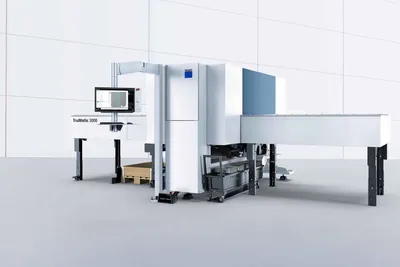
Trumpf TruMatic 3000
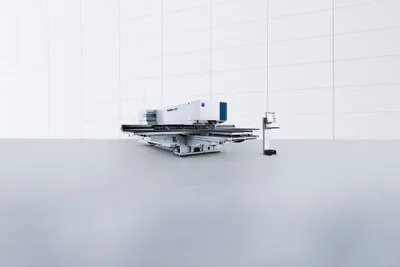
Trumpf TruMatic 7000
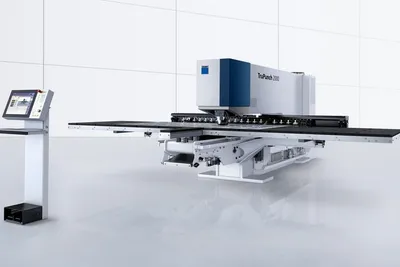
Trumpf TruPunch 2000
Trumpf TruPunch 3000