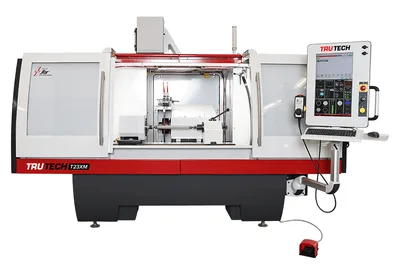
Mägerle MGC-L
Key Specifications
X Travel
Y Travel
Z Travel
Max Spindle
Table Size
Spindle Power
How much does the Mägerle MGC-L cost?
Estimated price range
Our best estimate for a cnc grinding machine in this class — not a quote from Mägerle. Configuration moves it a long way.
Overview
The Mägerle MGC-L is a 5-axis grinding centre offered in several lengths: Mägerle lists X travel of 1300 mm (51.2 inch), 2100 mm (82.7 inch) or 2600 mm (102.4 inch), with Z travel of 500 mm (19.7 inch) or 750 mm (29.5 inch). Rapid traverse is 20000 mm/min (787 inch/min) on X, Y and Z, and the grinding spindle runs to 8000 /min (8000 rpm).
This is a large-wheel machine. Maximum wheel diameter is 500 mm (19.7 inch) or 600 mm (23.6 inch) and maximum wheel width 240 mm (9.4 inch) or 300 mm (11.8 inch), depending on the version. A wheel that wide can carry a complete profile and grind it in a single plunge, and a wheel that large holds its diameter longer between dressings. The moderate spindle speed fits that picture: big wheels reach their cutting speed at low revolutions.
Two table sizes are listed, 760 x 325 mm (29.9 x 12.8 inch) and 1000 x 440 mm (39.4 x 17.3 inch). Even the larger table is shorter than the shortest X travel of 1300 mm (51.2 inch), so the long stroke is not there to carry one part the length of the axis. Ask how the remaining travel is used on the length being quoted. Maximum workpiece weight is 600 kg (1,320 lb), and the table gives that single figure whichever length is chosen.
The axis row reads 5-axis (X, Y, Z, A, B/C), so the fifth axis is listed as B or C and the rotary arrangement should be confirmed for the machine on order. The same goes for the slash-separated options in general: travels, tables and wheel sizes are listed as alternatives without stating which belong together. For shorter work the MFP 100 offers 1000 mm of X travel, wheels up to 300 mm and a spindle that reaches 12000 /min.
Full Specifications
| Parameter | Value |
|---|---|
| Table Cross Travel | 600 mm (23.6 in) |
| Vertical Travel | 500 mm (19.7 in) |
| Max Workpiece Weight | 600 kg (1,320 lb) |
| Grinding Spindle Power | Up to 50 kW (67 HP) |
| Max Grinding Wheel Diameter | 500 mm (19.7 inch) / 600 mm (23.6 inch) |
| CNC Axes | 5-axis (X, Y, Z, A, B/C) |
| X-Axis Travel | 1300 mm (51.2 inch) / 2100 mm (82.7 inch) / 2600 mm (102.4 inch) |
| Y-Axis Travel | 650 mm (25.6 inch) / 900 mm (35.4 inch) |
| Z-Axis Travel | 500 mm (19.7 inch) / 750 mm (29.5 inch) |
| Max Spindle Speed | 8000 /min (8000 rpm) |
| Spindle Motor Power | 75 kW (100 hp) / 115 kW (154 hp) |
| Max Grinding Wheel Width | 240 mm (9.4 inch) / 300 mm (11.8 inch) |
| Table Size | 760 x 325 mm (29.9 x 12.8 inch) / 1000 x 440 mm (39.4 x 17.3 inch) |
| Rapid Traverse X | 20000 mm/min (787 inch/min) |
| Rapid Traverse Y | 20000 mm/min (787 inch/min) |
| Rapid Traverse Z | 20000 mm/min (787 inch/min) |
Specifications sourced from maegerle.com — verified 2026-10-03
Strengths & Limitations
Strengths
- Three X travel lengths: 1300 mm (51.2 inch), 2100 mm (82.7 inch) or 2600 mm (102.4 inch)
- Wheels up to 500 mm (19.7 inch) or 600 mm (23.6 inch) in diameter and 240 mm (9.4 inch) or 300 mm (11.8 inch) wide, depending on version
- Rapid traverse of 20000 mm/min (787 inch/min) on each of X, Y and Z
- 5-axis configuration, listed as X, Y, Z, A and B/C
- Z travel of 500 mm (19.7 inch) or 750 mm (29.5 inch) to suit fixture height
Limitations
- Spindle speed tops out at 8000 /min (8000 rpm), against 12000 /min on the MFP 100, which works against small-diameter wheels
- The larger table is 1000 x 440 mm (39.4 x 17.3 inch); the MFP 100 lists 1000 x 750 mm
- A single workpiece weight limit of 600 kg (1,320 lb) is given for every length
- Travels, tables and wheel sizes are listed as alternatives without saying which combine, so the exact build has to be fixed in the quotation
Best For
Frequently Asked Questions
01
Three: 1300 mm (51.2 inch), 2100 mm (82.7 inch) and 2600 mm (102.4 inch). Z travel is listed as 500 mm (19.7 inch) or 750 mm (29.5 inch). The table does not say which Z travel goes with which length, so confirm the combination when requesting a quotation.
02
The maximum wheel diameter is 500 mm (19.7 inch) or 600 mm (23.6 inch), and the maximum width is 240 mm (9.4 inch) or 300 mm (11.8 inch), depending on the version. The spindle turns these wheels at up to 8000 /min (8000 rpm).
03
Up to 600 kg (1,320 lb). Two table sizes are listed, 760 x 325 mm (29.9 x 12.8 inch) and 1000 x 440 mm (39.4 x 17.3 inch), and the weight limit is given as one figure, with no separate value for each table.
04
Rapid traverse is 20000 mm/min (787 inch/min) on X, on Y and on Z. On the longest version, with 2600 mm (102.4 inch) of X travel, that rate is what keeps the non-cutting moves along the axis short.
05
It depends on wheel size and part length. The MFP 100 has 1000 mm of X travel, a 300 mm maximum wheel diameter, a 12000 /min spindle and 68 tool positions. The MGC-L starts at 1300 mm (51.2 inch) of X travel, takes wheels up to 500 mm (19.7 inch) or 600 mm (23.6 inch) and runs its spindle to 8000 /min (8000 rpm).
Videos

grindingmachines1