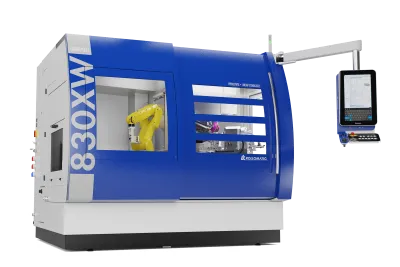
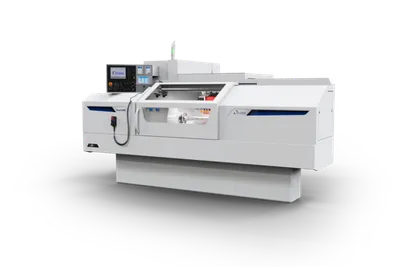
Mägerle MGC-B-630
Key Specifications
table longitudinal travel
table cross travel
vertical travel
max workpiece weight
axis drive system
cnc axes
Overview
The Mägerle MGC-B-630 is a CNC creep-feed grinding machine in Mägerle's MGC-B (Blade) series, built for precision profile grinding of compressor and turbine blade root forms, vane segments, and high-value aerospace components on a 630 mm longitudinal table platform. The 630 designation positions this machine between Mägerle's smaller platforms and the larger 840 mm variant, covering the blade length range most prevalent in high-pressure compressor and turbine stages of commercial and military jet engines — where component counts are highest and production volumes justify dedicated high-precision grinding investment.
The MGC-B-630 shares the defining technical architecture of the full MGC-B series: linear motor drives on all primary axes for ±1 µm positioning repeatability, active thermal management of the machine bed and coolant circuit, and the Siemens 840D sl control with Mägerle's dedicated turbine blade grinding software. These platform fundamentals are not compromised in the 630 variant — the same capability that makes the MGC-B-840 the reference platform for large blade production is present in the MGC-B-630, scaled to the 630 mm travel for the compressor and turbine blade dimensions most commonly ground in this tier.
The grinding spindle delivers 45 kW with peripheral wheel speeds to 80 m/s, providing full CBN creep-feed capability for Inconel 718, titanium 6Al-4V, and high-pressure turbine alloys. An automatic wheel changer with up to 10 positions supports complete multi-operation blade grinding cycles — roughing, form grinding, semi-finish, and finish — in a single unattended program. In-process gauging integration allows closed-loop blade root form verification after the final finishing pass, with measurement data fed back to the grinding cycle for automatic size correction on the following blade.
For aerospace shops grinding predominantly high-pressure compressor and turbine blades in the 400–600 mm overall length range, the MGC-B-630 provides the full Mägerle platform capability at a lower capital cost than the 840 variant. New pricing typically falls in the $950,000–$1,400,000 range depending on automation level, wheel changer configuration, and gauging options.
Full Specifications
| Parameter | Value |
|---|---|
| Table Longitudinal Travel | 630 mm (24.8 in) |
| Table Cross Travel | 600 mm (23.6 in) |
| Vertical Travel | 500 mm (19.7 in) |
| Max Workpiece Weight | 600 kg (1,323 lb) |
| Axis Drive System | Linear motors (X, Y, Z axes) |
| Cnc Axes | 4-axis standard (X, Y, Z, A); 5-axis optional |
| Grinding Spindle Power | 45 kW (60.3 HP) |
| Max Wheel Peripheral Speed | 80 m/s |
| Max Grinding Wheel Diameter | 500 mm (19.7 in) |
| Positioning Repeatability | ±1 µm |
| Wheel Changer | Automatic (up to 10 positions) |
| Thermal Compensation | Active thermal management — bed, spindle, coolant |
| Coolant Pressure | Up to 150 bar (2,175 psi) |
| CNC Control | Siemens 840D sl with Mägerle turbine blade grinding software |
| Machine Base | Polymer concrete with active thermal stabilization |
Specifications compiled from manufacturer literature and industry references. Not independently verified against a published spec sheet — confirm with the manufacturer or an authorised dealer before making a purchasing decision.
Strengths & Limitations
Strengths
- Full MGC-B platform architecture — linear motors, ±1 µm repeatability, active thermal management — in a 630 mm table format optimized for high-pressure compressor and turbine blade lengths
- 45 kW spindle with CBN wheel capability at 80 m/s provides full production creep-feed grinding capacity for the most demanding aerospace superalloy blade materials
- 10-position automatic wheel changer enables complete multi-operation blade grinding (roughing through finishing) in a single unattended program cycle
- Closed-loop in-process gauging after finishing pass provides automatic size correction per blade, protecting yield and enabling unattended batch production
- Lower capital cost than the 840 variant while delivering the same precision platform — the right choice for shops where the 630 mm travel covers their primary blade length range
Limitations
- At $950,000–$1,400,000, the MGC-B-630 remains a high-capital investment accessible only to high-volume aerospace turbine component manufacturers or their well-capitalized suppliers
- The 630 mm longitudinal travel excludes longer blades from large turbofan fan stages and industrial gas turbines — those applications require the MGC-B-840
- Like all Mägerle platforms, the MGC-B-630 is highly optimized for aerospace turbine applications and offers poor return on investment when applied to general surface grinding or non-aerospace workpieces
Best For
Frequently Asked Questions
01
The MGC-B-630 has 630 mm longitudinal table travel versus 840 mm on the larger variant, and slightly lower workpiece weight capacity (600 kg vs. 800 kg). Both share the same spindle power (45 kW), linear motor drives, ±1 µm positioning repeatability, active thermal management, and Siemens 840D sl control. The 840 variant adds capacity for longer blades and heavier components. Choose the 630 when your blade family fits within 600 mm length — you get the same precision platform at lower cost.
02
The MGC-B-630 is designed to grind all standard turbine blade root form geometries: fir-tree profiles (multi-lobe, single-lobe), dovetail profiles (straight and angularly inclined), T-slot roots, and serrated platforms. Both compressor blade roots (typically titanium alloy) and turbine blade roots (typically nickel superalloy) are within the machine's design scope. Custom root forms specific to engine OEM specifications are programmed using Mägerle's blade grinding software with the geometry defined parametrically.
03
Creep-feed grinding uses a very slow workpiece feed rate (typically 0.5–200 mm/min) combined with a large radial infeed to remove material in one or few passes rather than many light passes. For turbine blade root forms, creep-feed produces the precise profile geometry in a single pass with controlled surface integrity — the slow feed allows the wheel to cut to the exact form profile without building up thermal damage in the workpiece. This is critical for aerospace alloys like Inconel 718 and titanium that are sensitive to thermal damage affecting fatigue life.
04
Yes. The MGC-B-630 includes PROFINET robot integration interfaces, automatic pallet or zero-point clamping system compatibility, and in-process gauging for closed-loop size control. United Grinding's automation team provides turnkey cell packages with robot loading, automatic workpiece pallet transfer, post-process blade inspection, and MES data connection. Fully automated cells with this machine typically run 16–20 hours per day with one operator monitoring multiple machine centers.
05
The MGC-B-630's linear motor drives eliminate the mechanical wear items of ballscrew systems (replacement interval, preload adjustment), but require periodic encoder and motor performance verification. The coolant system with high-pressure jets and fine-filtration requirements needs regular filter changes and coolant chemistry monitoring, particularly when grinding Inconel where fine metallic particles and tramp oil can accumulate rapidly. United Grinding provides annual service contracts with preventive maintenance schedules, and remote diagnostics capability through the Siemens 840D sl network interface.
Videos

PROTEM GMBH

B2BManufactures

STROJE SVOBODA s.r.o.

Mach4Metal
Community Discussions
Community discussion — What form tap do you like for #6-32 in 303, blind ...
Community discussion — Magerle Surface Grinder | Practical ...
Community discussion — Magerle F7 Grinder Questions - Practical Machinist
Community discussion — Preferred surface grinder manufacturer ...
Community discussion — What coolant do you like and why? - CNCzone
Community discussion — Laser control board, 6c6879-laser-M2:2 no dongle - CNCzone
Community discussion — Laser Engraving / Cutting Machine General Topics - CNCzone
Troubleshooting and problem-solving — Error Codes - CNCzone
Links to community discussions. Summaries are editorial — visit the original thread for full context.