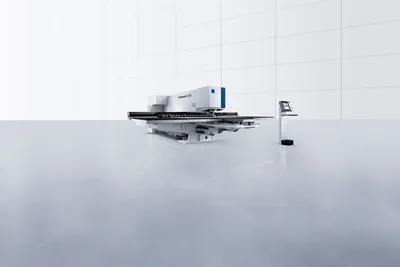
LVD Strippit Single 30
Key Specifications
Accuracy
punching force
punch stations
max hit rate
max sheet size
max sheet thickness mild steel
Overview
The LVD Strippit Single 30 is a 30-ton CNC single-head punch press from LVD Strippit, representing a fundamentally different machine architecture from LVD's turret punch presses. Where the PFC and V-series use a rotating turret to hold and index multiple tools, the Single 30 uses a single punch station that is manually tooled for one punch-and-die set at a time. This single-station design makes the machine simpler, lower-cost, and more focused on high-volume production of repetitive single-punch operations — blanking, perforating standard patterns, or piercing a single hole geometry across thousands of parts — rather than the complex multi-tool part programs that favor a turret punch.
The Single 30's core operating principle is simplicity and speed on repetitive work. With one punch-and-die loaded, the machine can punch at rates exceeding those of turret punches on the same single-tool operation, since there is no indexing time penalty and no turret rotation overhead. The 1,250 x 2,500 mm working area and CNC-controlled X/Y axes position the sheet precisely under the single punch station. For production runs of simple perforated panels, electrical knockouts in a standard pattern, or high-volume bracket blanking in one punch size, the Single 30 is faster and more economical than a turret press.
The Single 30 finds its niche in specific production environments: perforating shops producing ventilation grilles and acoustic panels in large quantities, manufacturers with standardized hole patterns that repeat across product families, and fabricators needing a dedicated punch press for one class of operation alongside a turret punch handling complex parts. The machine's simplicity also means lower maintenance costs and a smaller footprint than equivalent turret punch presses — it requires less floor space and has fewer mechanical systems to maintain.
LVD Strippit programs the Single 30 via CADMAN-P, the same software environment used across the PFC and V-series. For the Single 30's typical use cases, programming is straightforward — define the sheet, define the hole pattern, assign the single punch tool, and generate the program. CADMAN-P handles nesting and sequence optimization for maximum throughput. Operators can also program simple repetitive patterns directly at the machine control without involving offline software.
New Single 30 machines are priced significantly lower than LVD's turret punch presses, typically in the $100,000 to $180,000 range, reflecting the simpler mechanical architecture. This makes the Single 30 an attractive option as a dedicated production machine or as a complement to a turret punch — the turret handles complex work while the Single 30 runs the repetitive single-tool programs that would otherwise consume turret punch capacity on high-volume orders.
Full Specifications
| Parameter | Value |
|---|---|
| Punching Force | 30 tons (267 kN) |
| Punch Stations | 1 (single-station, manually tooled) |
| Max Hit Rate | 500 hits/min (single-tool operation) |
| Max Sheet Size | 1,250 x 2,500 mm (49.2 x 98.4 in) |
| Max Sheet Thickness Mild Steel | 6.35 mm (0.25 in) |
| Max Sheet Thickness Stainless | 4 mm (0.16 in) |
| X Axis Speed | 80 m/min |
| Y Axis Speed | 50 m/min |
| Positioning Accuracy | ±0.1 mm (±0.004 in) |
| Ram Drive | Servo-electric |
| Tooling Compatibility | LVD Strippit single-station tooling; standard thick-punch tooling |
| CNC Control | LVD CNC with CADMAN-P integration |
| Machine Weight | 6,000 kg (13,228 lb) |
Specifications compiled from manufacturer literature and industry references. Not independently verified against a published spec sheet — confirm with the manufacturer or an authorised dealer before making a purchasing decision.
Strengths & Limitations
Strengths
- Lower capital cost than turret punch presses makes it accessible as a dedicated production machine or complement to existing turret punch capacity
- High single-tool hit rate with no turret indexing overhead — faster than a turret press on pure single-operation repetitive work
- Simpler mechanical architecture means lower maintenance costs and fewer systems compared to turret punch presses with 20-58 station turret mechanisms
- Compact footprint versus equivalent turret punches — useful for shops with limited floor space needing dedicated punch capacity
- CADMAN-P compatibility with the full LVD product line means no retraining if operators also use PFC or V-series machines
Limitations
- Single punch station requires manual tool change for every different punch geometry — no rapid tooling changes between different hole sizes within a program
- Not suitable for complex parts requiring multiple punch sizes or forming operations in a single program — a turret punch is required for those applications
- Limited resale value and market liquidity compared to versatile turret punch presses — single-station punches are narrower in application scope
Best For
Frequently Asked Questions
01
The Single 30 is the right choice when the majority of your production involves repetitive single-tool operations — the same punch size used across thousands of parts or large sheets. The single-station design is faster and lower-cost for these applications. Choose the V-30 turret punch when your production requires multiple punch sizes per part, forming operations, or frequent tool changes within a single program. Many shops run both: the turret for complex work, the Single 30 for dedicated high-volume single-operation production.
02
The Single 30 uses a single punch holder that is manually changed between jobs. The operator removes the current punch-and-die assembly, installs the new tooling, and confirms the tool parameters in the CNC. This process typically takes 5-15 minutes depending on tool type and operator familiarity. Because of this manual tool change, the Single 30 is best suited to jobs where the same tool runs for an entire production run rather than programs requiring multiple tools.
03
Yes, within limitations. The Single 30 can be set up with a forming tool — a louver die, emboss tool, or lance-and-form — in place of the punch tool. However, because only one tool is installed at a time, a part requiring both punching and forming would need two separate setups (and potentially two machine passes). For parts with mixed punch and form requirements, a PFC-series machine with multiple forming stations in the turret is far more practical.
04
The Single 30 handles mild steel up to 6.35 mm (1/4 inch) and stainless steel up to 4 mm with its 30-ton capacity. These specifications match the PFC 1225 and V-30 since all three share the same 30-ton punch force class. Near maximum thickness, appropriate punch-to-die clearances are critical — LVD Strippit's application team provides recommended clearances for specific material grades and thicknesses to ensure clean holes and good tool life.
05
CADMAN-P programs the Single 30 the same way it programs LVD's turret presses — import the CAD geometry, assign the single punch tool, optimize the punching sequence, and generate the NC program. For simple repetitive patterns (grid arrays, uniform spacing), CADMAN-P's nesting and pattern tools can generate the complete program in minutes. The software's familiarity across the LVD product line means operators who know CADMAN-P from a PFC or V-series machine can program the Single 30 immediately.
Videos

Norman Machine Tool Ltd.

PRIDEMACHINERY

VanderZiel Machinery

Arrow Industrial Sales

The Equipment Hub
Community Discussions
Options and configuration advice — Bridgeport cat30 spindle? : r/Machinists - Reddit
Community discussion — What’s your go-to tapping and threading fluid? :
Community discussion — CADMAN SOFTWARE ST-1225 STRIPPIT LVD Machine :
Pricing and buying discussion — Where do you buy your metal stock? : r/machining - Reddit
Links to community discussions. Summaries are editorial — visit the original thread for full context.
Related Machines
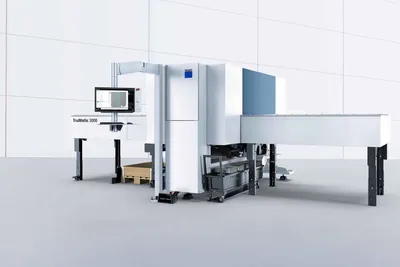
Trumpf TruMatic 3000
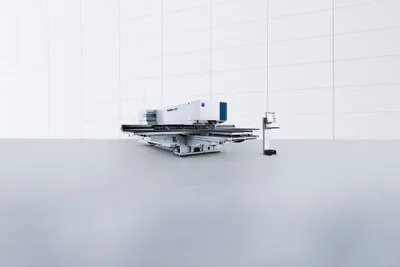
Trumpf TruMatic 7000
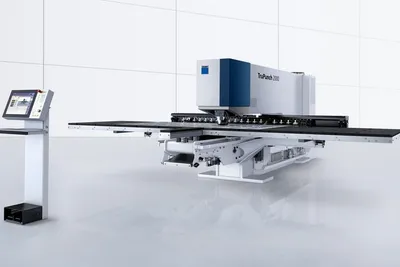
Trumpf TruPunch 2000
Trumpf TruPunch 3000