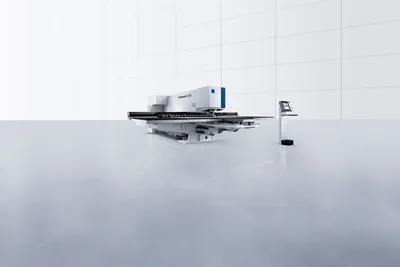
LVD Strippit PFC 1525
Key Specifications
Accuracy
punching force
turret stations
max hit rate
max sheet size
max sheet thickness mild steel
Overview
The LVD Strippit PFC 1525 is a 30-ton servo-electric CNC turret punch press from LVD Strippit, the punch press brand within Belgium-based LVD Group, representing the larger-format version of the PFC series. The 1525 designation indicates the 1,500 x 2,500 mm maximum sheet capacity, making it one of the wider-format punch presses in the PFC line and positioning it for shops that process full-size European sheets or require more X-axis travel than the 1225 provides. Like all PFC series machines, it uses a servo-electric ram drive — meaning no hydraulic system, lower energy consumption, reduced noise, and programmable punch speed for adapting to different materials.
The PFC 1525 is configured with a 32-station thick turret in the standard A/B/C station mix. The wider working envelope increases its utility for HVAC panel fabricators, electrical enclosure manufacturers, and telecom cabinet producers working in 1,500 mm sheet widths — a common format in European fabrication. The servo-electric drive delivers up to 600 hits per minute on short-pitch repositioning programs, matching the PFC 1225 in speed while extending the sheet size range. All stations accept LVD Strippit's own tooling as well as industry-standard thick-turret tooling from Wilson Tool, Mate Precision Technologies, and other aftermarket suppliers.
LVD Strippit's CADMAN-P software manages programming for the PFC 1525. Operators import CAD geometry in DXF or DWG format, assign tools from the loaded turret inventory, and generate optimized NC programs from a single environment. CADMAN-P shares the same data architecture as CADMAN-L (laser) and CADMAN-B (press brake) software, enabling unified job management across the LVD fabrication cell for shops running multiple LVD machines. The programming integration becomes a meaningful efficiency advantage when the same part families flow through punch, laser, and bend operations.
The PFC 1525 competes with the Amada HPN-1003L (large format), Trumpf TruPunch 1000 (wider configuration), and Finn-Power P series in the mid-range large-format servo punch segment. The 1525's combination of industry-standard tooling compatibility, servo-electric efficiency, and CADMAN software integration gives it a competitive position for European-format shops. Its larger working envelope also makes it suitable for producing perforated panels, large-format decorative sheets, and architectural metalwork where the 1225's capacity is insufficient. Pricing ranges from $280,000 to $420,000 for standard configurations.
For shops evaluating the PFC 1525 versus the PFC 1225, the decision typically comes down to sheet width. If 1,250 mm sheet width is the standard, the 1225 is more economical. If 1,500 mm sheet widths appear regularly in the job mix — or if the shop buys 1,500 x 3,000 mm stock and saws it down — the 1525's larger capacity eliminates the re-sizing step and may justify the higher capital cost through material yield and handling savings.
Full Specifications
| Parameter | Value |
|---|---|
| Punching Force | 30 tons (267 kN) |
| Turret Stations | 32 stations (thick-turret, A/B/C station mix) |
| Max Hit Rate | 600 hits/min (at 1 mm pitch) |
| Max Sheet Size | 1,500 x 2,500 mm (59 x 98.4 in) |
| Max Sheet Thickness Mild Steel | 6.35 mm (0.25 in) |
| Max Sheet Thickness Stainless | 4.5 mm (0.18 in) |
| X Axis Speed | 100 m/min |
| Y Axis Speed | 60 m/min |
| Positioning Accuracy | ±0.05 mm (±0.002 in) |
| Ram Drive | Servo-electric |
| Tooling Compatibility | LVD Strippit + Wilson Tool, Mate, and standard thick-turret tooling |
| CNC Control | LVD CNC with CADMAN-P integration |
| Machine Weight | 9,200 kg (20,284 lb) |
| Brand | LVD STRIPPIT |
| Model | 1000M XP/30 |
| Id | 725103 |
| Type | Turret Punches |
| Year | 2000 |
| Location | New YorkUnited States |
| Stock | 44770 |
| First Name | Last Name |
| Will You Need Financing | YesNo |
| Yes | No |
| Will You Need Freight Service | YesNo |
Specifications sourced from machinetools.com — verified 2026-03-28
Strengths & Limitations
Strengths
- 1,500 x 2,500 mm sheet capacity handles European-format wide sheets without re-sizing, improving material yield for shops using 1,500 mm standard stock
- Servo-electric drive provides 50-70% energy savings over hydraulic equivalents with programmable ram speed for sensitive materials and noise reduction
- Compatible with industry-standard thick-turret tooling from Wilson Tool and Mate — broad sourcing options and ability to transfer existing tooling from other punches
- CADMAN-P software integrates with CADMAN-L and CADMAN-B for unified programming across laser, punch, and press brake operations in LVD-equipped shops
- LVD Strippit's deep heritage in turret punch design provides proven application support for complex forming and large-format sheet processing
Limitations
- 32-station turret is fewer stations than competitors offering 36-58 stations, potentially requiring more tool change setups on high-mix programs
- The wider 1,500 mm Y-axis capacity increases machine footprint and cost versus the 1225 — unnecessary for shops that never process 1,500 mm sheets
- LVD North American service density is lower than Amada or Trumpf, which may affect response times in some regions
Best For
Frequently Asked Questions
01
The primary difference is sheet capacity. The PFC 1225 handles sheets up to 1,250 x 2,500 mm, while the PFC 1525 handles 1,500 x 2,500 mm — a 250 mm wider Y-axis. Both use the same 30-ton servo-electric drive, 32-station turret, and CADMAN-P software. The 1525 is appropriate for shops that regularly process 1,500 mm wide sheets; the 1225 is more cost-effective for shops where 1,250 mm is the standard sheet width.
02
The PFC 1525 accepts LVD Strippit's own tooling catalog as well as industry-standard thick-turret tooling from Wilson Tool International, Mate Precision Technologies, and other aftermarket suppliers. This broad compatibility allows shops to source tooling from multiple vendors on competitive lead times and transfer existing thick-turret tooling from previous machines. Most standard punch geometries, forming tools, and special-application tooling are available from multiple compatible sources.
03
Yes. The PFC 1525 handles stainless steel (304 and 316 grades) up to 4.5 mm with its 30-ton capacity. Stainless punching requires sharper tooling clearances (approximately 15-18% per side for 304), controlled punch speed to limit work hardening at the shear face, and appropriate lubrication. LVD's CADMAN-P software allows tool-specific speed settings, enabling operators to program slower speeds for stainless operations while maintaining full speed on mild steel within the same program.
04
The PFC designation (Punch/Form Center) indicates full forming capability. The 32-station turret's C-station positions accommodate forming tools for louvers, raised flanges, dimples, lance-and-form features, and embossing. LVD Strippit's forming tooling catalog covers the most common formed features, and custom tooling is available for specific geometries. Forming on the PFC 1525 can eliminate secondary press operations for many enclosure and panel part families.
05
CADMAN-P imports CAD geometry in DXF, DWG, and other standard formats, automatically assigns punch tools from the loaded turret configuration, optimizes the punching sequence to minimize air-cut travel, and generates NC programs for the machine control. CADMAN-P shares a common database with CADMAN-L (laser) and CADMAN-B (press brake) software — part data programmed for one machine is accessible in the others without re-import. This integration is particularly valuable for fabrication cells where the same flat blank goes through punch and then laser or bend operations.
Community Discussions
Troubleshooting and problem-solving — Anyone with experience on a LVD Strippit SP series press ...
Troubleshooting and problem-solving — Need a service company who works on LVD Strippit
Community discussion — LVD Pressbrake help needed - Practical Machinist
Community discussion — Strippit LVD Press Brake - Practical Machinist
Options and configuration advice — Turret punch repositioning - CNCzone
Community discussion — Need Help! Strippit Cadman LVD - cnczone.com
Troubleshooting and problem-solving — Problem Referencing turret on punch press - CNCzone
Pricing and buying discussion — Need Help! LVD Strippit PPED 90/08 press brake with Cadman ...
Links to community discussions. Summaries are editorial — visit the original thread for full context.
Related Machines
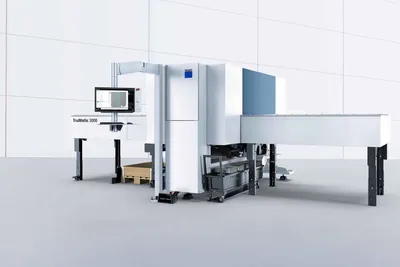
Trumpf TruMatic 3000
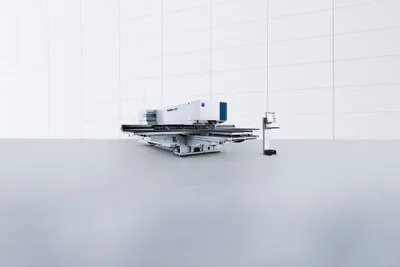
Trumpf TruMatic 7000
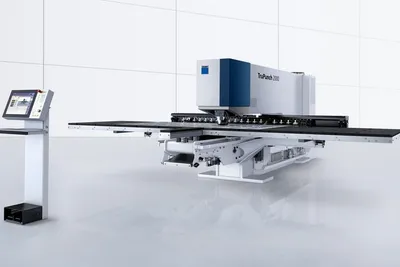
Trumpf TruPunch 2000
Trumpf TruPunch 3000