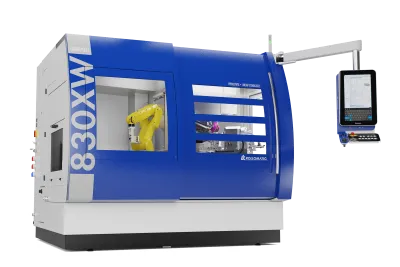
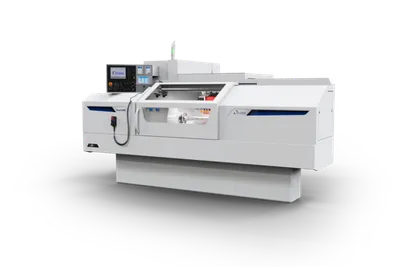
Loeser SZ 250
Key Specifications
grinding wheel diameter
grinding wheel width
regulating wheel diameter
max workpiece diameter through feed
min workpiece diameter through feed
max workpiece diameter infeed
Overview
The Loeser SZ 250 is a CNC centerless grinding machine from Loeser GmbH, a German specialist in centerless and through-feed grinding for high-volume precision part production. With a 250 mm grinding wheel diameter, the SZ 250 is positioned as a production-focused centerless grinder for bar stock, pins, rollers, fasteners, and cylindrical precision components in the small-to-medium diameter range — up to approximately 60 mm diameter. Centerless grinding is the preferred process for high-volume OD grinding where workpiece throughput, diameter consistency, and cycle time are more important than the fixture-based positioning accuracy of a cylindrical grinder.
Loeser's SZ series uses the infeed (plunge) and through-feed centerless grinding modes. In through-feed mode, the workpiece is fed continuously between the grinding wheel and a regulating wheel, emerging from the exit side finished — ideal for long bars, shafts, pins, and rollers where the same diameter is maintained along the entire length. In infeed mode, the workpiece is loaded in position against a work rest blade and the grinding wheel plunges radially to the finished diameter — suited for stepped parts, parts with shoulders, and form grinding where a specific section must be ground to a profile.
The SZ 250's CNC control provides programmable control of the regulating wheel speed (which controls workpiece rotational speed and through-feed rate), grinding wheel infeed rate, dressing parameters for both wheels, and automatic part ejection sequencing. For production applications, the CNC stores complete process recipes — when switching between part types, the operator recalls the saved program and the machine configures itself to the correct parameters, reducing changeover time versus purely manual centerless grinders.
Loeser SZ 250 pricing typically falls between $120,000 and $200,000 new, depending on control options, automation integration, and dressing unit configuration. The machine competes with Mikrosa's KRONOS series (also a United Grinding brand), Cincinnati Milacron's centerless grinders, and Junker's CNC centerless machines in the production centerless grinding segment.
Full Specifications
| Parameter | Value |
|---|---|
| Grinding Wheel Diameter | 250 mm (9.8 in) |
| Grinding Wheel Width | Up to 200 mm (7.9 in) |
| Regulating Wheel Diameter | 150 mm (5.9 in) |
| Max Workpiece Diameter Through Feed | 60 mm (2.4 in) |
| Min Workpiece Diameter Through Feed | 1 mm (0.04 in) |
| Max Workpiece Diameter Infeed | 80 mm (3.1 in) |
| Max Workpiece Length Through Feed | Unlimited (continuous bar feed) |
| Grinding Wheel Speed | Up to 45 m/s |
| Regulating Wheel Speed | 2 – 80 RPM (adjustable) |
| Infeed Resolution | 0.001 mm (0.00004 in) |
| Roundness Achievable | 0.001 – 0.003 mm (1 – 3 µm) |
| Machine Base | Cast iron |
| Dressing System | CNC diamond dresser (both wheels) |
| CNC Control | Siemens or proprietary Loeser CNC |
| Automation Interface | Part ejector, feed chute, robot loading optional |
Specifications compiled from manufacturer literature and industry references. Not independently verified against a published spec sheet — confirm with the manufacturer or an authorised dealer before making a purchasing decision.
Strengths & Limitations
Strengths
- Centerless grinding eliminates workpiece fixturing — no chucking, no centers — dramatically increasing throughput for high-volume OD grinding of pins, rollers, and bar stock compared to cylindrical grinders
- Through-feed capability enables continuous grinding of long bars and shafts — workpieces longer than the machine's grinding wheel width can be processed in a single continuous pass
- CNC process parameter storage with named programs enables rapid changeover between part families — particularly valuable in job shop environments producing multiple part types on one machine
- Loeser's German centerless grinding specialization provides application expertise for difficult-to-grind materials and tight-tolerance applications where process know-how matters
Limitations
- Centerless grinding requires skilled setup — setting the work rest blade height, regulating wheel angle, and wheel gap is a skilled operation, and an improperly set machine will produce out-of-round parts regardless of wheel condition
- Workpieces with shoulders, flanges, or features that prevent through-feed must use infeed (plunge) mode, which reduces throughput advantage over cylindrical grinding for complex part profiles
- At $120,000–$200,000, the SZ 250 is a significant investment for shops with modest volume — centerless grinding's throughput advantages only fully materialize in medium-to-high production volumes
Best For
Frequently Asked Questions
01
In cylindrical grinding, the workpiece is held between centers or in a chuck and rotated against the grinding wheel — the workpiece center position is fixed by the fixturing. In centerless grinding, the workpiece is not fixed: it rides on a work rest blade between the grinding wheel (which removes material) and a regulating wheel (which controls rotation speed and through-feed rate). The workpiece's position is controlled by the geometry of the blade-wheel-regulating wheel relationship, not by mechanical fixturing. Centerless grinding is faster for high volumes because loading is simpler, but it cannot grind features that require a fixed datum like cylindrical grinding can.
02
In through-feed mode, the SZ 250 handles workpiece diameters from approximately 1 mm to 60 mm. In infeed mode, larger diameters up to approximately 80 mm are possible. The minimum diameter for through-feed is limited by the stability of small-diameter workpieces on the work rest blade — very thin parts (under 2–3 mm) require specialized blade and wheel configurations to prevent the part from riding up the wheel.
03
Under production conditions with properly dressed wheels, correct blade height, and appropriate regulating wheel speed, the SZ 250 can achieve roundness (out-of-roundness) of 0.001–0.003 mm (1–3 µm). For bearing-quality roller elements, roundness below 0.001 mm is achievable with optimized setup and premium CBN wheels. The achievable roundness is influenced significantly by the incoming workpiece roundness — centerless grinding cannot easily correct a strongly out-of-round starting condition in a single pass.
04
Yes, the SZ 250 supports CBN (cubic boron nitride) grinding wheels. CBN is commonly used in high-volume centerless grinding of hardened steel (60+ HRc) bearing components and precision pins because CBN wheels last dramatically longer than conventional abrasive wheels, maintain their profile more consistently, and can grind hardened steel faster without burning. The SZ 250's spindle speed and power specifications support vitrified-bond CBN wheels, which are the industry standard for bearing component centerless grinding.
05
Loeser and Mikrosa (United Grinding) are both German centerless grinding specialists, and both produce quality production centerless grinders. Mikrosa tends to focus more on the high-precision, high-volume bearing and automotive component segment with very high-rigidity machines. Loeser offers comparable capability with perhaps a slightly broader application range covering precision parts and job shop work. Both brands are well-regarded and the choice often comes down to application-specific requirements, existing machine fleet relationships, and the application engineering support provided by each company's sales team.
Community Discussions
Community discussion — Loeser cylindrical grinder | Practical ...
Community discussion — Where to find instruction/parts manuals ...
Community discussion — Schaublin, Cazeneuve, Weiler, Graziano, Mori Seiki | Help ...
Community discussion — Schaublin, Cazeneuve, Weiler, Graziano, Mori Seiki | VDF ...
Community discussion — Greetings, fellow clausing owners : r/Machinists - Reddit
Community discussion — Why would this happen on a swiss type? : r/Machinists - Reddit
Community discussion — Swiss crash, no idea what happened : r/Machinists - Reddit
Pricing and buying discussion — Quiet air compressor recommendations? : r/Machinists - Reddit
Links to community discussions. Summaries are editorial — visit the original thread for full context.