Loeser RF 600
Key Specifications
Max Workpiece ⌀
workpiece diameter range
max workpiece height
finishing surfaces
abrasive media
workpiece rotation speed
Overview
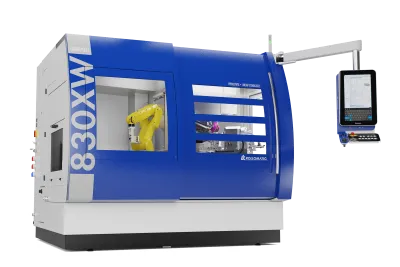
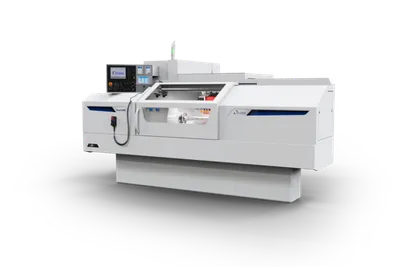
The Loeser RF 600 is a CNC rotary finishing machine from Loeser GmbH of Remscheid, Germany, designed for all-surface finishing, deburring, and edge rounding of round and near-round components up to 600 mm in diameter. The RF (Rotationsfinish/Rotary Finish) series uses a combination of workpiece rotation and abrasive tool rotation — both axes CNC-controlled — to produce a controlled isotropic (non-directional or circumferential) surface finish on disc-shaped, ring-shaped, or cylindrical workpieces requiring consistent surface treatment on all exposed surfaces including OD, ID, and face surfaces in a single setup.
Rotary finishing applications include bearing ring surface preparation (before or after heat treatment), gear blank face finishing, disc brake rotor surface condition preparation, hydraulic manifold block face finishing, and decorative or functional finishing of round industrial components where a non-directional surface texture is preferred over the directional texture produced by belt grinding or superfinishing. The RF 600's 600 mm workpiece diameter capacity covers large bearing rings, large disc brake rotors, turbine disc blanks, and industrial gear blanks in the medium-to-large size range.
The CNC control of both the workpiece rotation axis and the abrasive tool contact parameters — pressure, oscillation, and traverse position — enables recipe-based processing for repeatable results across production runs without operator skill dependency. The machine supports multiple abrasive media: abrasive stones (for heavier stock removal and geometry correction), abrasive film pads (for surface finish without geometry change), and non-woven abrasive (Scotch-Brite equivalent) for surface conditioning and decorative finishing.
At $180,000–$350,000 depending on configuration and automation, the Loeser RF 600 addresses the rotary component surface finishing market — a segment where few dedicated CNC machine solutions exist, with most shops relying on manual bench grinding or slow vibratory finishing processes that cannot achieve consistent results on precision round components.
Full Specifications
| Parameter | Value |
|---|---|
| Max Workpiece Diameter | 600 mm (23.6 in) |
| Workpiece Diameter Range | 20 - 600 mm (0.79 - 23.6 in) |
| Max Workpiece Height | 150 mm (5.9 in) — for disc and ring components |
| Finishing Surfaces | OD, face, and ID (with appropriate tooling) |
| Abrasive Media | Stones, abrasive film pads, or non-woven abrasive (application-specific) |
| Workpiece Rotation Speed | 5 - 100 RPM (CNC programmable) |
| Abrasive Tool Contact Force | CNC servo-controlled, 5 - 200 N |
| Surface Finish Achievable | Ra 0.1 - 3.2 µm (abrasive media and pressure dependent) |
| Edge Rounding Radius | 0.1 - 2.0 mm (programmable) |
| CNC Control | Siemens 828D with Loeser rotary finishing software |
| Machine Weight | ~3,500 kg (7,716 lb) |
| Coolant | Oil mist or water-soluble coolant (application-specific) |
Specifications compiled from manufacturer literature and industry references. Not independently verified against a published spec sheet — confirm with the manufacturer or an authorised dealer before making a purchasing decision.
Strengths & Limitations
Strengths
- 600 mm workpiece diameter capacity covers large bearing rings, gear blanks, disc brake rotors, and turbine disc components — the key round component finishing applications
- Produces isotropic (non-directional) surface texture on workpiece OD, face, and ID in a single setup — eliminating multiple manual bench operations and achieving consistent circumferential finish quality
- CNC-controlled edge rounding (0.1–2.0 mm radius) produces consistent edge breaks on gear blanks and bearing rings, replacing manual filing and inconsistent hand-deburring operations
- Multiple abrasive media support (stones, film pads, non-woven) enables a single machine to perform rough finishing (scale removal), precision finish, and surface conditioning in sequential operations
- Recipe-based CNC process management stores component-specific programs for rapid changeover — critical in bearing ring and gear blank finishing where multiple variants run on the same machine
Limitations
- 150 mm maximum workpiece height limits the RF 600 to disc, ring, and short cylindrical components — tall cylindrical components (shaft-like geometry) require belt or superfinishing machines
- Rotary finishing is not a precision sizing process — the RF 600 produces surface condition and edge condition improvement without the close dimensional control of grinding (cannot control OD tolerance to ±0.01 mm)
- Non-woven abrasive media (for surface conditioning applications) has short media life on hard materials (bearing steel, carbide) and requires frequent media changes to maintain consistent finishing action
Best For
Frequently Asked Questions
01
Rotary finishing uses a combination of workpiece rotation and abrasive tool contact — the workpiece rotates on its axis while an abrasive tool (stone, film pad, or non-woven) contacts the workpiece surface with controlled force. The relative motion between workpiece and tool produces material removal and surface finishing across all contacted surfaces. Superfinishing (as in the Loeser SZ series) uses a short-stroke oscillating stone applied to a specific journal surface — producing a cross-hatch or circumferential texture at Ra < 0.05 µm with very precise material removal control. Rotary finishing is less precise (Ra 0.1–3.2 µm range, less controlled material removal) but covers larger areas and multiple surfaces (OD, face, ID) in one operation. Superfinishing is for precision bearing surfaces; rotary finishing is for all-surface preparation and conditioning.
02
An isotropic surface finish has no dominant texture direction — the surface looks similar in all inspection directions (unlike a ground surface with circumferential lay, or a milled surface with tool marks in one direction). Isotropic finish is produced by random-direction abrasive action — tumbling, vibratory finishing, or rotary finishing with combined workpiece and tool rotation producing random abrasive paths. Isotropic finishes are specified for: gear tooth flanks in some aerospace transmission specifications (to reduce the risk of directional surface lay aligning with fatigue crack initiation sites), bearing ring surfaces in some bearing manufacturer specifications, and hydraulic manifold sealing faces where directional surface lay could create leak paths across the seal face.
03
Yes. Bearing rings are typically finished in the hardened condition (through-hardened 58–62 HRC for through-hardened bearing steel, or case-hardened for case-carburized rings). The RF 600 handles hardened bearing ring finishing with appropriate abrasive selection: aluminum oxide (Al2O3) for general hardened steel finishing, CBN (cubic boron nitride) for faster stock removal on very hard rings, and fine-grit aluminum oxide or silicon carbide film pads for final surface finish improvement. Post-heat-treatment finishing of hardened rings removes heat treatment scale, surface oxidation, and minor distortion-induced surface irregularities, preparing the ring for final grinding of raceways. The Loeser RF 600's abrasive force control prevents excessive pressure that could cause localized surface thermal damage on hardened rings.
04
Gear blank edge rounding before gear cutting and after gear cutting serves different purposes and has different specifications. Before gear cutting (on the blank faces and OD edges), rounding is cosmetic and handling-safety related — typically 0.2–0.5 mm radius. After gear cutting and heat treatment, the gear tooth edge — the sharp junction between the tooth flank and face — is rounded to 0.1–0.3 mm radius for two reasons: to improve coating adhesion (PVD/CVD coatings on sharp edges are thin and peel) and to reduce stress concentration at the tooth edge (sharp edges are fatigue crack initiation sites). Some aerospace gear specifications precisely define the edge radius (e.g., 0.15 ± 0.05 mm) and require measurement verification — a level of control the Loeser RF 600's CNC force management is designed to achieve.
05
Vibratory tumbling (mass finishing) is a batch process that finishes many parts simultaneously in a vibrating tub with abrasive media — fast and inexpensive for high-volume small components but offers no process control per part, cannot achieve tight surface finish consistency between parts (especially on edges where media contact is variable), and is limited to components that can tumble without interlocking or surface damage from part-to-part contact. The Loeser RF 600 finishes one component at a time with controlled abrasive force, rotation speed, and traversal — producing consistent Ra and edge radius on every part. For precision bearing rings (where surface condition consistency is critical for subsequent grinding operations) and for large rings that cannot be vibratory tumbled without interlocking, the RF 600 provides the process control that vibratory finishing cannot deliver.
Videos

Robert Loeser

USC Darla Moore School of Business

Rebuild Your Knees

jacknjellify

San Diego Pain Summit
Community Discussions
Troubleshooting and problem-solving — TOOL RECOVER PROBLEM - CNCzone
Troubleshooting and problem-solving — Haas bar feeder problem - CNCzone
Community discussion — floppy to usb emulator help please - cnczone.com
Community discussion — Fanuc rom files - CNCzone
Links to community discussions. Summaries are editorial — visit the original thread for full context.