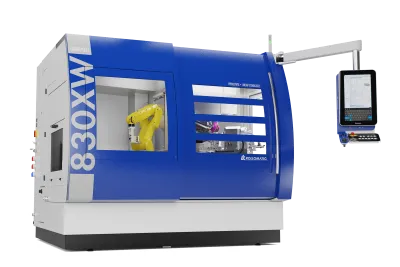
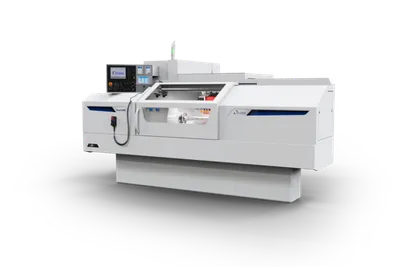
Loeser LF 500
Key Specifications
max shaft diameter
max shaft length
finishing method
surface texture direction
surface finish achievable
abrasive type
Overview
The Loeser LF 500 is a CNC longitudinal grinding and finishing machine from Loeser GmbH of Remscheid, Germany, designed for external cylindrical finishing of shafts, bars, and cylindrical components up to 500 mm in length. The LF (Längsschleif/Longitudinal finishing) designation distinguishes this machine from Loeser's superfinishing (SZ series) and belt finishing (BF series) products — the LF series uses longitudinal abrasive belt or stone finishing in a traverse motion along the shaft axis, producing a longitudinal (axial-direction) surface texture rather than the circumferential or cross-hatch textures produced by superfinishing and grinding.
Longitudinal finishing is applied to shaft surfaces where the functional surface requirement is for a consistent longitudinal texture — sealing surfaces for lip seals (rotary shaft seals), where a circumferential grind pattern can cause oil pumping along the spiral micro-grind marks and a purely longitudinal finish eliminates this pumping tendency. The LF 500 produces the longitudinal surface texture required by RWDR (Rotary Shaft Seal) standards (DIN 3760, ISO 6194) for shaft surfaces mating with oil seals, a common requirement in gearbox output shafts, hydraulic motor shafts, and pump drive shafts.
The machine accommodates shaft diameters from 20 mm to 200 mm and lengths up to 500 mm, covering the majority of gearbox output shaft, hydraulic pump shaft, and industrial motor shaft applications. CNC control of the abrasive contact force, traverse speed, and traverse stroke length enables recipe-based process management for production shaft finishing operations.
At $150,000–$300,000 depending on configuration, the Loeser LF 500 is a specialized machine addressing the oil seal surface finish market — a requirement that is common in drivetrain and hydraulic pump manufacturing but often overlooked in shaft grinding process planning.
Full Specifications
| Parameter | Value |
|---|---|
| Max Shaft Diameter | 200 mm (7.87 in) |
| Max Shaft Length | 500 mm (19.7 in) |
| Finishing Method | Longitudinal abrasive belt or stone traverse |
| Surface Texture Direction | Longitudinal (axial) — required for rotary shaft seal surfaces |
| Surface Finish Achievable | Ra 0.2 - 0.8 µm (longitudinal texture per DIN 3760) |
| Abrasive Type | Abrasive belt (aluminum oxide or SiC), grit 120–600 |
| Contact Pressure | CNC servo-controlled, 5 - 100 N programmable |
| Traverse Speed | CNC programmable, 0.1 - 5 m/min |
| Workpiece Rotation Speed | 20 - 300 RPM |
| CNC Control | Siemens 828D with Loeser finishing software |
| Machine Weight | ~2,800 kg (6,173 lb) |
| Coolant | Oil mist or dry finishing (application-dependent) |
Specifications compiled from manufacturer literature and industry references. Not independently verified against a published spec sheet — confirm with the manufacturer or an authorised dealer before making a purchasing decision.
Strengths & Limitations
Strengths
- Produces longitudinal surface texture (DIN 3760 compliant) required for rotary shaft seal surfaces — eliminating the oil-pumping tendency of circumferentially ground shaft surfaces
- CNC servo-controlled contact pressure and traverse speed enables consistent results across production shaft families with recipe-based changeover between shaft variants
- Handles shaft diameters 20–200 mm covering gearbox output shafts, hydraulic pump shafts, and industrial motor shafts — the key rotary shaft seal application segments
- Integrates into CNC cylindrical grinding cell workflow — LF 500 operates after grinding to add the required longitudinal finish as a secondary operation with short cycle times (30–120 seconds per shaft)
- Loeser's German drivetrain application knowledge provides proven process parameters for common shaft materials (case-hardened steel 58-62 HRC, induction-hardened steel, stainless steel)
Limitations
- Longitudinal finishing is a secondary operation after cylindrical grinding — adds cycle time and machine investment for shaft surfaces that require seal compatibility
- Abrasive belt consumables require regular replacement and correct specification — the belt grit, material, and contact roll hardness must match the shaft material and target Ra for consistent results
- 500 mm maximum shaft length limits coverage to shorter shaft assemblies — longer shafts (> 500 mm between seal seats) require either larger LF machine or alternative finishing methods
Best For
Frequently Asked Questions
01
A rotary shaft seal (lip seal, RWDR) works by a rubber lip pressing against the rotating shaft surface. When the shaft surface has a circumferential grinding pattern — circumferential scratches from cylindrical grinding — the helix-angle of the grinding marks can act as a micro-pump, drawing oil from the wet (oil) side to the dry (air) side along the spiral groove path as the shaft rotates. This is called 'oil pumping' and causes shaft seal leakage even on a new, correctly installed seal. DIN 3760 and ISO 6194 specify that the shaft surface under the lip seal must have a longitudinal (axial-direction) surface texture — produced by longitudinal finishing — to eliminate the spiral groove oil-pumping tendency. The Loeser LF 500 is specifically designed to produce this DIN 3760-compliant longitudinal texture.
02
DIN 3760 (Rotary shaft seals — technical requirements) specifies shaft surface Ra 0.2–0.8 µm for the shaft running surface under the lip seal, with the additional requirement that the surface texture must be dominantly longitudinal (axial direction) with no spiral marks or circumferential lay. Rmax (maximum peak height) is often additionally specified at < 6.3 µm to prevent individual grinding burrs from cutting the seal lip. Too smooth (Ra < 0.1 µm) causes adhesive wear of the seal lip (insufficient oil film). Too rough (Ra > 1.0 µm) causes excessive seal lip wear from surface asperities. The Loeser LF 500's Ra 0.2–0.8 µm range with longitudinal texture is exactly the DIN 3760 target window.
03
Yes. Case-hardened steel (58–62 HRC) is one of the primary materials for gearbox and differential shafts requiring seal surface finishing. The Loeser LF 500 uses aluminum oxide or silicon carbide abrasive belts rated for hardened steel finishing. CBN abrasive belt options are available for high-hardness materials or high-volume applications where longer belt life reduces consumable cost. The key consideration for hardened shaft finishing is avoiding thermal damage — the LF 500's controlled contact pressure and oil mist cooling prevent abrasive belt finishing from generating significant heat (unlike grinding), making it inherently safer for hardened shafts than grinding-based finishing operations.
04
Many gearbox and motor shafts have two or more lip seal seats at different positions along the shaft — for example, a front seal and a rear seal at different axial positions on the same shaft. The Loeser LF 500's CNC-programmed traverse stroke positions and dwell zones allow independent finishing of each seal seat zone. The CNC program specifies: traverse start position (axial), traverse end position, traverse speed, contact pressure, and number of finishing passes for each seal seat zone independently. Between seal seats, the contact tool can be retracted (no contact) during the rapid traverse to the next zone. Multiple seal seat finishing is handled in a single workpiece setup.
05
The Loeser SZ series (SZ 250, SZ 600) uses short-stroke oscillating superfinishing stones applied to journal bearing surfaces — producing circumferential or cross-hatch textures at Ra < 0.05 µm for bearing and tribological contact applications. The Loeser LF series uses traversing abrasive belts or stones applied in a longitudinal (axial) direction — producing a longitudinal texture at Ra 0.2–0.8 µm specifically for rotary shaft seal surfaces. The two products serve different surface texture requirements: SZ for ultra-smooth bearing surfaces (negative Rsk, high bearing ratio), LF for DIN 3760 seal surfaces (longitudinal lay, moderate Ra). A complete shaft finishing cell for an automotive gearbox output shaft might include both: SZ superfinishing on the bearing journal seats, LF longitudinal finishing on the oil seal seats.
Videos

Retro Racing Reports

Michael Loeser

Osher Lifelong Learning Institute UW

Michael Loeser

USC Darla Moore School of Business
Community Discussions
Troubleshooting and problem-solving — Centerless Grinder Recomendations ...
Community discussion — Loeser cylindrical grinder | Practical ...
Pricing and buying discussion — Anyone farmiliar with rust removal lasers ...
Community discussion — Bar Feeder Alignment - Practical Machinist
Comparison and buying advice — Video Shop air vs O2 for assist gas on 500 watt fiber laser.
Community discussion — Ebay Laser Always fires when moving - cnczone.com
Community discussion — Fiber Laser Cutting Topics - CNCzone
Pricing and buying discussion — Need Help! Fiber Laser Selection Recommendation And Insight
Community discussion — What's your favorite anti-rust spray? : r/Machinists - Reddit
Community discussion — Why would this happen on a swiss type? : r/Machinists - Reddit
Owner experience and review — Can you help me pick a used Swiss? : r/Machinists - Reddit
Pricing and buying discussion — Indexable cutter vs .500 solid endmill : r/Machinists - Reddit
Links to community discussions. Summaries are editorial — visit the original thread for full context.