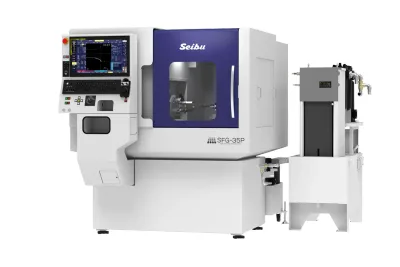
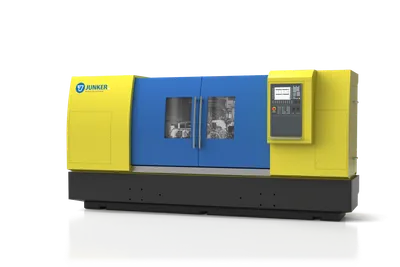
Junker QUICKPOINT 3000
Key Specifications
available wheelhead versions
quantity wheelhead
grinding length
clamping length
center height
workpiece weight
How much does the Junker QUICKPOINT 3000 cost?
Estimated price range
Our best estimate for a cnc grinding machine in this class — not a quote from Junker Group. Configuration moves it a long way.
Overview
The Junker QUICKPOINT 3000 grinds parts up to 500 mm long and 15 kg on a 12,000 kg machine with a single wheelhead. Swing diameter is 150 mm, center height 150 mm and the grinding wheel 350 mm in diameter. Of the QUICKPOINT models it has the wide choice of wheelheads, eight versions in all: /10, /10i, /20, /30, /40, /50, /50S and /60.
Against the QUICKPOINT 1000, this is the frame for longer shafts. The QUICKPOINT 1000 stops at 150 mm of grinding length, an 80 mm swing diameter and 5 kg, and lists four wheelhead versions.
The figures also sit very close to those of the JUMAT 3000. The JUMAT 3000 has the same 12,000 kg weight, the same 3,400 x 2,800 x 2,200 mm footprint, the same 150 mm center height and the same 15 kg workpiece limit, but 400 mm of grinding length against 500 mm here. A buyer weighing the two is therefore choosing between wheelhead ranges and grinding lengths, not between sizes of machine.
Grinding length and clamping length are both 500 mm, so a part can be ground over the whole length it is clamped on. The site has to take 12,000 kg on a base of 3,400 x 2,800 mm, with 2,200 mm of height. Junker's table stops at capacities, dimensions and weight. Spindle power, wheel speed and control are left to the quotation.
Full Specifications
| Parameter | Value |
|---|---|
| Available Wheelhead Versions | /10 /10i /20 /30 /40 /50 /50S /60 |
| Quantity Wheelhead | 1 |
| Grinding Length | 500 mm |
| Clamping Length | 500 mm |
| Center Height | 150 mm |
| Workpiece Weight | 15 kg |
| Grinding Wheel Diameter | 350 mm |
| Swing Diameter | 150 mm |
| Floor Space Required | 3,400 x 2,800 x 2,200 mm (W x D x H) |
| Machine Weight | 12,000 kg |
Specifications sourced from junker-group.com — verified 2026-10-03
Strengths & Limitations
Strengths
- Eight wheelhead versions listed, including /40, /50, /50S and /60 that the QUICKPOINT 1000 does not offer
- 500 mm of grinding length, equal to the clamping length
- 12,000 kg of machine weight for a 15 kg workpiece limit
- 150 mm swing diameter under a 350 mm grinding wheel
Limitations
- Workpiece weight is capped at 15 kg
- Swing diameter is 150 mm, so flanged or large-diameter parts are out
- Occupies 3,400 x 2,800 mm of floor, against 1,500 x 2,500 mm for the QUICKPOINT 1000
- No spindle power, wheel speed or control data in Junker's table
Best For
Frequently Asked Questions
01
500 mm of grinding length and the same clamping length, 150 mm center height, 150 mm swing diameter and a 15 kg workpiece weight. The grinding wheel diameter is 350 mm. The machine weighs 12,000 kg.
02
Eight: /10, /10i, /20, /30, /40, /50, /50S and /60. The quantity of wheelheads on the machine is 1, so one version is fitted. The QUICKPOINT 1000 is listed with the first four only.
03
On the listed figures, nearly. The JUMAT 3000 shares the 12,000 kg machine weight, the 3,400 x 2,800 x 2,200 mm footprint, the 150 mm center height, the 350 mm wheel and the 15 kg workpiece limit, and lists 400 mm of grinding length where the QUICKPOINT 3000 has 500 mm. The wheelhead version lists differ as well.
04
The foundation, for 12,000 kg on a 3,400 x 2,800 mm base, and headroom for the 2,200 mm height. Junker's table does not state connected load, air or coolant requirements for this model, so get those from the quotation before preparing the site.
Videos

M. BAIER (LANG GMBH)
More from Junker Group
Other CNC Grinding Machines
Palmary OCD-2040
Bourn & Koch Blanchard 72HAD-120
Blohm Orbit 36
EMAG SN 208