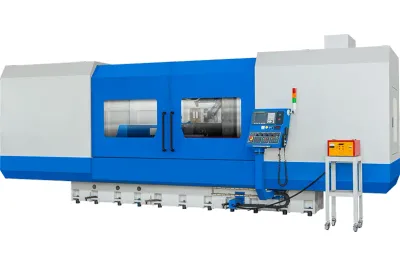
Junker QUICKPOINT 1000
Key Specifications
distance between centers
center height
max workpiece weight
grinding process
wheel width
wheel speed
Overview
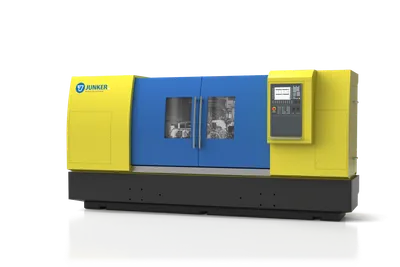
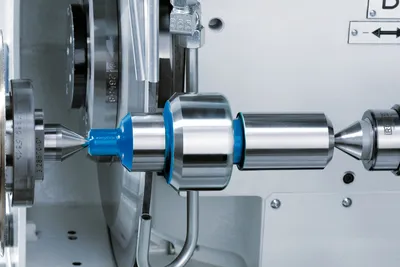
The Junker QUICKPOINT 1000 is a CNC peel grinding machine — the definitive machine for the peel grinding process that Junker pioneered and patented. Unlike conventional plunge or traverse cylindrical grinding, peel grinding uses a narrow CBN wheel (typically 3-5 mm wide) traversing at high feed rates to remove material in a helical path, similar to turning. This approach eliminates the need for multiple wheel profiles and enables a single narrow wheel to grind complex shaft profiles — multiple diameters, shoulders, radii, and tapers — in a single uninterrupted cycle.
The QUICKPOINT 1000 handles workpieces up to 1,000 mm between centers and is optimized for medium-to-short shaft-type components common in automotive powertrains — valves, pins, injection components, small shafts, and precision spindles. The narrow CBN wheel at high surface speeds (up to 120 m/s) combined with high traverse feed rates gives the QUICKPOINT its speed advantage: on components with multiple features, peel grinding is typically 30-60% faster than plunge grinding with profiled wheels because there is no dressing of complex profiles and no wheel inventory for different diameter combinations.
The machine uses hydrostatic guideways on both linear axes, providing the frictionless, wear-free axis motion essential for the continuous, interpolated contouring that peel grinding demands. The interpolation between X and Z axes during grinding must be smooth and precise to produce the required surface profile — stick-slip from mechanical guides would produce chatter and surface irregularities. Hydrostatic guides eliminate this risk entirely.
Junker's QUICKPOINT software, running on the Siemens 840D sl platform, provides specialized peel grinding programming that converts part geometry into optimized grinding cycles automatically. The software manages entry and exit ramps, shoulder approach angles, radii blending, and wheel speed compensation — the operator enters the desired part profile geometry and the software generates the grinding program.
Pricing for the QUICKPOINT 1000 typically falls in the $500,000-$750,000 range, with automation adding $80,000-$200,000. The machine is competitive with conventional cylindrical grinders in capital cost while delivering significantly lower tooling cost (one narrow CBN wheel versus a library of profiled wheels) and faster cycle times on multi-feature shafts.
Full Specifications
| Parameter | Value |
|---|---|
| Distance Between Centers | 1,000 mm (39.4 in) |
| Center Height | 175 mm (6.9 in) |
| Max Workpiece Weight | 100 kg (220 lb) |
| Grinding Process | Peel grinding (high-speed traverse with narrow CBN wheel) |
| Wheel Width | Typically 3-5 mm CBN wheel |
| Wheel Speed | Up to 120 m/s |
| Grinding Spindle Type | High-frequency motorized spindle |
| Guideways | Hydrostatic on X and Z axes |
| Machine Bed | Mineral cast polymer concrete |
| CNC Control | Siemens 840D sl with Junker QUICKPOINT software |
| Axis Interpolation | Simultaneous X/Z for profile contouring |
| In Process Gauging | Marposs / Renishaw interface |
| Workhead Speed Range | 1 - 1,500 RPM |
| Automation Interface | Robot / gantry loader compatible |
| Modelquickpoint 1000brandjunkertypeuniversal Cylindrical Grinderscontrolcontact Sales Rep | Contact Sales Rep. |
| Modelquickpoint 1000brandjunkertypeuniversal Cylindrical Grinderscontrol | Contact Sales Rep. |
| Model | QUICKPOINT 1000 |
| Brand | JUNKER |
| Type | Universal Cylindrical Grinders |
| Swing31496centers59055grinding Wheel Dia1378 | ControlCNCDimensions1450W x 2850D x 2000H mmWeight6000 (KGS) |
| Swing Over Bed | 3.1496" |
| Centers | 5.9055" |
| Grinding Wheel Dia | 13.78" |
| Cnc Control | CNC |
| Dimensions | 1450W x 2850D x 2000H mm |
| Machine Weight | 6000 (KGS) |
| Looking To Purchase A New Junker Quickpoint 1000 | Contact Sales Rep. |
Specifications sourced from machinetools.com — verified 2026-03-28
Strengths & Limitations
Strengths
- Peel grinding eliminates the need for profiled wheel inventories — one narrow CBN wheel grinds any shaft profile within the machine envelope, dramatically reducing tooling cost and changeover time
- Single-wheel peel grinding cycles complete multiple diameters, shoulders, tapers, and radii without wheel changes, delivering 30-60% faster cycle times on multi-feature shafts versus plunge grinding
- Hydrostatic X and Z axes enable smooth, interpolated contouring required for peel grinding without the stick-slip that mechanical guides produce
- QUICKPOINT software automatically generates optimized grinding programs from part geometry — reducing programming time and process knowledge barrier
- CBN wheel life is significantly longer than profiled conventional wheels — a single narrow CBN wheel may grind tens of thousands of parts before replacement
- Narrow wheel reduces grinding forces compared to wide-face plunge grinding, enabling grinding of more slender workpieces without deflection
Limitations
- Peel grinding with a narrow CBN wheel requires precise coolant delivery at the narrow wheel contact zone — coolant system and nozzle setup is more critical than in conventional plunge grinding
- At $500,000-$750,000, the QUICKPOINT 1000 is priced above conventional CNC cylindrical grinders — justification requires multi-feature shaft components where the cycle time and tooling cost advantages materialize
- The peel grinding process generates higher surface speeds and traverse forces that require the workpiece to be adequately supported — very slender workpieces may require steady rests
- Peel grinding is optimized for external cylindrical features — internal grinding requires a separate ID spindle attachment and is less integral to the peel process
Best For
Frequently Asked Questions
01
Peel grinding uses a narrow (3-5 mm) CBN wheel traversing at high feed rates in a helical path across the workpiece — similar to a turning operation but with an abrasive wheel. Plunge grinding uses a wide wheel (often as wide as the feature to be ground) that is fed directly into the workpiece. Peel grinding's advantage is that one narrow wheel can grind any profile within the machine envelope, while plunge grinding requires a different profiled wheel for each diameter combination. For shafts with multiple steps and features, peel grinding is typically faster and requires far less tooling investment.
02
For multi-feature shaft components, yes — the QUICKPOINT 1000 can replace multiple conventional cylindrical grinders or a conventional grinder combined with a profiling grinder. For simple, single-diameter cylindrical grinding of high-volume identical parts, a conventional plunge grinder may still offer competitive cycle times without the QUICKPOINT's capital cost. The QUICKPOINT delivers its strongest ROI when the part family requires multiple diameters, shoulders, tapers, and radii — the more complex the profile, the greater the QUICKPOINT's advantage.
03
A narrow vitrified CBN wheel on the QUICKPOINT is dressed periodically to restore its cutting ability and geometry. Because the wheel is narrow and the profile is simple (flat face), dressing is fast — typically 15-30 seconds per dressing cycle using a rotary diamond dressing roll. The CNC automatically compensates for wheel diameter reduction after each dressing cycle. Electroplated CBN wheels (single-layer) do not require dressing but are replaced when worn — their life at the QUICKPOINT's operating parameters is typically 50,000-150,000 parts per wheel.
04
The QUICKPOINT 1000 achieves surface finishes in the Ra 0.1-0.4 µm range in production conditions, depending on workpiece material, hardness, CBN wheel specification, and final traverse parameters. For precision bearing journals and hydraulic valve stems, Ra 0.1-0.2 µm is typical with a finishing pass at reduced feed rate. The peel grinding process can produce a fine helical surface texture that, in many applications, is functionally superior to a random-lay finish from wide-wheel plunge grinding for fluid film bearing and sealing applications.
05
Yes, Junker offers the QUICKPOINT series in multiple size variants. The 1000 handles up to 1,000 mm between centers. Larger variants extend to 1,500 mm and beyond for longer shaft components. Junker's application engineering team will recommend the appropriate variant based on the customer's longest workpiece and the specific grinding strategy required. The core peel grinding process and hydrostatic guideway technology are consistent across all QUICKPOINT variants.
Videos
JUNKER Group
JUNKER Group
EMUK GmbH Werkzeugmaschinen
JUNKER Group
JUNKER Group
Community Discussions
Community discussion — Need Help! Hi torque / Low RPM (1000 - 3000rpm) spindle/router
Comparison and buying advice — Experinces and tips for Stepcraft CNC (M1000, Q204) versus ...
Community discussion — Lang Quick Point - In a Lathe? - cnczone.com
Troubleshooting and problem-solving — Bar Feeder Issue - cnczone.com
Pricing and buying discussion — Newbie to Countersinks and going down the rabbit holeTips on knurling? : r/Machinists - RedditWhy is my countersink bit cutting like this : r/MachinistsBest Budget CNC : r/Machinists - RedditWho makes a good drill chuck these days? : r/Machinists - RedditLine boring q
Community discussion — Tips on knurling? : r/Machinists - Reddit
Community discussion — Why is my countersink bit cutting like this :
Troubleshooting and problem-solving — Best Budget CNC : r/Machinists - Reddit
Links to community discussions. Summaries are editorial — visit the original thread for full context.