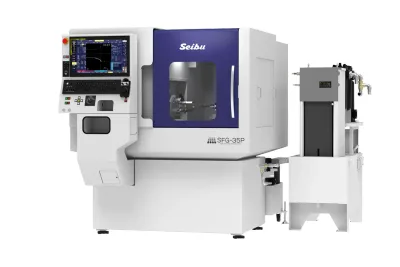
Junker JUCENTER 6000
This model was not found in Junker Group's current lineup when we checked on 2026-10-03 . It may be a superseded or older model; the specifications below are as we last recorded them.
Key Specifications
distance between centers
center height
max workpiece weight
grinding spindle type
wheel speed
wheelhead configuration
How much does the Junker JUCENTER 6000 cost?
Estimated price range
Our best estimate for a cnc grinding machine in this class — not a quote from Junker Group. Configuration moves it a long way.
Overview
The Junker JUCENTER 6000 is a CNC grinding center for long shaft work, listed with a maximum workpiece length of 6,000 mm (236 in), a 250 mm (9.8 in) center height and an 800 kg (1,764 lb) workpiece limit. The model is not in Junker Group's current lineup. The listed figures have not been confirmed against a maker document, so read them as a guide.
What separates this table from that of a plain cylindrical grinder is the wheelhead and the loading. The wheelhead row reads multi-wheel or automatic wheel changer, depending on configuration, so several grinding operations can share one clamping when the machine is equipped for it. Loading is listed as an integrated gantry loader or a robot cell, and the cycle-time row says the machine was designed for sub-10-minute automotive shaft cycles with CBN. That is the profile of a series-production machine. Anyone considering one for mixed, low-volume work should find out how easily it can be loaded by hand.
The grinding spindle is a high-frequency motorized unit described as CBN-optimized, with wheel speed up to 120 m/s, and the workhead runs from 1 - 800 RPM. Hydrostatic guideways on X and Z and a mineral cast polymer concrete bed are listed, along with closed-loop in-process gauging and Junker JUCENTER software on the control. Wheel diameter, spindle power, machine weight and footprint are all missing from the table, and they are the first things to request for a specific machine.
Full Specifications
| Parameter | Value |
|---|---|
| Distance Between Centers | 6,000 mm (236 in) maximum workpiece length |
| Center Height | 250 mm (9.8 in) |
| Max Workpiece Weight | 800 kg (1,764 lb) |
| Grinding Spindle Type | High-frequency motorized spindle, CBN-optimized |
| Wheel Speed | Up to 120 m/s |
| Wheelhead Configuration | Multi-wheel / automatic wheel changer (configuration-dependent) |
| Guideways | Hydrostatic on X and Z axes |
| Machine Bed | Mineral cast polymer concrete |
| In Process Gauging | Marposs / Renishaw closed-loop control |
| CNC Control | Siemens 840D sl with Junker JUCENTER software |
| Loading System | Integrated gantry loader or robot cell |
| Cycle Time Capability | Designed for sub-10-minute automotive shaft cycles with CBN |
| Workhead Speed Range | 1 - 800 RPM |
Specifications compiled from manufacturer literature and industry references. Not independently verified against a published spec sheet — confirm with the manufacturer or an authorised dealer before making a purchasing decision.
Strengths & Limitations
Strengths
- Maximum workpiece length listed as 6,000 mm (236 in), with an 800 kg (1,764 lb) workpiece limit
- Multi-wheel wheelhead or automatic wheel changer, depending on configuration
- Wheel speed up to 120 m/s on a CBN-optimized high-frequency motorized spindle
- Integrated gantry loader or robot cell listed as the loading system
- Hydrostatic guideways on X and Z, and closed-loop in-process gauging
Limitations
- Not in Junker Group's current lineup, and the listed figures are not confirmed against a maker document
- Wheelhead and loading depend on configuration, so two machines with this name can differ in what they grind in one clamping
- Workhead speed range is 1 - 800 RPM, which limits work speed on small-diameter parts
- No wheel diameter, spindle power, machine weight or footprint is listed
Best For
Frequently Asked Questions
01
The listed maximum workpiece length is 6,000 mm (236 in), with a center height of 250 mm (9.8 in) and a maximum workpiece weight of 800 kg (1,764 lb). These are unconfirmed figures, so check them against the documentation of the machine in question.
02
The model is not in Junker Group's current lineup. A buyer is therefore most likely looking at an existing machine, and should confirm its wheelhead configuration and loading system, because the table lists both as options and not as one fixed build.
03
Wheel speed is listed as up to 120 m/s, on a high-frequency motorized spindle described as CBN-optimized. The workhead speed range is 1 - 800 RPM. The table does not give a wheel diameter or spindle power.
04
The loading row lists an integrated gantry loader or a robot cell. Read together with the cycle-time row, which describes sub-10-minute automotive shaft cycles with CBN, this is a machine laid out for automatic loading in series production.
More from Junker Group
Other CNC Grinding Machines
Palmary OCD-2040
Bourn & Koch Blanchard 72HAD-120
Blohm Orbit 36
EMAG SN 208