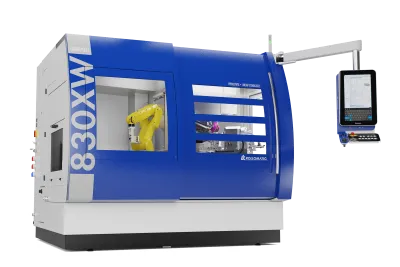
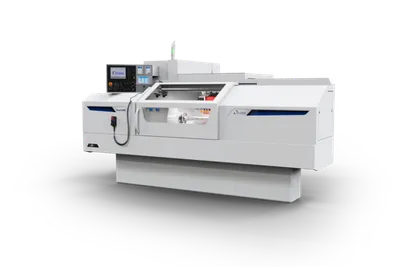
Junker CYLINDRA
Key Specifications
distance between centers
center height
max workpiece weight
max grinding wheel diameter
grinding spindle type
wheel speed
Overview
The Junker CYLINDRA is a flexible CNC cylindrical grinding system positioned as Junker's adaptable platform for shops that need cylindrical grinding capability across a broad range of workpiece types without committing to the dedicated high-volume configuration of the JUMAT or JUCENTER series. The CYLINDRA combines the hydrostatic guideway and high-frequency spindle technology that defines Junker's grinding machines with a more accessible price point and broader configuration flexibility.
The CYLINDRA is available in multiple size variants spanning a wide range of workpiece envelopes, from compact short-part configurations to long-shaft variants. The machine supports both conventional abrasive and CBN/diamond superabrasive wheels, giving shops the flexibility to grind soft and hardened materials, rough and finish operations, and diverse workpiece families on a single platform. This flexibility is a deliberate departure from the JUMAT's optimization for superabrasive, high-volume production.
The wheelhead configuration options include single external grinding spindle, external plus internal grinding spindle combinations, and angular approach capability for face and taper grinding. Dressing systems support conventional diamond roll and point diamond dressing for conventional wheels, and electroplated CBN wheels that require no dressing for superabrasive operations. The modular approach lets shops equip the machine for their specific application and upgrade incrementally.
Siemens 840D sl control with Junker's CYLINDRA operating software provides conversational programming with graphical support, reducing the skill barrier for shops transitioning from manual or older CNC cylindrical grinders. Integrated dressing cycle management, in-process gauging interfaces, and automation-ready design round out the platform.
The CYLINDRA is particularly relevant for job shops and contract grinders that serve multiple industries and need to grind a variety of shaft types, spindle components, toolholders, and precision pins without the dedicated-application rigidity of the JUMAT series. Pricing falls in the $350,000-$650,000 range depending on configuration.
Full Specifications
| Parameter | Value |
|---|---|
| Distance Between Centers | Multiple variants: 500 / 750 / 1,000 / 1,500 mm |
| Center Height | 150 - 200 mm (configuration-dependent) |
| Max Workpiece Weight | Up to 200 kg (configuration-dependent) |
| Max Grinding Wheel Diameter | 500 mm (19.7 in) |
| Grinding Spindle Type | High-frequency motorized spindle |
| Wheel Speed | Up to 100 m/s (CBN configuration) |
| Wheelhead Options | Single external; external + internal; angular approach |
| Guideways | Hydrostatic on X and Z axes |
| Machine Bed | Mineral cast polymer concrete |
| CNC Control | Siemens 840D sl with Junker CYLINDRA software |
| Dressing | Diamond roll or point diamond, CNC-controlled |
| In Process Gauging | Marposs / Renishaw interface |
| Automation Interface | Robot / gantry loader compatible |
Specifications compiled from manufacturer literature and industry references. Not independently verified against a published spec sheet — confirm with the manufacturer or an authorised dealer before making a purchasing decision.
Strengths & Limitations
Strengths
- Flexible configuration options — multiple center distances, wheelhead configurations, and abrasive types — enable one machine to serve diverse workpiece families
- Hydrostatic guideways and mineral-cast bed provide JUMAT-series accuracy and damping at a more accessible price point than the dedicated production variants
- Supports both conventional and CBN/diamond wheels, giving shops the freedom to choose the abrasive strategy that fits their production economics
- Conversational Siemens 840D sl programming with graphical support reduces the skill barrier for shops transitioning from older grinding machines
- Automation-ready design allows shops to start with manual loading and add robot or gantry automation as volume grows
- Multiple center distance variants let shops choose the configuration that matches their workpiece range without overpaying for unused capacity
Limitations
- The CYLINDRA's flexibility means it does not achieve the cycle times of a JUMAT configured and optimized for a single dedicated application — it is a general-purpose platform, not a production optimizer
- At $350,000-$650,000, it is more expensive than conventional (non-hydrostatic) cylindrical grinders from competitors — the hydrostatic guideway premium requires justification
- Shops doing primarily simple single-diameter grinding in low volumes may find the CYLINDRA's capability exceeds their needs and budget
Best For
Frequently Asked Questions
01
The JUMAT is application-optimized — configured for a specific workpiece type, wheel system, and production volume from the outset. It achieves the shortest cycle times and lowest cost per part for high-volume, dedicated applications. The CYLINDRA is flexibility-optimized — it can accommodate a broader range of workpieces and configurations without requiring the application-specific engineering that a JUMAT purchase involves. Both share the same hydrostatic guideway and mineral-cast bed technology. The CYLINDRA will typically be 20-40% slower on a dedicated application than an optimized JUMAT, but it can earn its keep across multiple part families simultaneously.
02
Yes, with the external plus internal spindle wheelhead configuration. The internal grinding spindle is typically a high-speed (up to 100,000 RPM) motorized spindle for small-bore ID grinding, or a standard internal spindle for larger bores. The wheelhead swivels to position the ID spindle at the bore, and the CNC manages the transition between OD and ID operations in the same program cycle. Shops that need frequent OD/ID combined operations should specify the dual-spindle wheelhead at the time of order.
03
For hardened steel (58-65 HRC) components, switching from conventional aluminum oxide to CBN on the CYLINDRA typically reduces grinding cycle time by 40-70% depending on the specific application. The cycle time improvement is most dramatic on larger material removal operations and less significant on light finishing passes. CBN wheel life is also 20-100x longer than conventional wheels, dramatically reducing wheel cost per part even though individual CBN wheels cost more. The economics of CBN conversion on the CYLINDRA are most favorable when monthly part volumes exceed 500-1,000 identical pieces.
04
Junker provides full application engineering support during the specification and purchase process, including grinding trials at the Junker test center in Nordrach, Germany for customers who want to validate cycle times before ordering. After delivery, Junker offers training programs for operators and programmers, process optimization support, and an applications hotline. Junker's service network in North America is managed through Junker Inc. in Dayton, Ohio, with service engineers covering the US and Canada.
Videos

Power Driven
Appliance Factory & Mattress Kingdom

PeriscopeFilm

Famulus99

Endpoint101 Tech
Community Discussions
Community discussion — Junkers engine details ...
Community discussion — Junkers ... - Practical Machinist
Community discussion — Grinding Video
Community discussion — Jung "F" series grinders. | Practical ...
Options and configuration advice — Guys on the cylindrical grinder knocking it out of the park ...Made a cyro can from Jurassic Park : r/machining - Redditso, i bought a jig borer... : r/Machinists - RedditCylinder Manufacturing process : r/machining - RedditAny idea of how the first jet turbines we
Community discussion — Made a cyro can from Jurassic Park : r/machining - Reddit
Community discussion — so, i bought a jig borer... : r/Machinists - Reddit
Community discussion — Cylinder Manufacturing process : r/machining - Reddit
Links to community discussions. Summaries are editorial — visit the original thread for full context.