HOMAG Centateq P-310
Key Specifications
Max Spindle
Spindle Power
work area x
work area y
work area z
axes
Overview
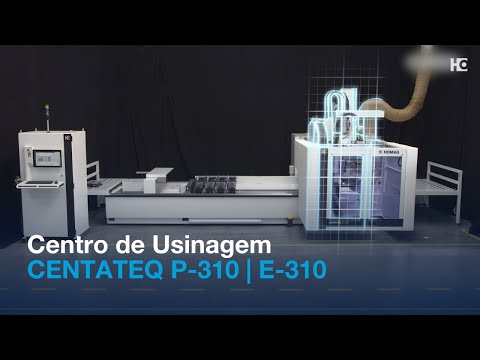
The HOMAG Centateq P-310 is a CNC machining center for flat panel processing, produced by HOMAG GmbH of Schopfloch, Germany. The Centateq P series is HOMAG's mid-range panel machining platform, positioned between the entry-level BAZ series and the large-format CENTATEQ E series. The P-310 is designed for furniture manufacturers and kitchen producers who require a versatile, production-capable CNC machining center for routing, drilling, grooving, and edge-profiling of panels up to full 4 x 8 ft (1,220 x 2,440 mm) sheet sizes, with options for slightly larger format work.
The P-310 features HOMAG's pod-and-rail workholding system — adjustable suction cups (pods) on aluminum T-slot rails clamp the workpiece from below, leaving the panel top face fully accessible for machining. This pod-and-rail system is particularly suited for processing panels that cannot be nested on a full vacuum table, such as pre-cut parts, parts with cutouts, or workpieces that require access to all four edges in a single setup. The spindle and ATC (automatic tool changer) configuration enables the P-310 to execute routing, drilling, edge profiling, and aggregate-head operations within a single program cycle.
HOMAG's powerTouch touchscreen control system runs the woodWOP 8 CAM programming environment, which connects to HOMAG's broader software ecosystem including CABINETIC production management and standard CAD/CAM systems via DXF and STEP import. woodWOP macros for cabinet programming reduce part programming time — standard cabinet side panels, shelves, and door profiles are programmed using parametric macros rather than manual toolpath construction.
The Centateq P-310 is widely used in kitchen and bathroom cabinet production, custom furniture manufacturing, and shop fitting — applications where mix of part sizes and shapes requires flexible workholding and the processing volumes justify a dedicated CNC machining center rather than manual routing. It competes with the Biesse Rover C and B series and the SCM Accord series in the mid-range furniture production CNC class. Pricing typically ranges from $90,000 to $200,000 depending on table format, spindle specification, and ATC size.
Full Specifications
| Parameter | Value |
|---|---|
| Work Area X | Up to 3,100 mm (122 in) |
| Work Area Y | 1,550 mm (61 in) |
| Work Area Z | 200 mm (7.9 in) |
| Spindle Motor Power | 9 kW (12 HP) |
| Max Spindle Speed | 24,000 RPM |
| Axes | 5-axis (optional C-axis rotation) |
| Tool Changer | Up to 14 positions (automatic tool changer) |
| Feed Rate | Up to 70 m/min rapid |
| CNC Control | HOMAG powerTouch (woodWOP 8 programming) |
| Machine Weight | 4,500 kg (9,920 lb) approximate |
Specifications sourced from homag.com — verified 2026-03-28
Strengths & Limitations
Strengths
- Pod-and-rail workholding allows flexible clamping of pre-cut parts, irregular shapes, and panels requiring access to all four edges without vacuum table reconfiguration
- woodWOP parametric macros for cabinet programming reduce part setup time — standard kitchen cabinet components are programmed in minutes from dimension inputs
- Mid-range price positioning delivers HOMAG build quality and software ecosystem at a lower cost than the large-format CENTATEQ E series
- Compact machine footprint relative to processing capacity makes the P-310 suitable for medium-sized shops without large floor space
- Integration with HOMAG's full production line ecosystem (edge banders, drilling centers, saws) via HOMAG software enables future automation expansion
Limitations
- Pod-and-rail workholding is slower to set up per part than a vacuum table for nested-based full-sheet processing — shops running high-volume nesting benefit more from a vacuum table machine
- 9 kW spindle is lighter than the CENTATEQ E-700's 12 kW — limits maximum chip load and feed rates in dense hardwoods or thick composite panels
- 14-position ATC is adequate for most furniture work but constrains shops with diverse tooling requirements needing 20+ tools in a single program
Best For
Frequently Asked Questions
01
Pod-and-rail workholding uses individual suction cup pods mounted on adjustable aluminum T-slot rails to clamp each workpiece from below. Pods are repositioned to match each part's dimensions and leave the full top face accessible for machining. A vacuum table, by contrast, uses a full flat table surface with zone-selectable vacuum for nested-based full-sheet production. Pod-and-rail is preferable when: processing pre-cut parts that do not cover a full sheet; machining parts that require edge access on all four sides; processing parts with large cutouts that would break vacuum seal on a flat table; and handling mixed-size jobs with frequent changeover. Vacuum tables are preferable when running high volumes of nested parts from full sheets where the setup-per-sheet approach delivers higher throughput.
02
The P-310 is a mid-range panel machining center and the E-700 is a large-format production machine — the differences are in table format, spindle power, and production orientation. The E-700 has a table up to 5,600 mm x 2,100 mm with a full vacuum table for nested-based sheet production, 12 kW spindle, and is designed for high-volume furniture component production from full sheets. The P-310 has a table up to 3,100 mm x 1,550 mm with pod-and-rail workholding, 9 kW spindle, and is optimized for flexible single-part and small-batch processing. A furniture factory might use both: E-700 for production nesting of standard components, P-310 for custom parts, special profiles, and prototype work.
03
Standard operations include: profile routing (edge profiles, decorative grooves, shaped cutouts); pocket milling (drawer bottom grooves, hinge pockets, handle recesses); drilling (hardware holes — dowels, hinges, shelf pins, cam locks); sawing (panel cut-to-size with saw aggregate); edge profiling (with horizontal routing head aggregate for panel edge work without repositioning); tenoning (with tenon head aggregate for solid wood frame joints). Five-axis capability with optional C-axis rotation allows angled cuts, compound bevels, and sculptural forms in a single setup. woodWOP aggregate head support means all operations are programmed in a single software environment with tool library management.
04
Yes. While HOMAG's woodWOP is the native programming environment and provides the deepest integration with HOMAG-specific features (aggregate heads, drill banks, parametric macros), the P-310 control accepts G-code programs from any CAD/CAM system that can post-process to HOMAG's controller format. Popular integrations include: Cabinet Vision (via HOMAG's certified post-processor); Alphacam; Mastercam Wood; and Enroute. DXF part geometry imports directly into woodWOP for toolpath generation. For shops already using a preferred CAD/CAM system, the transition to the P-310 does not require switching software — though shops starting from scratch benefit most from the woodWOP + CABINETIC native workflow.
05
HOMAG offers a range of aggregate heads that mount in the ATC and connect to the machine spindle to extend machining capability. Common aggregates for the P-310: angling head (tilts the spindle to cut bevels and compound angles without repositioning the workpiece); horizontal routing head (routes horizontally for edge profiles and hardware pockets on panel edges); saw aggregate (circular saw blade for trim-to-size and groove cutting); tenon head (produces tenon profiles for frame and panel joinery in solid wood and MDF); Forstner bit head (produces large-diameter flat-bottom holes for hinge cups and decorative plugs). Each aggregate is stored in the ATC when not in use and is automatically loaded into the spindle when called in the program, enabling complex multi-operation programs without operator intervention.
Videos
Electrotech machinery
Stiles Machinery
HOMAG (English)
HOMAG Brasil
HOMAG (English)
Community Discussions
Troubleshooting and problem-solving — Issues with old Edgebander machine - Practical Machinist
Community discussion — CNC router dust collection - Practical Machinist
Community discussion — How to remove tooling without power ...
Electrical and installation requirements — dust collection - Practical Machinist
Community discussion — Need Help! alpha-cam progs to MPR - cnczone.com
Community discussion — Search Results - CNCzone.com- Largest Forums for CNC ...
Community discussion — alphacam postprocessor for woodwop - CNCzone
Community discussion — Need professional advice- Alphacam+SCM+Homag
Links to community discussions. Summaries are editorial — visit the original thread for full context.