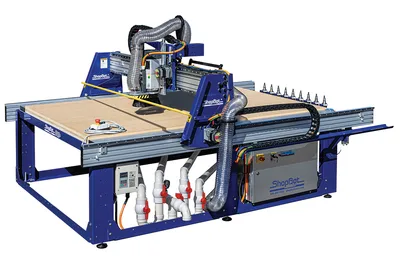
HOMAG Beamteq B-560
Key Specifications
Max Spindle
Spindle Power
work area x
work area y
work area z
axes
Overview
The HOMAG Beamteq B-560 is a CNC beam processing machine designed for cross-cutting, drilling, routing, and profiling of structural timber, solid wood beams, and glulam (glued laminated timber) elements. Produced by HOMAG GmbH of Schopfloch, Germany, the Beamteq series addresses the industrial timber frame construction sector — a distinct application from furniture panel processing that requires machines capable of handling large cross-section solid wood elements, structural timber precision, and the heavy cutting forces associated with large-dimension lumber.
The B-560 processes beams in a horizontal feed-through configuration — timber enters from one end, is processed across all faces by machining aggregates positioned around the beam cross-section, and exits finished on the other end. This feed-through concept enables continuous processing of long structural elements (rafters, ridge beams, purlins, wall studs, and engineered timber I-joists) without manual repositioning. The machining aggregates include cross-cut saws for length cutting, drilling units for bolt holes and connector hardware, and routing heads for housing cuts, birdsmouth notches, and other structural joinery cuts required in timber frame construction.
HOMAG's btL (HOMAG Timber Language) software handles Beamteq programming — accepting structural drawings from timber engineering CAD systems (Dietrich's, CADWORK, Archiframe) and generating machining programs automatically. This direct CAD-to-machine workflow eliminates manual programming of structural joints and dramatically reduces setup time for complex timber frame elements. Production timber frame companies can process complete house frame packages — all rafters, beams, posts, and plates with their specific cuts and holes — directly from the structural engineering model.
The B-560 competes in the industrial timber processing sector against Weinig's Beammaster series, Hundegger's K2i and Speed-Cut machines, and WALTER Timber's range of structural processing centers. This is a highly specialized segment of industrial woodworking — distinct from furniture production — serving prefabricated house manufacturers, timber frame construction companies, and structural glulam producers. Pricing for the Beamteq B-560 typically falls in the $200,000–$450,000 range depending on machining unit configuration and automation level.
Full Specifications
| Parameter | Value |
|---|---|
| Work Area X | Up to 13,000 mm (511 in) beam length |
| Work Area Y | 560 mm (22 in) beam width |
| Work Area Z | 560 mm (22 in) beam height |
| Spindle Motor Power | 15 kW (20 HP) routing spindle |
| Max Spindle Speed | 12,000 RPM |
| Axes | 5-axis CNC + rotating machining aggregates |
| Tool Changer | Automatic aggregate change system |
| Feed Rate | Up to 100 m/min feed-through speed |
| CNC Control | HOMAG powerTouch (btL timber programming) |
| Machine Weight | 18,000 kg (39,683 lb) approximate |
Specifications sourced from homag.com — verified 2026-03-28
Strengths & Limitations
Strengths
- Feed-through beam processing concept handles structural timber up to 13 meters in a single pass without manual repositioning — essential for full rafter and ridge beam lengths
- Direct integration with Dietrich's, CADWORK, and Archiframe structural timber CAD systems eliminates manual programming of complex structural joints
- 560 mm x 560 mm cross-section capacity covers all standard residential and light commercial glulam beam sizes without requiring special setup
- Multi-face machining aggregates process all four beam faces in a single pass — birdsmouth cuts, bolt holes, housing cuts, and length cuts simultaneously
- HOMAG's global service network and the btL software ecosystem provide consistent production support for high-volume timber frame manufacturers
Limitations
- High machine weight (18+ tonnes) and large footprint require purpose-built facility with adequate floor loading and structural clearance
- Very specialized machine — investment is only justified for dedicated timber frame or structural glulam production; too specialized for general woodworking shops
- btL software requires structural timber engineering file formats (Dietrich's, CADWORK) — shops without compatible engineering software face programming workflow challenges
Best For
Frequently Asked Questions
01
Beam processing refers to CNC machining of structural timber elements — solid wood or glulam beams, posts, rafters, and plates used in building construction. The key differences from furniture routing are: workpiece scale (beams up to 560 mm x 560 mm cross-section and 13 meters long vs. panels of 18–38 mm thickness); cutting forces (large cross-section lumber requires substantially more force than thin panel routing); joint types (structural joinery — birdsmouth, lap, scarf, timber frame mortise and tenon — rather than furniture hardware holes and profiles); and production context (building construction with structural engineering drawings rather than furniture design CAD). Beam processing machines are built much heavier and with larger cutting capacity than furniture CNC routers, and the software ecosystem is connected to structural engineering CAD rather than furniture design tools.
02
The B-560 handles the full range of structural timber joints used in platform frame, timber frame, and heavy timber construction: birdsmouth notches (rafter seat cuts for roof framing); ridge board end cuts (compound angle cuts for rafter pairs at the roof peak); hip and valley cuts (compound geometry cuts for hip roofs); lap joints and half-lap joints; scarf joints for beam extension; housing cuts (slots for beam-in-beam connections); bolt holes and lag screw pilot holes (through-holes for structural fasteners); connector plate slots (for manufactured steel plate connectors); and mortise cuts for post-and-beam tenon joinery. The five-axis machining capability handles compound geometry cuts that require simultaneous multi-axis motion. All joint geometry comes from the structural engineering model, not manual measurement.
03
btL (HOMAG Timber Language) is the CNC programming language and file exchange format HOMAG developed for structural timber machine programming. It is an industry-standard file format supported by the major structural timber engineering CAD systems — Dietrich's, CADWORK, Archiframe, and others. When a structural engineer designs a timber frame building in Dietrich's, the software exports a btL file containing every beam in the structure with its exact dimensions, all joint geometries, bolt hole positions, and machine operation requirements. The Beamteq B-560 reads this btL file and automatically generates machining programs for every beam in the package. This direct CAD-to-machine workflow eliminates manual CNC programming entirely for standard structural timber production.
04
Glulam (glued laminated timber) is an engineered wood product made by laminating individual lumber boards with structural adhesive to produce large cross-section beams with superior strength, dimensional stability, and length capability compared to sawn timber. Glulam beams are common in large-span commercial and industrial construction where solid sawn timbers of equivalent size are not available or practical. The Beamteq B-560 processes glulam using the same operations as solid timber — the machine does not differentiate between the materials in its programming. However, glulam's adhesive layers can cause slightly more tool wear than clear solid wood, and glulam's dimensional precision (glulam is manufactured to tight tolerances) simplifies setup compared to variable-dimension sawn timber. HOMAG's tool management system tracks tool life separately for different material types.
05
In a prefabricated timber frame factory, the Beamteq typically sits at the center of the production workflow: raw timber or glulam blanks arrive from a lumber yard or lamination press; they are cross-cut to rough length on a preliminary saw; then fed through the Beamteq for all precision cuts, joints, and holes; finished beams exit to labeling and sorting; and labeled beams are bundled into house frame packages for delivery. HOMAG offers automated infeed and outfeed conveyor systems, beam labeling stations, and sorting automation that integrate with the Beamteq and connect to the factory's ERP or production management system. A complete automated Beamteq line can process hundreds of structural elements per shift from a single building engineering file.
Videos
Electrotech machinery
NOINER
Höchsmann GmbH - Technology for Wood
Electrotech machinery
HOMAG (German-Language Channel)
Community Discussions
Pricing and buying discussion — Quiet air compressor recommendations? : r/Machinists - Reddit
Pricing and buying discussion — Line boring questions : r/Machinists - Reddit
Options and configuration advice — benchtop lathe/mill recommendations? : r/Machinists - Reddit
Owner experience and review — Water jet recommendations? : r/Machinists - Reddit
Links to community discussions. Summaries are editorial — visit the original thread for full context.