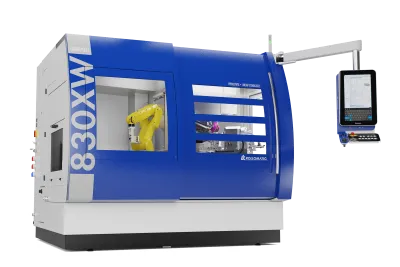
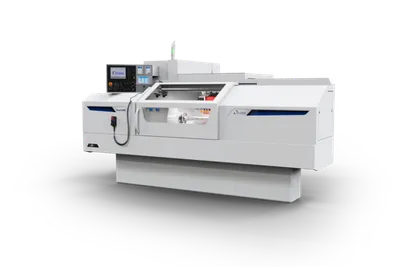
Hegenscheidt RH 36
Key Specifications
max crankshaft length
main journal diameter
pin journal diameter
grinding method
cycle time reference
journal roundness
Overview
The Hegenscheidt RH 36 is a CNC crankshaft pin grinding machine from Hegenscheidt-MFD, the German machine tool specialist in crankshaft and camshaft machining systems for automotive engine manufacturing. Hegenscheidt (based in Erkelenz, Germany, and Mönchengladbach) is one of only two or three companies globally that designs and manufactures complete crankshaft machining lines — from rough turning through finish grinding of main journals and pin journals — at the production rates required by automotive OEM engine assembly.
The RH 36 is Hegenscheidt's crankshaft pin journal grinding machine — specifically designed for the grinding of the eccentric (pin) journal positions of automotive crankshafts. Pin journal grinding differs fundamentally from main journal grinding: while main journals rotate about the crankshaft centerline during grinding, pin journals rotate eccentrically. The RH 36 uses orbital or CBN belt grinding technology to grind pin journals at production rates matching automotive engine assembly line throughput — typically 150-250 crankshafts per hour for passenger car 4-cylinder crankshafts.
Hegenscheidt's RH series crankshaft grinders use CBN (cubic boron nitride) abrasive belts or wheels that can be dressed and changed rapidly to maintain the required journal geometry (diameter, roundness, cylindricity, surface finish Ra 0.2-0.4 µm) across millions of crankshaft cycles. The CBN grinding approach provides significantly longer abrasive life than conventional abrasive stone grinding, reducing wheel changes and maintaining consistent geometry across production runs.
At $800,000-$1,500,000 per machine (crankshaft lines typically consist of multiple machines), the RH 36 is installed at automotive OEM captive crankshaft machining lines and their tier-1 crankshaft suppliers. Major automotive engine producers — General Motors, Ford, Volkswagen, Toyota, and their crankshaft supply base — use Hegenscheidt crankshaft grinding machines as the production standard.
Full Specifications
| Parameter | Value |
|---|---|
| Max Crankshaft Length | 700 mm (27.6 in) for 4-6 cylinder |
| Main Journal Diameter | Up to 80 mm (3.1 in) |
| Pin Journal Diameter | Up to 65 mm (2.6 in) |
| Grinding Method | CBN belt grinding (orbital) or CBN wheel |
| Cycle Time Reference | ~15-25 sec per crankshaft (4-cylinder) |
| Journal Roundness | < 0.003 mm |
| Surface Finish | Ra 0.2 - 0.4 µm |
| CNC Control | Siemens Sinumerik 840D sl |
| Machine Weight | ~12,000 kg (26,455 lb) |
Specifications compiled from manufacturer literature and industry references. Not independently verified against a published spec sheet — confirm with the manufacturer or an authorised dealer before making a purchasing decision.
Strengths & Limitations
Strengths
- CBN belt/wheel grinding provides consistent pin journal geometry at automotive production throughputs (150-250 crankshafts/hour)
- Orbital pin grinding technology handles eccentric pin journal grinding without complex orbital chucking mechanisms
- < 0.003 mm journal roundness matches or exceeds engine assembly crankshaft specification requirements
- Hegenscheidt is the global reference for automotive crankshaft machining — installed at virtually all major OEM engine plants
- Siemens Sinumerik 840D sl control provides familiar programming environment in European automotive manufacturing
Limitations
- $800K-$1.5M per machine, with complete crankshaft lines requiring multiple machines at $5M-$15M+ total investment
- Crankshaft grinding expertise is highly specialized — programming, setup, and maintenance require dedicated engineers
- CBN belt and wheel costs are significant operating expenses at automotive production volumes
- Machine is specific to crankshaft pin journal grinding — not applicable to other applications
Best For
Frequently Asked Questions
01
A crankshaft's pin journals are offset from the main journal centerline (the crankshaft's rotation axis) by the stroke radius. During conventional cylindrical grinding, the crankshaft would need to rotate about the pin journal center — requiring a special orbital chuck that repositions the crankshaft center from main journal to pin journal position. Orbital grinding instead uses a grinding head that tracks the eccentric pin journal position as the crankshaft rotates about its main journal centerline. The grinding head's position is continuously CNC-interpolated to follow the pin journal's orbital path, maintaining contact with the pin journal surface regardless of where the pin is in its eccentric orbit.
02
The RH 36 handles crankshafts with main journal diameters up to 80 mm and pin journal diameters up to 65 mm — covering the full range of passenger car 4-cylinder and 6-cylinder crankshafts, and light commercial vehicle 4-6 cylinder engines. For larger crankshafts (commercial vehicle inline-6 and V8 diesel engines with larger journals), Hegenscheidt offers larger capacity machines in the RH series with main journals up to 120 mm and pin journals up to 100 mm.
03
A 4-cylinder crankshaft has 4 pin journals. On the RH 36 with CBN grinding, all 4 pin journals can be ground in approximately 15-25 seconds per crankshaft — the machine grinds one or two pin journals simultaneously, cycling through all pins in sequence. This production rate enables a single RH 36 to process 150-250 crankshafts per hour, matching the output of a high-volume automotive engine assembly line. This production rate is only achievable with CBN abrasives — conventional abrasive grinding would take 3-5 minutes per crankshaft.
Community Discussions
Troubleshooting and problem-solving — Haas Cutter Comp Error 367 - Practical Machinist
Community discussion — Fillet Rolling Surface Finish | Practical ...
Pricing and buying discussion — UHMW advice
Community discussion — Leads and feeds for UHMW | Practical ...
Community discussion — railroad - cnczone.com
Troubleshooting and problem-solving — Need Help! heidenhain tnc 426 - CNCzone
Electrical and installation requirements — URGENT HELP NEEDED! HEIDENHAIN 24V DC EXT RELAY MISSING - CNCzone
Community discussion — HEIDENHAIN - CNCzone
Community discussion — Polycarbonate speeds/feeds? : r/Machinists - Reddit
Options and configuration advice — Biggest n baddest endmill I’ve ever ripped. 42mm ... - Reddit
Community discussion about this machine.
Community discussion — Speeds and Feeds : r/Machinists - Reddit
Links to community discussions. Summaries are editorial — visit the original thread for full context.