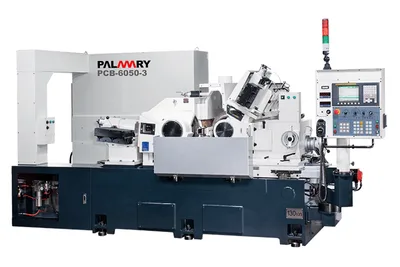
Hardinge Kellenberger H2000

Image: kellenberger.com, Hardinge
Key Specifications
X Travel
Y Travel
Table Size
xy adjustment range
table usable area
table t slots
How much does the Hardinge Kellenberger H2000 cost?
Estimated price range
Our best estimate for a cnc grinding machine in this class — not a quote from Hardinge. Configuration moves it a long way.
Overview
The Kellenberger H2000 is a jig grinding machine with an X/Y adjustment range of 550 x 300 mm (21.7 x 11.8 in) and a 70HS grinding spindle that runs from 8,000 - 70,000 RPM. The table has a usable area of 650 x 400 mm (25.6 x 15.7 in) and carries up to 300 kg (661 lb).
The rows that describe the grinding motion are the ones that separate a jig grinder from other grinders. The spindle orbits at a planetary speed of 1 - 350 rpm while the wheel itself turns at up to 70,000 RPM, and the Z axis can oscillate at up to 10 Hz, which is the stroke used to grind the walls of a bore or a contour over their full depth. Conical grinding is possible up to an angle of 120 degrees, so tapered bores and draft angles are within reach without tilting the part.
Six axes are standard, and the count rises to 8 with the optional rotary table. That option is worth deciding at purchase, because it determines whether features around the circumference of a part can be reached in one clamping. W travel is 450 mm (17.7 in). A spindle range starting at 8,000 RPM also means the 70HS motor is aimed at small and medium wheels; wheels that need lower speed are outside the listed range.
The usable table is larger than the X/Y range in both directions, 650 mm against 550 mm and 400 mm against 300 mm, so a plate that fills the table cannot be reached corner to corner. The T-slot row reads 8, 10 mm. The control is FANUC 30i-B with the WHITE Solution interface, and the machine needs a 2.4 m × 5.4 m footprint and a 400 V / 460 V supply.
Full Specifications
| Parameter | Value |
|---|---|
| Xy Adjustment Range | 550 x 300 mm (21.7 x 11.8 in) |
| Table Usable Area | 650 x 400 mm (25.6 x 15.7 in) |
| Table T Slots | 8, 10 mm |
| Conical Grinding Angle | 120 degrees |
| Spindle 70hs | 8,000 - 70,000 RPM |
| Z Oscillation Frequency | Up to 10 Hz |
| Standard Axes | 6 (optional 8 with rotary table) |
| CNC Control | FANUC 30i-B |
| Floor Space Required | 2.4 m × 5.4 m |
| Power Supply | 400 V / 460 V |
| X-Axis Travel | 550 mm (21.7 in) |
| Y-Axis Travel | 300 mm (11.8 in) |
| Travel W | 450 mm (17.7 in) |
| Table Size | 650 × 400 mm |
| Max Table Load | 300 kg (661 lb) |
| Grinding Spindle Speed | 8,000 - 70,000 rpm (70HS motor) |
| Planetary Speed | 1 - 350 rpm |
| Hmi | WHITE Solution |
Specifications sourced from kellenberger.com — verified 2026-10-03
Strengths & Limitations
Strengths
- 70HS grinding spindle with a range of 8,000 - 70,000 RPM
- Z oscillation at up to 10 Hz and planetary speed of 1 - 350 rpm
- Conical grinding up to an angle of 120 degrees
- 6 axes as standard, with 8 available when the optional rotary table is fitted
- Table load of 300 kg (661 lb) on a 650 x 400 mm (25.6 x 15.7 in) usable area
Limitations
- X/Y range of 550 x 300 mm (21.7 x 11.8 in) is smaller than the 650 x 400 mm (25.6 x 15.7 in) table, so the full table cannot be covered
- The rotary table and the two axes it adds are optional
- Footprint of 2.4 m × 5.4 m is large for the working range
- Only the 70HS spindle is listed; its minimum of 8,000 RPM excludes wheels that need lower speed
Best For
Frequently Asked Questions
01
The X/Y adjustment range is 550 x 300 mm (21.7 x 11.8 in), listed separately as 550 mm (21.7 in) of X travel and 300 mm (11.8 in) of Y travel. W travel is 450 mm (17.7 in). The usable table area is 650 x 400 mm (25.6 x 15.7 in) and the maximum table load is 300 kg (661 lb).
02
The table lists the 70HS motor spindle with a speed range of 8,000 - 70,000 RPM. Planetary speed is 1 - 350 rpm and Z oscillation runs at up to 10 Hz. No spindle power figure is published, and no other spindle option appears in the table.
03
Six as standard. With the optional rotary table the count is listed as 8. If the parts need features ground around their circumference or on several faces, include the rotary table in the quotation, since it is not part of the standard machine.
04
Yes. The table lists conical grinding up to an angle of 120 degrees. Combined with Z oscillation at up to 10 Hz, that covers tapered bores and relief angles in dies and moulds. Check the reachable depth and wheel size for a specific taper with the supplier, because neither is in the table.
05
The control is FANUC 30i-B and the operator interface is listed as WHITE Solution. Footprint is 2.4 m × 5.4 m and the supply is 400 V / 460 V. Machine weight and connected load are not in the table, so ask for the foundation and installation plan.
Videos
Kellenberger