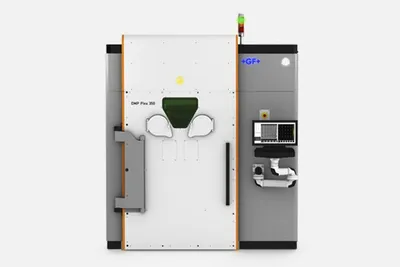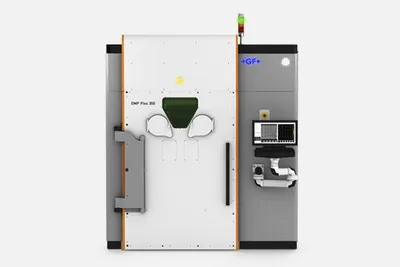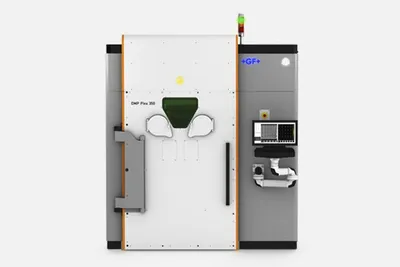
GF DMP Factory 350
Key Specifications
Repeatability
build volume single dual
build volume triple
laser type
laser power
layer thickness
Overview
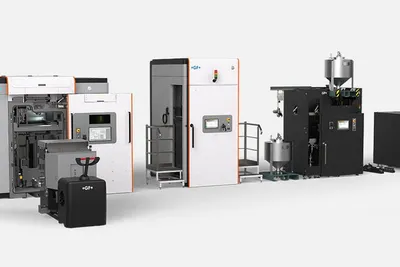
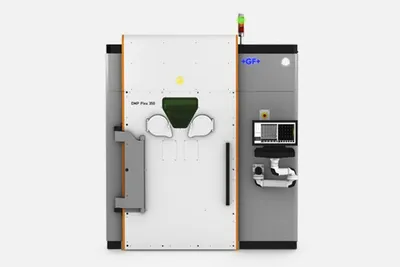
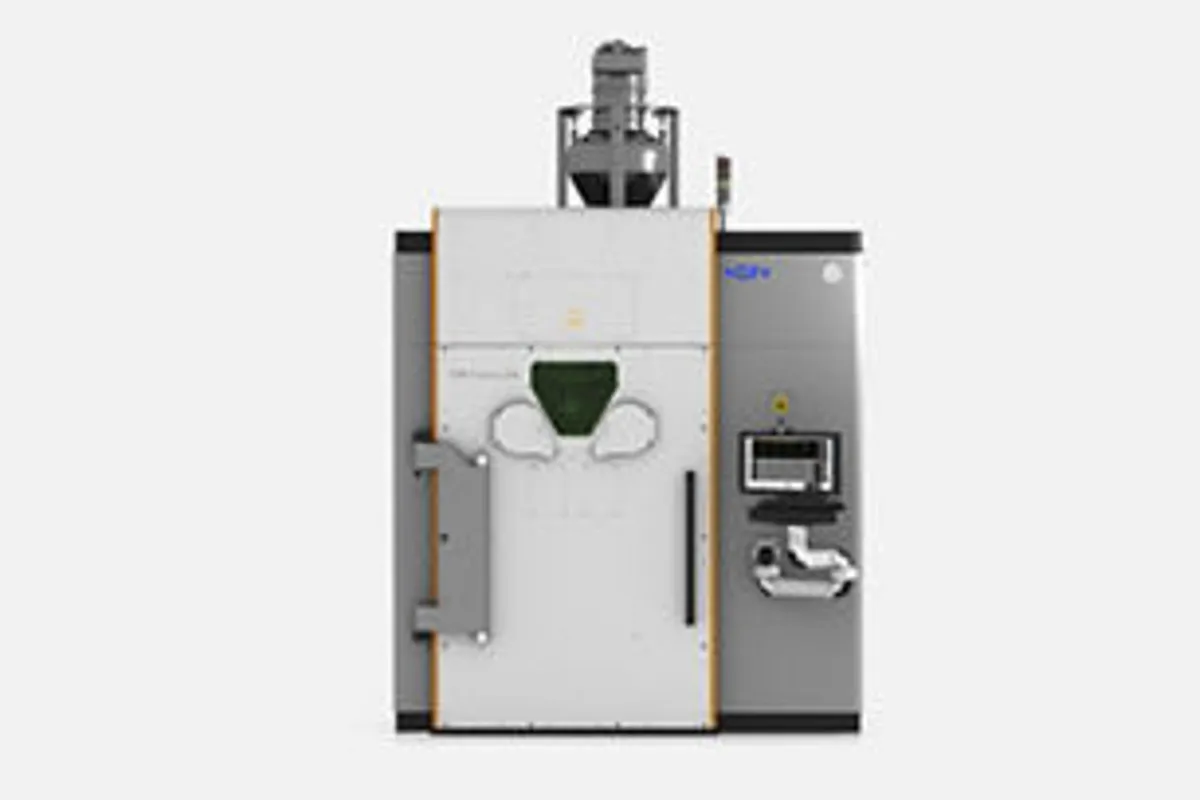
The GF DMP Factory 350 is the production-optimized version of the DMP 350 platform, developed jointly by GF Machining Solutions and 3D Systems for shops running metal additive manufacturing at scale in dedicated material families. Where the DMP Flex 350 emphasizes material changeover flexibility with its removable print module, the Factory 350 adds integrated powder management with high-performance automated sieving and powder conveyance, designed to maximize uptime and throughput in serial production environments.
The build volume matches the Flex 350: 275 x 275 x 420 mm (10.8 x 10.8 x 16.5 in) on single and dual laser configurations, expanding to 350 x 350 x 350 mm (13.8 x 13.8 x 13.8 in) with the triple 500 W laser option. Each laser operates at 1070 nm wavelength with full-field access -- all lasers can reach the entire build area simultaneously without zone restrictions, enabling near-linear throughput scaling regardless of part geometry or nesting arrangement.
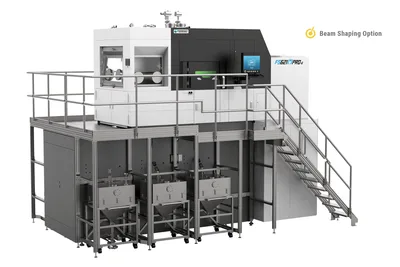
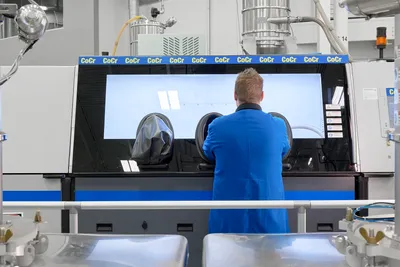
The integrated powder management system is the defining feature. Powder is automatically collected after each build, sieved to specification, and recirculated back to the supply hopper -- all under inert atmosphere. This closed-loop approach minimizes operator exposure to metal powders (critical for reactive materials like titanium), reduces powder waste, maintains consistent powder quality across builds, and eliminates manual handling steps that introduce variability and downtime in production workflows.
Layer thickness spans from 5 um minimum to typical production settings of 30, 60, and 90 um. Accuracy holds at plus or minus 0.1-0.2% with a 100 um minimum, and repeatability is 60 um (3 sigma) in all axes. These specifications are identical to the Flex 350 -- the Factory version doesn't compromise precision for throughput.
The material portfolio covers the same extensive range as the Flex platform: aluminum alloys (AlSi7Mg0.6, AlSi10Mg, Al6061-RAM2, Scalmalloy), titanium grades (Gr1, Gr5, Gr23), stainless steels (316L, 17-4PH), maraging steel, cobalt-chrome (CoCrF75), nickel superalloys (Ni718, Ni625), and specialty materials including tungsten, C-103, and copper alloys. However, the Factory's integrated powder system is optimized for running a single material family -- frequent material changes aren't practical with the built-in powder handling infrastructure.
The machine footprint is slightly taller than the Flex at 2,370 x 2,400 x 3,470 mm to accommodate the integrated powder management hardware. Weight remains 4,200 kg. The 3DXpert software handles build preparation, process simulation, and monitoring.
New DMP Factory 350 systems typically price between $600,000 and $1,000,000 depending on laser count and powder management configuration. The integrated powder system adds a meaningful premium over the Flex variant. Specs sourced from GF Machining Solutions / 3D Systems published technical data.
Full Specifications
| Parameter | Value |
|---|---|
| Build Volume Single Dual | 275 x 275 x 420 mm (10.8 x 10.8 x 16.5 in) |
| Build Volume Triple | 350 x 350 x 350 mm (13.8 x 13.8 x 13.8 in) |
| Laser Type | Fiber laser, 1070 nm wavelength |
| Laser Power | 1x, 2x, or 3x 500 W |
| Layer Thickness | Adjustable, min 5 um; typical 30, 60, 90 um |
| Accuracy | +/- 0.1-0.2% with 100 um minimum |
| Repeatability | 60 um (3 sigma) in X, Y, Z |
| Powder Management | Integrated automated sieving and powder conveyance under inert atmosphere |
| Materials | Aluminum, titanium, stainless steel, maraging steel, cobalt-chrome, nickel alloys, tungsten, niobium (C-103), copper alloys |
| Software | 3DXpert |
| Machine Dimensions | 2,370 x 2,400 x 3,470 mm |
| Machine Weight | 4,200 kg (9,259 lb) |
Specifications sourced from gfms.com — verified 2026-03-28
Strengths & Limitations
Strengths
- Integrated powder management with automated sieving and recirculation under inert atmosphere maximizes uptime and eliminates manual powder handling steps in production workflows
- Closed-loop powder system minimizes operator exposure to hazardous metal powders -- particularly important for reactive materials like titanium and nickel alloys
- Triple laser configuration with full-field access delivers near-linear throughput scaling without zone boundaries, critical for meeting serial production volume targets
- Identical precision specifications to the Flex 350 (60 um repeatability, 5 um minimum layer) -- production optimization doesn't sacrifice accuracy
- Automated powder quality maintenance ensures consistent particle size distribution across hundreds of builds, reducing batch-to-batch variability in part properties
- Same extensive material portfolio as the Flex 350, including specialty alloys (copper, tungsten, C-103) for aerospace propulsion applications
Limitations
- Entry price above $600K with triple laser configurations pushing toward $1M -- significant premium over the Flex variant for the integrated powder management
- Designed for dedicated single-material production -- frequent material changes are impractical with the built-in powder infrastructure, unlike the Flex's swappable modules
- Taller machine footprint (3,470 mm height) due to integrated powder management requires adequate ceiling clearance that some facilities may not have
- Automated powder system adds mechanical complexity and maintenance requirements compared to the simpler manual powder handling on entry-level LPBF systems
- Smaller install base than EOS or SLM Solutions means fewer third-party resources, published studies, and community knowledge specific to this platform
Best For
Frequently Asked Questions
01
New DMP Factory 350 systems typically run $600,000 to $1,000,000 depending on configuration. A single laser system with standard powder management starts near the lower end. The triple 500 W laser configuration with expanded 350 x 350 mm build plate and full monitoring suite pushes toward $1 million. The integrated powder management adds a meaningful premium over the comparable DMP Flex 350 configuration.
02
Choose the Factory 350 if you're running production volumes in one or two dedicated materials and want automated powder management for maximum uptime and consistency. Choose the Flex 350 if you run multiple different alloys and need the removable print module for quick material changeover. The Factory costs more but pays back through reduced operator intervention, better powder quality control, and higher machine utilization in dedicated production. The Flex is better for R&D, prototyping shops, and multi-material bureaus.
03
After each build, unused powder is automatically collected, conveyed to a sieving station, sieved to remove oversized particles and spatter, and returned to the supply hopper -- all under inert atmosphere (nitrogen or argon). This closed loop maintains consistent powder quality without operator intervention, prevents oxygen pickup on reactive powders like titanium, and provides traceability data on powder usage and recycling. The system tracks powder lot history for quality documentation required in regulated industries.
04
You can, but it's not designed for frequent changeover. The integrated powder management system needs to be thoroughly cleaned when switching materials, which can take hours to days depending on the material pair and contamination sensitivity. For shops that need to run multiple materials regularly, the DMP Flex 350 with its removable print modules is the better choice. The Factory 350 is optimized for running one material family at production volume.
05
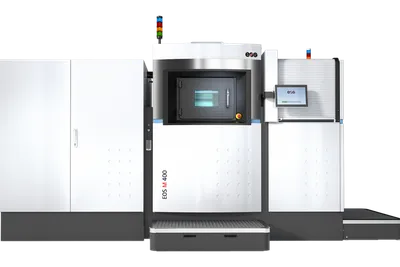
Both are multilaser LPBF systems targeting production. The EOS M 300-4 offers four 400 W lasers in a 300 x 300 x 400 mm build volume with full-field access. The DMP Factory 350 provides three 500 W lasers in a 350 x 350 x 350 mm volume (triple config). The DMP Factory 350 has higher per-laser power and broader material qualification including copper and refractory metals. EOS has a significantly larger install base, more published parameters, and broader ecosystem. Both have integrated powder management for production use.
06
The machine includes layer-by-layer imaging for post-build analysis and process monitoring through the 3DXpert software platform. Powder bed quality is monitored to detect recoating anomalies. The automated powder management provides traceability data including sieve records and lot tracking. For full in-process melt pool monitoring comparable to what some competitors offer, check with GF/3D Systems on current monitoring module availability as this capability continues to evolve across the DMP platform.
Videos
United Machining (USA)
3D Systems
United Machining (USA)
Community Discussions
Troubleshooting and problem-solving — AgieCharmille Cut E 350 - Cutting Issue ...
Capabilities and material handling — UMC-350 stuck in restricted zone | Practical ...
Comparison and buying advice — GF Charmilles Cut C350 - Practical Machinist
Community discussion — CNCzone.com - CNC Machines, CadCam, Classifieds, Metalworking ...
Troubleshooting and problem-solving — Need Help! GF Machining Agie CUT Error Messages
Community discussion — CNCzone.com- Largest Forums for CNC Professional and Hobbyist ...
Troubleshooting and problem-solving — Problem G71 TYPE II CANNED CYCLE, I'M CONFUSED! - CNCzone
Pricing and buying discussion — I did the thing with the thing. : r/Machinists - RedditBest and worst CNC machines and brands you've ever used ...Anyone know how to clear This? : r/Machinists - RedditWhat are the best machining companies in the U.S. - RedditGrob 150 / 350 : r/Machinists - RedditShop
Community discussion — Best and worst CNC machines and brands you've ever used ...
Community discussion — Anyone know how to clear This? : r/Machinists - Reddit
Community discussion — What are the best machining companies in the U.S. - Reddit
Links to community discussions. Summaries are editorial — visit the original thread for full context.