Industrial CNC Machine Directory

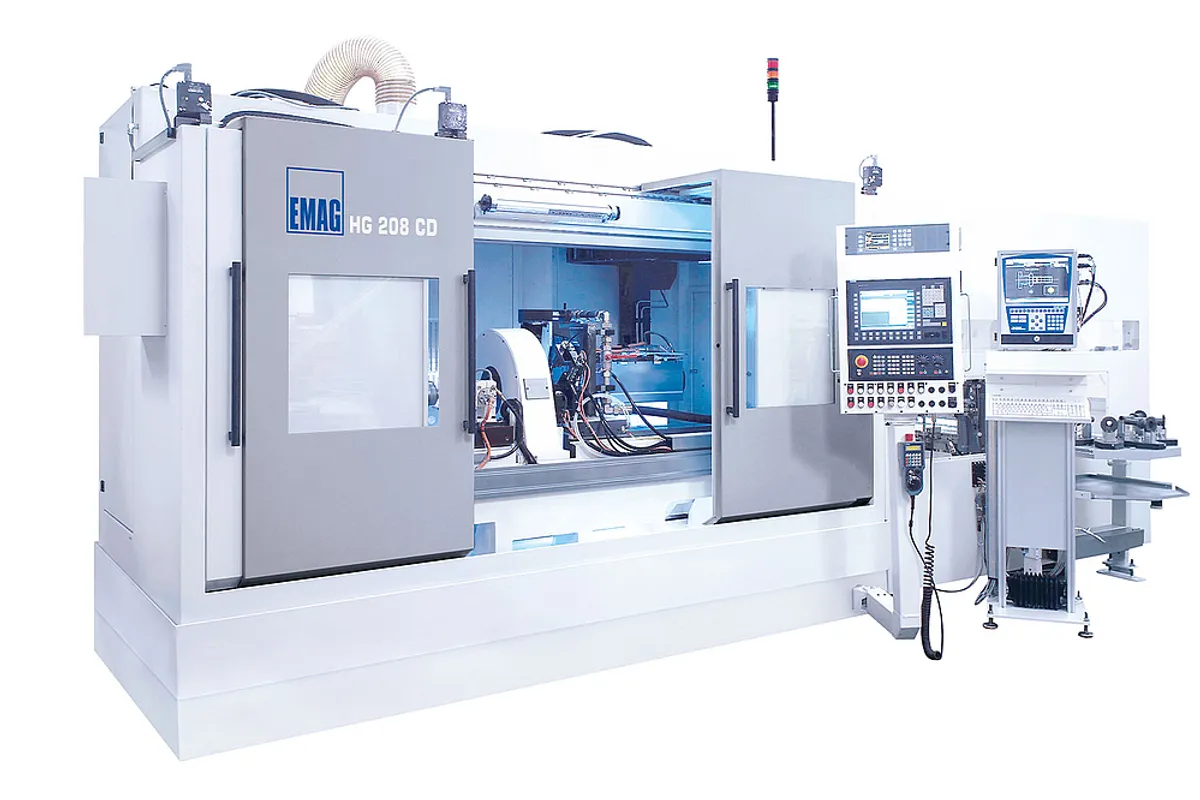
EMAG EMAG HG 208 CD

$500,000 - $800,000 Updated 2026-03-19
EMAG EMAG HG 208 CD CNC Grinding Machines
01

Key Specifications

Max Workpiece ⌀

100 mm (3.9 in)

max workpiece length

400 mm (15.7 in)

x axis travel

mmin

z axis travel

mmin

compound slides

2 (dual compound with independent B-axes)

internal grinding spindles

2

02

Overview

The EMAG HG 208 CD is a specialized dual-compound-slide CNC cylindrical grinder designed for simultaneous bore and outer diameter grinding of chucked components up to 100 mm in diameter and 400 mm in length. The CD designation stands for Compound Duo — the machine features two compound slides, each equipped with a B-axis, carrying a total of two internal and two external grinding spindles. This unique configuration enables simultaneous grinding of bore and OD surfaces in a single clamping, dramatically reducing cycle times on components that require both operations.

The machine provides 380 mm of X-axis travel and 600 mm of Z-axis travel, with the compact work envelope reflecting its focus on chucked parts rather than long shaft components. Unlike the standard HG 208 which handles shaft work up to 800 mm, the HG 208 CD’s 100 mm diameter and 400 mm length capacity is optimized for bearing rings, gear components, hydraulic valve bodies, and similar precision parts where concentricity between bore and OD is the critical quality parameter.

The dual-compound-slide architecture means two grinding operations happen simultaneously — while one slide grinds the bore, the other grinds the OD. This parallelization can cut cycle times by 30-50% compared to sequential grinding on a single-slide machine. Each compound slide independently positions its B-axis for optimal grinding approach angles, and the absolute measuring systems with linear glass scales across all axes ensure positioning accuracy on both slides simultaneously.

The HG 208 CD includes the full complement of EMAG production grinding features: in-process gauging control for OD and shoulder position verification, contact and crash recognition, automatic wheel balancing, and an NC tailstock with extended stroke. Large access doors provide operator convenience for setup and wheel changes.

New EMAG HG 208 CD machines typically price between $500,000 and $800,000 depending on configuration and automation options.

03

Full Specifications

Parameter Value
Max Workpiece Diameter 100 mm (3.9 in)
Max Workpiece Length 400 mm (15.7 in)
X Axis Travel mmin
Z Axis Travel mmin
Compound Slides 2 (dual compound with independent B-axes)
Internal Grinding Spindles 2
External Grinding Spindles 2
Measuring System Absolute glass scales in all axes
In Process Gauging OD and shoulder position control
Crash Recognition Contact and crash detection system
Wheel Balancing Automatic balancing unit
Tailstock NC-controlled with extended stroke
Grinding Media Corundum or CBN
CNC Control CNC (FANUC or Siemens)
Workpiece Dia Max mmin
Workpiece Length Max mmin

Specifications sourced from emag.com — verified 2026-03-28

04

Strengths & Limitations

Strengths

  • Dual compound slides with independent B-axes enable simultaneous bore and OD grinding cutting cycle times by 30-50% compared to sequential single-slide grinding
  • Four total grinding spindles (2 internal + 2 external) provide maximum flexibility for complex multi-surface grinding in a single clamping
  • Simultaneous OD/ID grinding in one setup guarantees concentricity between bore and outer diameter impossible to achieve with separate machines
  • In-process gauging on both slides ensures dimensional accuracy is maintained during parallel grinding operations
  • Absolute glass scale measuring across all axes maintains positioning accuracy on both compound slides independently
  • Compact 600 mm Z-axis travel reflects the focused design for chucked parts minimizing unnecessary machine size and floor space

Limitations

  • 100 mm maximum workpiece diameter limits the machine to small chucked components not suitable for larger bearing rings or gear blanks
  • Premium pricing of $500K-$800K for the dual-compound-slide architecture requires very high production volumes to justify over simpler single-slide alternatives
  • Dual-slide process development is significantly more complex than single-slide grinding requiring experienced grinding engineers for setup and optimization
  • 400 mm maximum workpiece length restricts the machine to shorter chucked parts as shaft work requires the standard HG 208
05

Best For

Bearing manufacturers grinding inner rings where concentricity between bore and OD raceway is critical and simultaneous grinding ensures optimal runout Automotive component producers grinding transmission gear rings, synchronizer sleeves, and similar chucked parts requiring both OD and bore finishing Hydraulic valve body manufacturers grinding precision bore and OD surfaces simultaneously for tight concentricity on spool valve housings High-volume production facilities where the 30-50% cycle time reduction from simultaneous grinding justifies the premium machine investment Fuel injection component manufacturers grinding nozzle bodies and injector housings where sub-micrometer concentricity between bore and OD is mandatory
06

Frequently Asked Questions

01 What does CD mean in the HG 208 CD designation?

CD stands for Compound Duo, referring to the machine’s two independent compound slides, each with its own B-axis. One slide carries external grinding spindles while the other carries internal grinding spindles, enabling simultaneous bore and OD grinding on chucked components.

02 How does simultaneous grinding improve concentricity?

When bore and OD are ground simultaneously in the same clamping, both surfaces are referenced to the same workholding datum. There is no re-chucking between operations, which eliminates the concentricity error introduced by removing and re-clamping the workpiece.

03 What is the difference between the HG 208 CD and the standard HG 208?

The standard HG 208 is designed for shaft-type components up to 800 mm long with a single-slide multi-spindle B-axis. The HG 208 CD is designed for chucked components up to 100 mm diameter and 400 mm length, with two independent compound slides enabling simultaneous OD and bore grinding.

04 What cycle time reduction can the HG 208 CD achieve?

By grinding bore and OD surfaces simultaneously rather than sequentially, the HG 208 CD typically reduces total grinding cycle time by 30-50%. The exact reduction depends on the balance between OD and bore grinding times.

07

Videos

B 500 – Nass-Schleifband wechseln

B 500 – Nass-Schleifband wechseln

KNECHT Maschinenbau GmbH

08

Related Machines