EMAG G 250
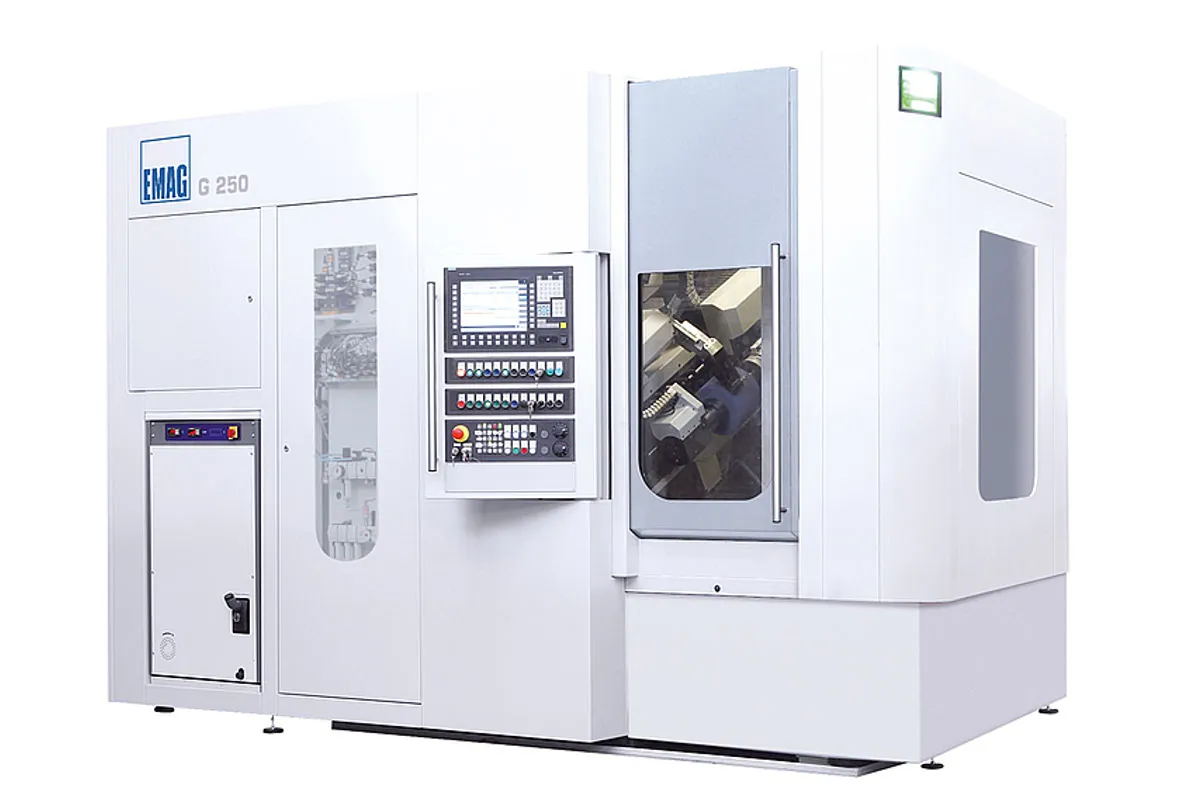
Image: cdn.emag.com, EMAG
Key Specifications
Max Workpiece ⌀
max workpiece length
max face width
helix angle
grinding wheel diameter
grinding spindle speed
How much does the EMAG G 250 cost?
Estimated price range
Our best estimate for a cnc grinding machine in this class — not a quote from EMAG. Configuration moves it a long way.
Overview
The EMAG G 250 grinds gears up to 250 mm (10 in) in diameter and 550 mm (21.5 in) long, across a module range of 0.5 - 7.0 mm and a face width of up to 380 mm (15 in). The helix angle runs to +45 / -45 °, and the control is a Siemens 840 D sl.
The long face width is the figure that separates it from the smaller G 160, which stops at 180 mm (7 in). At 380 mm (15 in) the G 250 can grind wide spur and helical gears and gear sections on shafts, and the 550 mm (21.5 in) workpiece length leaves room for the shaft ends beyond the toothing. The top module of 7.0 mm also takes it into heavier gearing than the 4.0 mm limit of the G 160.
The grinding wheel is 180 mm (7 in) wide and runs at 80 m/s. Its diameter is listed as 170 / 250 mm (6.5 / 10 in) with no label; on the G 160 the equivalent row is given as a maximum and a minimum, which suggests the same reading here, but confirm which is the new-wheel size before ordering wheels. Dressing uses a tool of 120 mm (4.5 in) diameter.
The G 250 HS uses the same 250 mm workpiece diameter, 550 mm (21.5 in) length and 380 mm (15 in) face width, but its table lists a 20,000 rpm grinding spindle and separate generating and profile grinding wheels of 160 / 68 mm and 160 / 30 mm. Where the G 250 table describes one larger wheel at 80 m/s, the HS describes smaller wheels at high spindle speed, so the choice turns on whether the parts have interference contours that only a small wheel can clear.
Full Specifications
| Parameter | Value |
|---|---|
| Max Workpiece Diameter | 250 mm (10 in) |
| Max Workpiece Length | 550 mm (21.5 in) |
| Max Face Width | 380 mm (15 in) |
| Helix Angle | +45 / -45 ° |
| Grinding Wheel Diameter | 170 / 250 mm (6.5 / 10 in) |
| Grinding Spindle Speed | 80 m/s |
| Dressing Tool Diameter | 120 mm (4.5 in) |
| CNC Control | Siemens 840 D sl |
| Module Range | 0.5 - 7.0 mm |
| Grinding Wheel Width | 180 mm (7 in) |
Specifications sourced from emag.com — verified 2026-10-03
Strengths & Limitations
Strengths
- Face width up to 380 mm (15 in), more than twice the 180 mm (7 in) of the G 160
- Module range of 0.5 - 7.0 mm
- Workpieces up to 250 mm (10 in) in diameter and 550 mm (21.5 in) long
- Helix angle of +45 / -45 °
- 180 mm (7 in) wide grinding wheel at 80 m/s
Limitations
- The grinding wheel diameter row, 170 / 250 mm (6.5 / 10 in), is not labelled as maximum and minimum
- No grinding spindle power or accuracy figure is listed
- Parts with tight shoulders next to the teeth may need the smaller wheels of the G 250 HS
Best For
Frequently Asked Questions
01
Up to 250 mm (10 in) in diameter and 550 mm (21.5 in) long, with a face width of up to 380 mm (15 in). The module range is 0.5 - 7.0 mm and the helix angle +45 / -45 °.
02
The workpiece envelope is the same on both: 250 mm diameter, 550 mm (21.5 in) length and 380 mm (15 in) face width. The G 250 HS lists a 20,000 rpm grinding spindle with generating wheels of 160 / 68 mm and profile wheels of 160 / 30 mm. The G 250 lists a 170 / 250 mm (6.5 / 10 in) wheel at 80 m/s.
03
It is larger in every envelope figure. The G 160 takes 160 mm (6.5 in) diameter, 300 mm (12 in) length, 180 mm (7 in) face width and modules of 0.5 - 4.0 mm. The G 250 takes 250 mm (10 in), 550 mm (21.5 in), 380 mm (15 in) and modules of 0.5 - 7.0 mm.
04
A Siemens 840 D sl. The table names the control but lists no software or measuring features, so ask EMAG what is included for the gear data you work with.
More from EMAG
Other CNC Grinding Machines
Schneeberger ARIES
Supertec G20A-30CNC
Voumard 1000
Palmary OCD-4280P
Studer S151