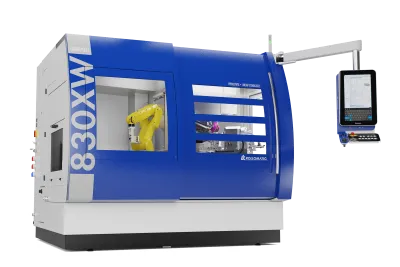
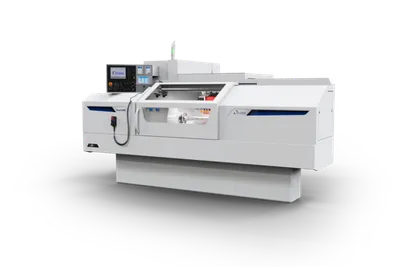
Danobat PP 300
Key Specifications
Accuracy
max workpiece length
max swing
grinding wheel width
grinding wheel diameter
wheel peripheral speed
Overview
The Danobat PP 300 is a CNC peel grinding machine from Danobat Group, built around the high-speed peel grinding process that uses a narrow CBN wheel to grind complex shaft geometries in a single setup through CNC-controlled multi-axis interpolation. Unlike conventional cylindrical grinding where a wide wheel grinds a single diameter at a time, peel grinding uses a wheel typically 3–10 mm wide running at 80–120 m/s to progressively remove material along the shaft profile — including diameters, shoulders, tapers, radii, and undercuts — following a CNC-programmed path analogous to turning, but with abrasive rather than cutting tool. The PP 300 designation indicates a maximum workpiece swing of 300 mm.
Danobat's peel grinding machines are engineered for the automotive and precision engineering markets where complex shaft geometries — gearbox input shafts, steering rack shafts, camshafts, and spline shafts — need to be ground complete in a single clamping. The peel grinding process eliminates the multiple setups traditionally required to grind different diameters, shoulders, and contour features on a complex shaft: all features are programmed in the CNC part program and executed in a single wheel-guided pass sequence. The PP 300 accommodates workpieces up to 700 mm between centers at 300 mm swing — covering the majority of automotive shaft components.
The machine's Siemens 840D sl CNC controls the B-axis wheelhead swivel (for tapers and angular features), X-axis infeed, and Z-axis traverse in coordinated interpolation to execute the programmed shaft geometry. Integrated in-process gauging (Marposs or Renishaw) verifies diameter at critical positions during the cycle. The high-speed CBN spindle at up to 120 m/s enables the specific cutting conditions required for peel grinding — high surface speed with narrow wheel contact generates localized heat that dissipates quickly rather than soaking into the workpiece, enabling higher stock removal rates than conventional grinding.
At $350,000–$600,000, the Danobat PP 300 targets automotive powertrain manufacturers and precision shaft grinders seeking to consolidate multiple grinding operations (OD, taper, shoulder, radius) into a single peel grinding machine. Competitors include the Junker JUCRANK peel grinder, Schaudt Mikrosa, and Studer S41 in the peel/speed stroke grinding segment.
Full Specifications
| Parameter | Value |
|---|---|
| Max Workpiece Length | 700 mm (27.6 in) between centers |
| Max Swing | 300 mm (11.8 in) |
| Grinding Wheel Width | 3 - 10 mm (peel grinding wheel) |
| Grinding Wheel Diameter | 400 mm (15.7 in) max |
| Wheel Peripheral Speed | Up to 120 m/s (CBN) |
| B Axis Swivel | ±30° for taper and angular grinding |
| X Axis Resolution | 0.0001 mm (0.1 µm) |
| Z Axis Resolution | 0.001 mm |
| Workhead Speed | 1 - 1,000 RPM |
| Positioning Accuracy | ±0.002 mm |
| Diameter Tolerance | ±0.003 mm in production |
| Surface Finish | Ra 0.2 - 0.8 µm (peel grinding typical) |
| CNC Control | Siemens 840D sl |
| Machine Weight | ~12,000 kg (26,455 lb) |
| Najnisza Cena | Cena |
| Najwysza Cena | Cena |
| Najnowsze Ogoszenia | Data dodania |
| Najstarsze Ogoszenia | Data dodania |
| Najkrtsza Odlego | odległość |
| Najdalsza Odlego | odległość |
| Najbardziej Aktualny Rok Produkcji | Rok produkcji |
| Najstarszy Rok Produkcji | Rok produkcji |
| Najnowsza Aktualizacja | Aktualizacja |
| Najstarsza Aktualizacja | Aktualizacja |
| Producenci Od A Do Z | producent |
| Producent Od Z Do A | producent |
| Nazwa Od A Do Z | Oznaczenie |
| Nazwa Od Z Do A | Oznaczenie |
| Model Od A Do Z | Model |
| Model Od Z Do A | Model |
| Najnisza Referencja | Referencja |
| Najwysza Referencja | Referencja |
| Najkrtszy Czas Pracy | Okres ważności |
| Najduszy Czas Pracy | Okres ważności |
| Znaczenie | Znaczenie |
| Spindle Bore | 91 mm |
Specifications sourced from machinio.com — verified 2026-03-28
Strengths & Limitations
Strengths
- Peel grinding consolidates all shaft features — OD, shoulders, tapers, radii, undercuts — into a single setup, eliminating multiple machine setups and re-clamping alignment errors
- CBN narrow wheel at 120 m/s enables aggressive stock removal rates competitive with or exceeding turn-grinding for complex shaft geometries
- B-axis wheelhead swivel (±30°) allows taper and angular feature grinding without workpiece repositioning, enabling true single-setup shaft complete grinding
- Siemens 840D sl with coordinated multi-axis interpolation handles complex shaft profiles programmed as geometric profiles rather than axis-by-axis moves
- In-process gauging ensures consistent diameter tolerancing across production batches without manual operator adjustment between parts
Limitations
- Peel grinding is optimized for high-production automotive shaft geometries — the process economics favor volume production rather than small batch or prototype work
- CBN wheel cost and dressing requirements represent higher tooling investment than conventional abrasive grinding in lower-volume applications
- Programming complex shaft profiles in peel grinding requires specialized grinding applications knowledge and CAM or conversational grinding programming software
Best For
Frequently Asked Questions
01
Peel grinding uses a very narrow CBN wheel (3–10 mm wide) running at extremely high peripheral speed (80–120 m/s) to grind complex shaft geometries by following a CNC-programmed path — similar to how a turning tool traces a profile on a lathe, but using an abrasive wheel instead of a cutting tool. Conventional cylindrical grinding uses a wide wheel (40–150 mm) to plunge-grind individual diameters one at a time, requiring the machine to reposition between each feature. Peel grinding eliminates these repositioning stops — the narrow wheel traverses the entire shaft profile in a continuous programmed path, grinding all features (diameters, tapers, shoulders, radii) in one pass sequence. Peel grinding excels for complex shaft profiles but requires CBN tooling and high-speed spindle capability not present on conventional cylindrical grinders.
02
The PP 300 can grind any shaft geometry expressible as a 2D profile in the XZ plane with optional B-axis tilt for tapers: straight OD diameters, stepped diameters, shoulders, tapers (using B-axis swivel), convex and concave radii (CNC interpolated), undercuts, and relief features. Splines and threads cannot be peel-ground (require specialized spline or thread grinding machines). The machine handles workpieces up to 700 mm in length and 300 mm swing, covering most automotive gearbox shafts, steering shafts, and driveline components encountered in passenger car and light commercial vehicle production.
03
The B axis is the rotational axis of the grinding wheelhead — tilting the wheelhead pivots the wheel spindle in the XZ plane, allowing the wheel to approach the workpiece at an angle. For taper grinding, the B-axis swivels the wheel to match the taper angle, enabling the narrow peel wheel to grind the taper face squarely rather than on an edge. For shoulder grinding with undercuts or relief features, B-axis angulation allows the wheel to contact recessed features that a fixed-axis wheel would not reach geometrically. The ±30° B-axis range on the PP 300 covers the majority of taper angles encountered in automotive shaft applications.
04
Peel grinding's narrow wheel contact generates heat in a very small, rapidly moving zone along the workpiece rather than a wide stationary contact zone as in plunge cylindrical grinding. The localized heat dissipates quickly into the surrounding workpiece material and coolant before it can soak into a deep heat-affected zone. This reduces the risk of grinding burn in hardened steel compared to aggressive plunge grinding with a wide wheel. High-speed CBN grinding also changes the chip formation mechanism — at 120 m/s wheel speed, the abrasive grain interaction produces thin chips with lower cutting forces and lower grinding zone temperatures than conventional abrasive at 45 m/s.
05
Cycle time for peel grinding a typical 4-speed gearbox input shaft (5–7 diameter steps, 400 mm length, 30–60 mm diameter range) is typically 3–8 minutes depending on stock removal, number of features, and required surface finish. This compares favorably to the 15–25 minutes required to grind the same shaft on multiple conventional cylindrical grinder setups (setup, grinding, and measurement time for each diameter). The break-even versus conventional grinding in terms of capital investment typically occurs at production volumes above 5,000–10,000 parts per year for complex shafts — below this volume, the flexibility of conventional grinding may be more cost-effective.
Videos

Patrick Thornton

GINDUMAC GmbH

DANOBAT

PRIMEMACHINERY

DANOBAT
Community Discussions
Troubleshooting and problem-solving — Danobat grinding machine - cnczone.com
Comparison and buying advice — Need Help! SYSTEM DATA SAVE - cnczone.com
Community discussion — Newbie Saving probing measurements and comparing to current ...
Community discussion — Need Help! Adv. Posting auger on/off - CNCzone
Troubleshooting and problem-solving — Problems Hard Turning C300 Steel : r/Machinists - Reddit
Community discussion — Polycarbonate speeds/feeds? : r/Machinists - Reddit
Owner experience and review — Water jet recommendations? : r/Machinists - Reddit
Community discussion — Who makes a good drill chuck these days? : r/Machinists - Reddit
Links to community discussions. Summaries are editorial — visit the original thread for full context.