Danobat GS 400
Key Specifications
Accuracy
max workpiece length
max swing
max grinding length
grinding wheel diameter
grinding wheel width
Overview
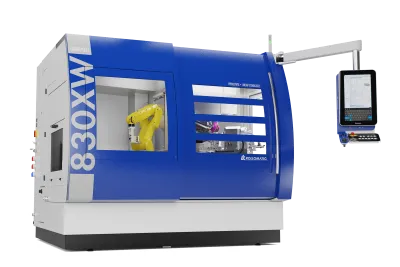
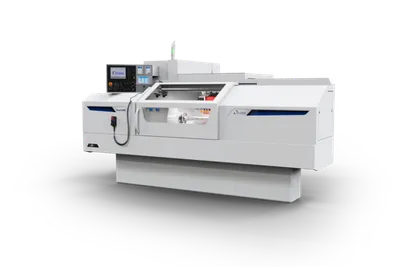
The Danobat GS 400 is a CNC cylindrical grinding machine from Danobat Group, the Basque Country (Spain) precision grinding machine manufacturer with over 60 years of experience in grinding technology. The GS 400 is Danobat's external cylindrical grinding platform designed for high-precision OD grinding of shafts, spindles, and rotational components in automotive, aerospace, and general precision manufacturing. The machine name reflects its 400 mm swing capacity — making it a mid-size cylindrical grinder suited to a broad range of industrial shaft and sleeve grinding applications.
The GS 400 is built on a rigid mineral cast or polymer concrete base that provides exceptional vibration damping and thermal stability — both critical for achieving consistent surface finishes in cylindrical grinding. The machine employs CNC-controlled workhead and tailstock with programmable speeds and positions, enabling multi-diameter shaft grinding programs to be executed fully automatically. Hydrostatic or rolling element guideways on the grinding wheel infeed axis (X) deliver the precise, backlash-free positioning needed for size tolerancing to ±0.002 mm or better.
Danobat equips the GS 400 with either Fanuc 0i-TF or Siemens 840D sl CNC controls, providing operators with conversational programming interfaces suited to both job shop and production environments. Automatic wheel dressing using a diamond dressing unit is integrated into the standard machine, enabling unattended grinding cycles with in-process measurement options available for closed-loop size control. The GS 400 competes with Studer S31, Kellenberger Kel-Varia, and Junker JUCRANK in the mid-range OD cylindrical grinder segment.
At a price range of $180,000–$320,000 new, the Danobat GS 400 offers European-built cylindrical grinding performance at a more competitive price than Swiss United Grinding brands, making it an attractive option for precision manufacturers in the automotive supply chain and aerospace subcontract market seeking a reliable OD cylindrical grinder with strong European technical support.
Full Specifications
| Parameter | Value |
|---|---|
| Max Workpiece Length | 1,000 mm (39.4 in) between centers |
| Max Swing | 400 mm (15.7 in) over table |
| Max Grinding Length | 900 mm (35.4 in) |
| Grinding Wheel Diameter | 500 mm (19.7 in) max |
| Grinding Wheel Width | 100 mm (3.9 in) max |
| Wheel Peripheral Speed | 45 m/s standard, 63 m/s HSK option |
| Workhead Speed | 1 - 400 RPM (stepless) |
| X Axis Resolution | 0.0001 mm (0.1 µm) |
| Z Axis Resolution | 0.001 mm |
| Positioning Accuracy | ±0.002 mm |
| Surface Finish Achievable | Ra 0.05 - 0.4 µm |
| CNC Control | Fanuc 0i-TF or Siemens 840D sl |
| Machine Weight | ~7,000 kg (15,432 lb) |
Specifications compiled from manufacturer literature and industry references. Not independently verified against a published spec sheet — confirm with the manufacturer or an authorised dealer before making a purchasing decision.
Strengths & Limitations
Strengths
- 400 mm swing accommodates a wide range of shaft and sleeve diameters found in automotive driveline, gearbox, and aerospace applications
- Polymer concrete or mineral cast base provides superior vibration damping versus cast iron — directly improves surface finish achievable in continuous production
- Fanuc or Siemens 840D sl control options allow shops standardized on either platform to integrate the GS 400 without operator retraining
- Integrated automatic dressing unit enables unattended grinding cycles and consistent wheel topography throughout long production runs
- Competitive European pricing versus United Grinding (Studer, Kellenberger) brands at equivalent specification levels
Limitations
- Danobat's North American service and applications engineering network is thinner than Studer or Junker — aftermarket support in the US requires planning
- The GS 400 is an OD-focused cylindrical grinder — internal bore grinding capability requires a separate machine or a Danobat universal grinding variant
- Brand recognition among North American precision shops is lower than Swiss or German competitors, which can complicate capital equipment approval processes
Best For
Frequently Asked Questions
01
OD (external) cylindrical grinding machines like the GS 400 are optimized for grinding the outer diameter of shafts and rotational parts held between centers or in a chuck. Universal cylindrical grinders add an internal grinding spindle attachment (ID grinding head) that allows bore grinding in the same machine setup, enabling shops to grind both the OD and ID of a workpiece (such as a bearing ring or sleeve) without re-clamping. The GS 400's OD-focused platform provides a stiffer, simpler grinding configuration optimized for external cylindrical work, while a universal machine trades some OD stiffness for the added flexibility of combined OD/ID grinding.
02
Polymer concrete (also called mineral cast or Granitan) is a composite material made from aggregate bonded with epoxy resin. It offers 8–10x better vibration damping compared to cast iron of equivalent mass, significantly reducing the transmission of external floor vibrations and machine-generated vibrations through the grinding spindle to the workpiece. This damping directly improves achievable surface finish — the grinding wheel stays in continuous, stable contact with the workpiece rather than chattering. Polymer concrete also has lower thermal conductivity than cast iron, reducing temperature-driven dimensional drift during long grinding runs. Most premium European cylindrical grinders use polymer concrete or mineral cast machine bases for these reasons.
03
The GS 400 grinds hardened and unhardened ferrous materials (carbon steel, alloy steel, tool steel, cast iron) and non-ferrous materials (aluminum, brass, bronze) using appropriate wheel specifications. Precision grinding applications typically involve hardened steel (58–64 HRC) such as bearing steel, carburized transmission shafts, and tool steel components. For hardened steel, conventional aluminum oxide or CBN (cubic boron nitride) wheels are used depending on production volume and required surface finish. CBN wheels offer dramatically longer wheel life in high-volume production of hardened steel but require higher wheel cost and proper machine speed and coolant setup.
04
In-process gauging uses a contact gauge (measuring probe) that remains in contact with the workpiece OD during the grinding cycle, continuously measuring the actual diameter being ground and feeding the real-time diameter data back to the CNC control. The control uses this feedback to automatically stop infeed when the target diameter is reached, compensating for wheel wear and machine drift without requiring the operator to manually measure and adjust. The GS 400 supports optional in-process gauging from Marposs, Renishaw, or similar gauge suppliers — this option is strongly recommended for high-volume automotive production where consistent size tolerancing (±0.003 mm or tighter) is required with minimal operator intervention.
05
The Studer S31 (United Grinding Group, Switzerland) is the market-leading mid-size cylindrical grinder in the 1,000 mm center distance class and sets the benchmark for precision, software capability (StuderGRIND), and brand recognition globally. The GS 400 competes at a similar specification level — similar between-center distance, comparable achievable tolerances — at a lower purchase price than the S31. The Studer S31's StuderGRIND programming software is widely regarded as the most capable cylindrical grinding programming environment available, while Danobat relies on Fanuc or Siemens grinding cycles. For North American shops, the Studer/United Grinding service network is considerably stronger. Danobat's advantage is primarily price competitiveness and availability through European automotive supply chains.
Videos

Hirt-Line

Wolfgang Kauls GmbH

DANOBAT

DANOBAT

DANOBAT
Community Discussions
Troubleshooting and problem-solving — Danobat grinding machine - cnczone.com
Community discussion — Fanuc rom files - CNCzone
Community discussion — Need Help! Fanuc 0M number and dripfeed? - CNCzone
Troubleshooting and problem-solving — How to fix servo alarm error - CNCzone
Community discussion — Coolant recommendations : r/Machinists - Reddit
Options and configuration advice — Coolant Replacement Options : r/Machinists - Reddit
Owner experience and review — End mill coatings? : r/Machinists - Reddit
Pricing and buying discussion — What kind of Coolant does your shop use? : r/Machinists - Reddit
Links to community discussions. Summaries are editorial — visit the original thread for full context.