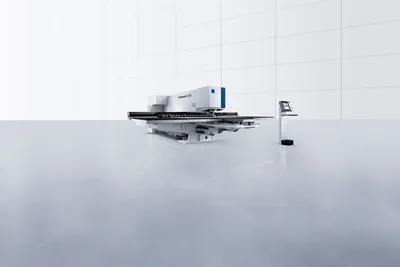
Boschert E-Notch 200
Key Specifications
Accuracy
max punching force
notching capacity steel
notching angle range
notching max depth
working area
Overview
The Boschert E-Notch 200 is a CNC notching and punching center from Boschert GmbH, representing a machine concept that inverts the priority of the Combi series: where the Combi machines are fundamentally punch presses with integrated notching, the E-Notch 200 is primarily a CNC notching machine with punching capability added as a secondary function. The 200 kN (approximately 22-ton) force rating and the E-Notch designation indicate that notching is the primary operation, with punching serving to pre-pierce holes near notched corners and perform simple hole patterns on parts that primarily require notching work.
The E-Notch 200's notching station is the machine's defining feature. Unlike the fixed 90-degree notching stations in the Combi series, the E-Notch 200 offers variable notch angle capability — the notching head can be positioned at multiple angles, enabling V-notches for fold preparation, miter cuts, and non-standard corner preparations beyond the 90-degree limit of fixed notching machines. This variable-angle notching is the key differentiator for applications like decorative metalwork, custom architectural components, sign fabrication, and non-standard structural profiles where 90-degree-only notching creates design limitations.
The punching section of the E-Notch 200 provides basic hole-punching capability alongside the notching operations. With 200 kN force, the punching section handles mild steel up to 5 mm and stainless steel up to 3 mm — sufficient for pilot holes, mounting holes, cable entry knockouts, and simple hole patterns on the same parts being notched. The integration avoids the need to move parts to a separate punch press for simple hole requirements after notching. However, the 200 kN punch force class is not appropriate for high-volume complex punching programs — for those applications, the Combi series or a standalone punch press is more suitable.
Boschert's CNC control on the E-Notch 200 manages both the notching head angle, notch depth, and punching positions in a single NC program. The operator loads the part, and the CNC sequences through all notching operations (at varying angles if programmed) and all punching operations in a single cycle. Variable-angle notching requires the CNC to control a rotary positioning axis on the notching head, which is a more sophisticated control requirement than fixed-angle notching but enables the design flexibility that justifies the E-Notch 200's specialized positioning.
New E-Notch 200 machines are priced in the $120,000 to $200,000 range, reflecting the specialized notching capability with variable angle control and the combined notch-and-punch architecture. This is a niche machine compared to the broader Combi and MAX series — it is the right choice for fabricators whose work demands variable-angle notching, and a poor fit for shops whose work primarily involves high-volume punching with occasional 90-degree notching.
Full Specifications
| Parameter | Value |
|---|---|
| Max Punching Force | 200 kN (22 tons) |
| Notching Capacity Steel | Up to 5 mm mild steel (variable angle notching) |
| Notching Angle Range | Variable (0°-135°, programmable via CNC) |
| Notching Max Depth | 120 mm from sheet edge |
| Working Area | 2,000 x 1,000 mm (79 x 39 in) |
| Max Stroke Rate | 180 strokes/min (punching section) |
| Max Sheet Thickness Punch Steel | 5 mm (0.197 in) mild steel (punching) |
| Max Sheet Thickness Punch Stainless | 3 mm (0.118 in) stainless steel (punching) |
| Drive Type | Hydraulic (notching); servo-electric or hydraulic (punching) |
| Notch Angle | Variable (CNC-controlled rotary axis) |
| Positioning Accuracy | ±0.1 mm (linear axes); ±0.2° (notch angle axis) |
| Traverse Speed | 50 m/min |
| CNC Control | Siemens or Beckhoff CNC with touchscreen |
| Machine Weight | Approx. 7,500 kg (16,535 lbs) |
| Model | K30-120 |
| Brand | BOSCHERT |
| Type | Angle & Bar Shears |
| Capacity 025 | Capacity (L2)7.9" |
| Capacity | 7.9" |
| Listings | (1) |
| Shears Angle Bar | 1 photo |
Specifications sourced from machinetools.com — verified 2026-03-28
Strengths & Limitations
Strengths
- Variable-angle CNC notching enables V-notches, miter preparations, and non-90-degree corner cuts that fixed-angle notching machines cannot produce
- Combined notch-and-punch capability allows hole punching and notching of the same part in a single setup, eliminating part movement between machines
- Specialized notching capability addresses a market gap — variable-angle CNC notching is not available on standard punch presses or fixed-angle notching machines
- CNC control of notch angle and depth enables complex decorative and architectural metalwork profiles that require precise multi-angle notching
- Lower capital cost than a Combi 500 or Combi 700 for shops whose primary requirement is notching rather than high-force punching
Limitations
- 200 kN (22-ton) punch force is entry-level — not suitable for thick-gauge punching, demanding forming operations, or high-volume complex punch programs
- Smaller working area (2,000 x 1,000 mm) versus the Combi series limits sheet size capability for large-format work
- Specialized machine concept means limited secondary market liquidity — the E-Notch 200 is harder to resell than versatile punch presses
Best For
Frequently Asked Questions
01
The key difference is notch angle flexibility. The Combi 500 notching station uses a fixed 90-degree die — it can only cut square corners. The E-Notch 200 uses a CNC-controlled variable-angle notching head that can be positioned at any angle in its range (0-135 degrees), enabling V-notch fold preparations, miter cuts, and non-standard corner geometries. The trade-off is that the E-Notch 200 has lower punch force (200 kN vs 500 kN) and is optimized for notching-first applications.
02
A V-notch is a triangular notch cut into the edge of a sheet before bending, removing material so that when the sheet is folded, the notched edges meet cleanly without overlap. V-notching is used in box-form fabrication to create sharp 90-degree corners without a press brake bend radius, producing crisp corners for display cases, enclosures, and decorative panels. The angle of the V-notch must match the intended bend angle precisely — which is why variable-angle CNC control on the E-Notch 200 is essential for this application.
03
Yes, within its capacity limits. The punching section handles stainless up to 3 mm, and the notching station handles stainless up to approximately 3-4 mm. Stainless steel requires sharper tooling and more notching force per unit thickness than mild steel due to its higher tensile strength. For heavier-gauge stainless notching, the Combi 500 or Combi 700 with their higher-force notching stations are more appropriate.
04
Programming uses the Siemens or Beckhoff CNC control's conversational interface for simple parts, or offline CAD/CAM software for complex programs. Each notch operation requires specifying the sheet position, notch angle, and notch depth. Punching operations are programmed as standard X/Y coordinate positions with tool and depth parameters. The CNC sequences notching and punching operations within a single program. Boschert provides post-processor support for common sheet metal CAD/CAM systems.
05
The E-Notch 200 handles aluminum up to approximately 6-8 mm in the notching station (aluminum's lower shear strength allows thicker material than mild steel), stainless steel up to 3-4 mm, and mild steel up to 5 mm. Copper, brass, and other soft metals within the force limits of the notching station are also processable. Material hardness directly affects notching capacity — high-strength structural steels (S355, S420) require reducing the maximum thickness recommendation for mild steel.
Videos

wismetcom
Ahmed El-Hageen - Comex Co.

Surplex

Quinn Bros Industries Ltd
Community Discussions
Community discussion — benchtop lathe/mill recommendations? : r/Machinists - Reddit
Owner experience and review — What kind of Coolant does your shop use? : r/Machinists - Reddit
Community discussion — Can you guys recommend me a good borescope? :
Owner experience and review — Water jet recommendations? : r/Machinists - Reddit
Links to community discussions. Summaries are editorial — visit the original thread for full context.
Related Machines
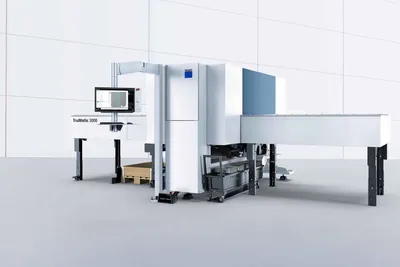
Trumpf TruMatic 3000
Trumpf TruMatic 7000
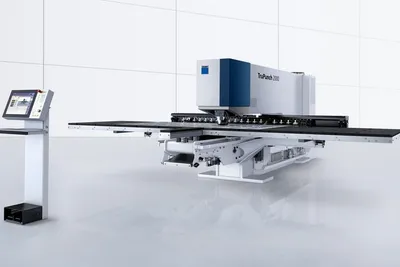
Trumpf TruPunch 2000
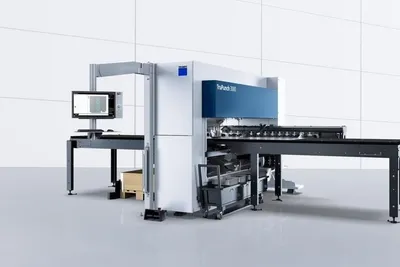
Trumpf TruPunch 3000