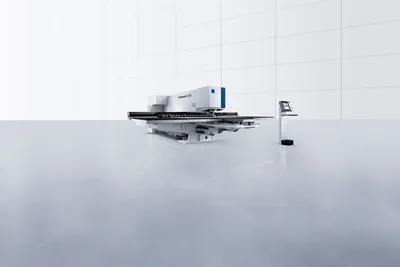
Boschert Combi 700
Key Specifications
Accuracy
max punching force
notching capacity steel
notching max depth
working area
max stroke rate
Overview
The Boschert Combi 700 is a CNC combination punch-and-notch machine from Boschert GmbH, positioned as the heavy-duty model at the top of the Combi series. The 700 designation indicates the 700 kN (approximately 79-ton) punching force — the highest in Boschert's standard Combi lineup — making it the appropriate choice for fabrication operations that regularly work in thick mild steel (up to 10 mm), heavy stainless steel, and large-format structural components where the Combi 500's 500 kN capacity becomes a limiting factor. Like the Combi 500, the Combi 700 integrates a hydraulic punch head with a separate hydraulic notching station in a single CNC machine, allowing both operations to be completed in one setup.
The Combi 700's punch section handles blanking and hole piercing in mild steel up to 10 mm and stainless up to 8 mm — specifications that overlap with heavy hydraulic ironworker territory and address fabrication requirements well beyond typical sheet metal gauge ranges. At 700 kN, the machine is capable of large-diameter blanking in thick material, heavy forming operations in structural sections, and punching applications where smaller machines stall or experience excessive tool wear. The working area of 3,000 x 1,500 mm (118 x 59 in) accommodates large structural sheet and plate sizes, extending the machine's utility beyond standard sheet metal shop work into structural fabrication.
The notching section of the Combi 700 uses a heavy-duty hydraulic notching die rated for 10 mm mild steel at 90 degrees — matching the punch section's heavy-gauge capability. This allows fabricators to complete thick-walled box sections, heavy structural brackets, and large-format enclosure corners without the limitation of a lower-rated notching station. Notch depth from the sheet edge extends to approximately 200 mm in the Combi 700 configuration, accommodating large flanges and deep corner preparations.
Boschert's CNC control on the Combi 700 typically uses a Siemens or Beckhoff platform with a touchscreen HMI. Programming integrates punch sequence and notch sequence in a single NC program — the operator loads the sheet and the machine completes all punching followed by all notching operations (or interleaved as programmed) without manual intervention between stations. For structural fabrication shops, HVAC manufacturers, and heavy enclosure producers, this integration eliminates material handling between a punch press and a separate industrial corner notcher.
New Combi 700 machines are priced in the $250,000 to $380,000 range, reflecting the heavy-duty hydraulic construction, large working envelope, and dual-station architecture. This positions the Combi 700 above the Combi 500 and well above standalone sheet metal punches, targeting structural fabrication shops and heavy industrial manufacturers where the combination of high punch force and heavy-gauge notching capability justifies the investment.
Full Specifications
| Parameter | Value |
|---|---|
| Max Punching Force | 700 kN (79 tons) |
| Notching Capacity Steel | Up to 10 mm mild steel (90° corner notch) |
| Notching Max Depth | 200 mm from sheet edge |
| Working Area | 3,000 x 1,500 mm (118 x 59 in) |
| Max Stroke Rate | 200 strokes/min (punching section) |
| Max Sheet Thickness Steel | 10 mm (0.394 in) mild steel (punching) |
| Max Sheet Thickness Stainless | 8 mm (0.315 in) stainless steel (punching) |
| Tool Stations | 24 (linear rail, automatic selection) |
| Drive Type | Hydraulic (both punch and notch stations) |
| Notch Angle | 90° fixed |
| Positioning Accuracy | ±0.1 mm |
| Traverse Speed | 50 m/min |
| CNC Control | Siemens or Beckhoff CNC with touchscreen |
| Machine Weight | Approx. 18,000 kg (39,683 lbs) |
Specifications compiled from manufacturer literature and industry references. Not independently verified against a published spec sheet — confirm with the manufacturer or an authorised dealer before making a purchasing decision.
Strengths & Limitations
Strengths
- 700 kN (79-ton) punch force handles thick plate and structural steel up to 10 mm mild steel — well beyond standard sheet metal punch press capacity
- Heavy-duty 90° notching station rated for 10 mm mild steel enables thick-walled box section and structural bracket fabrication without a separate industrial notcher
- 3,000 x 1,500 mm working area accommodates large structural sheets and plate sizes beyond standard 2,500 x 1,250 mm sheet metal formats
- Single CNC program sequences both punch and notch operations, eliminating material handling and repositioning between two separate machines
- 24 tool stations allow sufficient tooling variety for structural and heavy enclosure production programs without constant manual tool changes
Limitations
- Fixed 90° notch angle limits notching to standard right-angle corner cuts — non-standard notch angles require separate processing
- Hydraulic drive on both stations means higher energy consumption, noise, and maintenance requirements (fluid, filters, pumps, seals) versus servo-electric alternatives
- At $250K-$380K, the Combi 700 is a significant investment that requires consistent demand for heavy-gauge punch-and-notch work to justify the capital cost
Best For
Frequently Asked Questions
01
The Combi 700 provides 700 kN (79 tons) versus the Combi 500's 500 kN (56 tons) punching force, handles thicker material (10 mm vs 8 mm mild steel punching, 8 mm vs 6 mm stainless), has a larger working area (3,000 x 1,500 mm vs 2,500 x 1,250 mm), and offers a heavier-duty notching station (10 mm vs 6 mm notching capacity). The Combi 700 targets structural and heavy industrial fabrication; the Combi 500 is suited for standard sheet metal and enclosure work in the 1-8 mm range.
02
Yes. Aluminum sheet and plate up to 12-15 mm can be punched with the Combi 700's 700 kN force, and the notching station handles aluminum with ease given its lower shear strength. Aluminum punching requires appropriate clearances (8-12% per side), sharp tooling to avoid smearing, and lubrication to prevent galling. The larger working area accommodates the wider aluminum plates used in transportation and industrial equipment manufacturing.
03
The CNC program contains both punch operation sequences and notch operation sequences. Typically, all punching operations are completed first — the CNC axes position the sheet through all programmed punch locations — and then the sheet is repositioned at the notching station for all corner notch operations. In some programs, intermediate notching between punch sequences is possible. The operator loads the sheet and the machine completes both operation types under full CNC control without manual intervention.
04
The Combi 700 uses Boschert's own heavy-duty single-station punch tooling system, sized for the machine's 700 kN force class. The 24 linear-rail tool stations hold pre-loaded punch-and-die sets that are automatically selected by the CNC. Tool selection from the linear magazine is faster than manual tool change but slower than a rotating turret. Boschert's tooling catalog covers standard round, square, and oblong punch geometries in heavy-gauge specifications, plus forming tools for typical structural features.
05
Yes, and this is one of the Combi 700's distinguishing applications versus standard sheet metal punch presses. At 10 mm punching capacity in mild steel and with a 3,000 x 1,500 mm working area, the machine bridges sheet metal and light structural plate work. Punching plate (as opposed to coil-fed sheet) requires careful support to manage weight and flexure during processing — Boschert offers roller support and outfeed table options for heavy plate handling. Applications include structural connection plates, base flanges, and machine frame components.
Videos

TRUMPFtube

Hesse Maschinen

CleverTools

Boschert México

Logcut
Community Discussions
Troubleshooting and problem-solving — Press brake control - CNCzone
Community discussion — Tigerstop - or alternatives for pushing metal - CNCzone
Troubleshooting and problem-solving — AlphaCam nesting multiple lists - CNCzone
Community discussion — Here is an easy one, Tool Calibration. - CNCzone
Links to community discussions. Summaries are editorial — visit the original thread for full context.
Related Machines
Trumpf TruMatic 3000
Trumpf TruMatic 7000
Trumpf TruPunch 2000
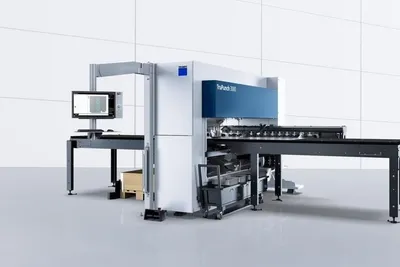
Trumpf TruPunch 3000