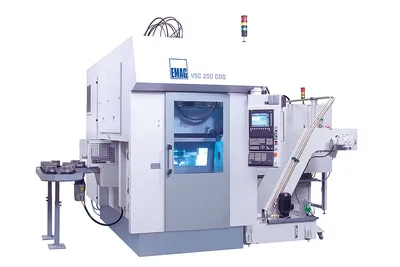
Blohm Orbit 36
This model was not found in Blohm's current lineup when we checked on 2026-10-03 . It may be a superseded or older model; the specifications below are as we last recorded them.
Key Specifications
Max Workpiece ⌀
rotary table diameter
max workpiece height
max workpiece weight
cnc axes
grinding spindle power
How much does the Blohm Orbit 36 cost?
Estimated price range
Our best estimate for a cnc grinding machine in this class — not a quote from Blohm. Configuration moves it a long way.
Overview
The Blohm Orbit 36 is listed as a 5-axis grinding machine for workpieces up to 350 mm (13.8 in) in diameter, 250 mm (9.8 in) high and 150 kg (330 lb). Blohm's current lineup does not include it. The listed figures are unverified and in places inconsistent with each other, so they are a guide to what to ask about a used machine, not a specification to rely on.
The axis rows describe X, Y and Z travels of 600 mm (23.6 in), 350 mm (13.8 in) and 350 mm (13.8 in), an A axis that swivels ±120° and a C axis with 360° continuous rotation, all moved simultaneously. On that description the wheel can be presented to a part from many angles in one clamping, which is what curved or multi-faced ground forms need. The part envelope is tight, though: Y and Z travel are the same 350 mm (13.8 in) as the maximum workpiece diameter, leaving little room for run-in and run-out on a full-size part.
On the wheel side, the maximum grinding wheel diameter is 400 mm (15.7 in) and the maximum peripheral speed 80 m/s. The base is polymer concrete of the Granitan type, and the control is a Siemens 840D sl with the Blohm OP 15 interface.
Two things cannot be settled from the table. It carries more than one power figure, and it lists a table width and length alongside a rotary table diameter. Before travelling to see a machine, ask the seller for the nameplate data and a photograph of the table.
Full Specifications
| Parameter | Value |
|---|---|
| Rotary Table Diameter | 600 mm (23.6 in) |
| Max Workpiece Diameter | 350 mm (13.8 in) |
| Max Workpiece Height | 250 mm (9.8 in) |
| Max Workpiece Weight | 150 kg (330 lb) |
| CNC Axes | 5-axis simultaneous (X, Y, Z, A, C) |
| Grinding Spindle Power | 30 kW (40.2 HP) |
| Max Wheel Peripheral Speed | 80 m/s |
| Max Grinding Wheel Diameter | 400 mm (15.7 in) |
| X Travel | 600 mm (23.6 in) |
| Y Travel | 350 mm (13.8 in) |
| Z Travel | 350 mm (13.8 in) |
| A Axis Swivel | +/- 120° |
| C Axis Rotation | 360° continuous |
| Machine Base | Polymer concrete (Granitan-type) |
| CNC Control | Siemens 840D sl with Blohm OP 15 interface |
| Table W | 11.811" |
| Table L | 39.37" |
| Power | 11.4 hp |
| RPM | 5,000 RPM |
Specifications sourced from machinetools.com — verified 2026-03-28
Strengths & Limitations
Strengths
- 5-axis simultaneous motion on X, Y, Z, A and C, with an A-axis swivel of ±120° and 360° continuous C rotation
- Maximum wheel peripheral speed of 80 m/s with wheels up to 400 mm (15.7 in) in diameter
- Polymer concrete (Granitan-type) machine base
- Siemens 840D sl control with the Blohm OP 15 interface
Limitations
- Workpieces are limited to 350 mm (13.8 in) diameter, 250 mm (9.8 in) height and 150 kg (330 lb)
- Y and Z travel are both 350 mm (13.8 in), no larger than the maximum workpiece diameter
- Not in Blohm's current lineup; the listed figures are unverified and disagree on spindle power and on the table, so neither can be taken from this page
Best For
Frequently Asked Questions
01
The listed limits are 350 mm (13.8 in) in diameter, 250 mm (9.8 in) in height and 150 kg (330 lb) in weight. Travels are listed as 600 mm (23.6 in) in X and 350 mm (13.8 in) in both Y and Z.
02
The table describes 5-axis simultaneous control over X, Y, Z, A and C. The A axis swivels ±120° and the C axis rotates 360° continuously.
03
The maximum grinding wheel diameter is listed as 400 mm (15.7 in) and the maximum wheel peripheral speed as 80 m/s. The table carries conflicting spindle power rows, so take the drive rating from the machine's nameplate.
04
No, it is not in Blohm's current lineup. The listed figures are unverified and some rows contradict each other, so confirm the table, the spindle drive and the axis configuration on any used machine before buying.