Biesse Rover B 7.23
Key Specifications
Max Spindle
Spindle Power
work area x
work area y
work area z
axes
Overview
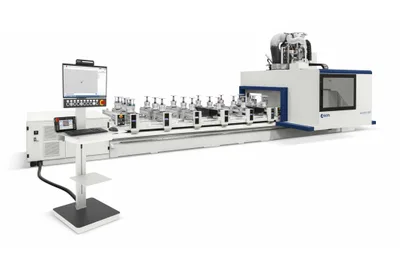
The Biesse Rover B 7.23 is a large-format five-axis CNC machining center from Biesse Group of Pesaro, Italy, combining extended X-axis travel with Biesse's continuous five-axis interpolation spindle for the most advanced panel and solid wood machining capability in the Rover B series. The Rover B is Biesse's premium pod-and-rail platform — above the mid-range Rover C in spindle power, five-axis capability, and construction weight — and the 7.23 configuration designates a 7-meter X-axis and 2,300 mm Y-axis working envelope, making it one of the largest standard CNC machining centers in the industrial wood routing class.
The Rover B 7.23 features Biesse's continuously tilting and rotating electrospindle with full B and C axis interpolation, providing true simultaneous five-axis machining for compound-angle cutting, sculptural surface machining, complex joinery at any orientation, and undercut operations without workpiece repositioning. At the 7-meter format, the machine serves applications where both large-format processing and five-axis capability must coexist — large architectural panels with complex three-dimensional profiles, oversized furniture elements with sculptural detail, and long solid wood components requiring compound-angle joinery along their full length.
Biesse's B_SOLID CNC control and BiesseWorks programming software run the machine, with full five-axis TCP (tool center point) programming support and integration with Alphacam, PowerMILL, and other professional five-axis CAM systems. The Sophia IoT platform provides real-time machine monitoring, predictive maintenance, and integration with factory production management systems. The Rover B 7.23 is suited to the most demanding industrial applications: bespoke yacht interior panel manufacturing, architectural millwork for large-scale commercial installations, high-end custom furniture production, and contract CNC service operations handling the widest range of customer requirements.
At this scale and specification level, the Rover B 7.23 competes with HOMAG's CENTATEQ E series five-axis configurations and SCM's Tech Z5 and Accord 50 FX. Biesse's differentiation is the combination of seven-meter X travel with continuous five-axis capability on a single platform — a configuration not all competitors offer as a standard catalog machine. Pricing for the Rover B 7.23 typically ranges from $280,000 to $550,000 depending on spindle specification, ATC configuration, and automation integration.
Full Specifications
| Parameter | Value |
|---|---|
| Work Area X | Up to 7,300 mm (287 in) |
| Work Area Y | 2,300 mm (90.5 in) |
| Work Area Z | 350 mm (13.8 in) |
| Spindle Motor Power | 14.5 kW (19.4 HP) |
| Max Spindle Speed | 24,000 RPM |
| Axes | 5-axis simultaneous (X, Y, Z, B-tilt, C-rotation) |
| Tool Changer | Up to 30 positions (automatic tool changer) |
| Feed Rate | Up to 90 m/min rapid |
| CNC Control | Biesse B_SOLID (BiesseWorks + five-axis TCP + Sophia IoT) |
| Machine Weight | 12,000 kg (26,455 lb) approximate |
| 400000usd | Sold |
| Pick Up Location | Joplin, MO |
| Make | Biesse |
| Model | 5000 SERIES |
| Serial Number | 17587 |
| Year | 2008 |
| Phase | 3 PHASE |
| Power Requirements | 208-230/460 |
| Load Out Period | See main page for loading dates |
| Estimated Dimensions | See photos and description |
| Estimated Weight | 10,000 Pounds |
| Seller Comment | Seller will disconnect and load onto buyer's flatbed truck/trailer for non-negotiable $500 loading fee. Palletizing, crating or other services may be available at an additional cost. |
| Load Fee | 500 |
| Page Views | 1275 |
| Loading Fee | $500.00 USD |
| Manufacturer | Thermwood |
Specifications sourced from machinio.com — verified 2026-03-28
Strengths & Limitations
Strengths
- Seven-meter X travel combined with continuous five-axis interpolation is a rare combination — enables complex 3D machining of large architectural panels and long structural elements without repositioning
- 14.5 kW spindle provides the cutting force for dense hardwoods and thick composite panels at the large-format scale where lighter spindles would compromise feed rates
- 30-position ATC is one of the largest in the class — sufficient for complex multi-operation programs mixing routing bits, drill aggregates, and profile tools without manual tool changes
- Sophia IoT integration at the machine level provides a foundation for full smart factory connectivity and industry 4.0 production management
- Y-axis of 2,300 mm accommodates extra-wide panels and double-width nested sets beyond standard 2,100 mm format machines
Limitations
- Very high capital cost ($280K–$550K) and large floor footprint require a purpose-built facility and substantial production volume to justify the investment
- Five-axis simultaneous programming complexity demands skilled CNC programmers and significant CAM software investment beyond what standard furniture production requires
- Machine weight (12+ tonnes) and size require purpose-built concrete foundation, overhead crane for installation, and adequate service access clearance on all sides
Best For
Frequently Asked Questions
01
The combination of large format and five-axis is justified in specific industries. In yacht interior manufacturing, cabin panels can be 4–6 meters long with compound curves that follow the hull shape — only simultaneous five-axis machining can follow these surfaces across the full panel length in a single setup. In large-scale architectural installations, 6+ meter decorative panels with profiled edges and three-dimensional surface texture require both the format to process the full panel and the five-axis capability to execute the profiles. In high-end furniture for commercial lobbies and public spaces, oversized pieces with sculptural detail combine format and five-axis requirements. For most standard furniture manufacturing, either large format OR five-axis is sufficient — the Rover B 7.23 is for applications that require both simultaneously.
02
The 14.5 kW spindle on the Rover B 7.23 is significantly more powerful than the Rover C and Rover A series spindles (9–10 kW range). This additional power matters at the large format scale for two reasons. First, long-reach tooling: machining at the far end of a 7-meter table requires longer tool extensions that increase cutting forces — a more powerful spindle maintains speed and torque under these conditions. Second, material range: the Rover B 7.23 is used for composite panels, solid surface materials, and thick hardwoods that demand higher cutting forces than standard 18mm MDF panel work. The higher spindle power also provides thermal headroom for sustained high-feed production runs without spindle overheating.
03
At the 7-meter scale, workholding options include: standard pod-and-rail (suction cups on T-slot rails, positioned to match each workpiece); extended vacuum zones for large flat panel sections; custom fixture systems for curved or non-planar workpieces (cast resin molds for yacht panels, for example); and mechanical clamping for solid wood blanks that cannot seal vacuum cups. For very large panels (7 x 2.3 m MDF — approximately 400+ kg), an overhead vacuum lifter crane is essential for safe loading. Biesse offers automated infeed systems for the Rover B 7.23 to reduce loading time and operator physical effort for large panels. The pod-and-rail design means workholding configuration takes more setup time per part at this scale — automated pod positioning systems (optional) reduce this setup time for production lots.
04
Sophia's predictive maintenance continuously monitors machine sensor data — spindle motor current, bearing temperature, axis drive loads, lubrication system pressures, and vacuum pump performance — and uses trend analysis to detect developing faults before they become failures. Examples: increasing spindle bearing temperature over several weeks indicates bearing wear approaching replacement threshold; gradual increase in axis drive current indicates linear guide or ballscrew wear; vacuum pump performance drop indicates filter blockage. Sophia sends alerts to the operator's smartphone or factory management system with recommended maintenance actions. For a machine investment at the $280K–$550K level, avoiding an unplanned spindle failure (which can cause weeks of downtime and $15,000–$40,000 in spindle repair cost) represents significant financial value from the predictive maintenance data.
05
The fundamental programming tools are the same — BiesseWorks software, Sophia-connected B_SOLID control, and the same integration with Cabinet Vision and Alphacam. The differences arise from scale and five-axis complexity. Long programs for 7-meter panels with many operations can take longer to load and simulate than standard programs. Five-axis programs require tool center point (TCP) verification to ensure the spindle does not collide with the machine frame or workpiece during complex tilt movements — this is automatic in the control but operators need to understand its function. Simulation time for complex five-axis programs in Alphacam or PowerMILL is also longer. For shops transitioning from smaller Biesse machines to the Rover B 7.23, the BiesseWorks familiarity is maintained — the complexity increase comes primarily from the five-axis CAM programming layer.
Community Discussions
Community discussion — Where are the G Code lovers at? : r/Machinists - Reddit
Community discussion — Why would this happen on a swiss type? : r/Machinists - Reddit
Community discussion — Reaming a blind hole : r/Machinists - Reddit
Community discussion — The cnc of my dad (biesse rover a 1542) : r/machining - Reddit
Links to community discussions. Summaries are editorial — visit the original thread for full context.