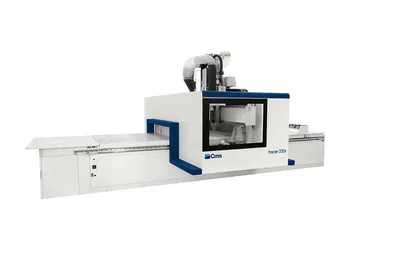
Biesse Brema Vertika 6
This model was not found in Biesse's current lineup when we checked on 2026-10-03 . It may be a superseded or older model; the specifications below are as we last recorded them.
Key Specifications
Max Spindle
Spindle Power
work area x
work area y
work area z
axes
How much does the Biesse Brema Vertika 6 cost?
Estimated price range
Our best estimate for a cnc router in this class — not a quote from Biesse. Configuration moves it a long way.
Overview
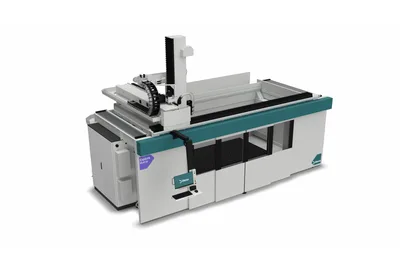
The Biesse Brema Vertika 6 is a vertical drilling and routing machine for panels. The listed figures give a panel length of up to 3,050 mm, a panel height of up to 1,220 mm in the vertical orientation and a panel thickness of up to about 60 mm against a vertical backstop. It is not in Biesse's current lineup, so read this page as a description of an older machine and check each figure against the machine in front of you.
Most of the work is done by fixed multi-spindle drilling heads arranged in 6 rows. Each drilling spindle is listed at 0.5 kW and runs at 2,800 to 3,000 RPM, which is boring speed for hinge, dowel and shelf holes, not routing speed. Three axes are listed: X feeds the panel, Y selects the drilling row and Z sets the depth. The row traverse is up to 25 m/min.
A routing unit of approx. 3 to 5 kW turning at up to 12,000 RPM adds grooves and cut-outs. Its tool change is manual, so a job that needs several cutter profiles stops for each swap. The panel stands on edge instead of lying flat, so the floor area is set by panel length more than by panel height, and the listed weight of approx. 1,800 to 2,400 kg is modest for a machine that takes a panel 3,050 mm long.
Full Specifications
| Parameter | Value |
|---|---|
| Work Area X | Up to 3,050 mm (panel length) |
| Work Area Y | Up to 1,220 mm (panel height in vertical orientation) |
| Work Area Z | Vertical backstop configuration (panel thickness up to ~60 mm) |
| Spindle Motor Power | Routing unit: approx. 3 – 5 kW; drilling spindles: 0.5 kW each |
| Max Spindle Speed | 2,800 – 3,000 RPM (drilling); up to 12,000 RPM (routing) |
| Axes | 3 (X panel feed, Y row selection, Z depth); 6-row drilling configuration |
| Tool Changer | Fixed multi-spindle drilling heads (6 rows); manual tool change for routing unit |
| Feed Rate | Up to 25 m/min (drilling row traverse) |
| Machine Weight | Approx. 1,800 – 2,400 kg |
Specifications compiled from manufacturer literature and industry references. Not independently verified against a published spec sheet — confirm with the manufacturer or an authorised dealer before making a purchasing decision.
Strengths & Limitations
Strengths
- Fixed multi-spindle drilling heads in 6 rows, each spindle listed at 0.5 kW and 2,800 to 3,000 RPM, drill hole patterns without a tool change
- Takes panels up to 3,050 mm long and up to 1,220 mm high, standing against a vertical backstop
- A routing unit of approx. 3 to 5 kW at up to 12,000 RPM adds grooving and cut-outs to the drilling work
- Listed weight of approx. 1,800 to 2,400 kg, far below the 12,000 kg (26,455 lb) approximate listed for the Rover B 7.23
Limitations
- Tool change on the routing unit is manual, so every change of cutter stops the machine
- Routing speed tops out at 12,000 RPM, half the 24,000 RPM listed for the Rover B 7.23, which limits small-diameter cutters
- Panel thickness is limited to about 60 mm and panel height to 1,220 mm
Best For
Frequently Asked Questions
01
The listed figures give a panel length of up to 3,050 mm and a panel height of up to 1,220 mm, with the panel held upright against a vertical backstop. Panel thickness is listed as up to about 60 mm.
02
The drilling side has no tool change during a job: the bits sit in fixed multi-spindle heads arranged in 6 rows, and the Y axis selects the row. The routing unit is different. Its tool change is listed as manual, so the operator swaps the cutter by hand.
03
No, it is not in the current lineup. Anyone looking at a used machine should confirm the panel limits of 3,050 mm and 1,220 mm, the number of drilling rows and whether the routing unit is fitted, since its power is listed only as approx. 3 to 5 kW.