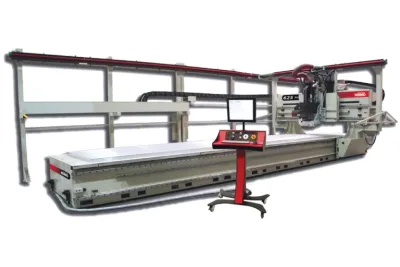
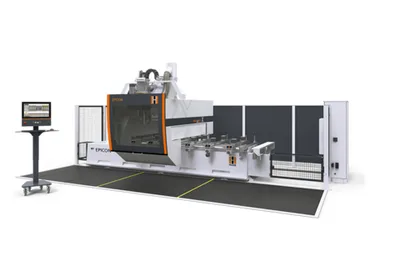
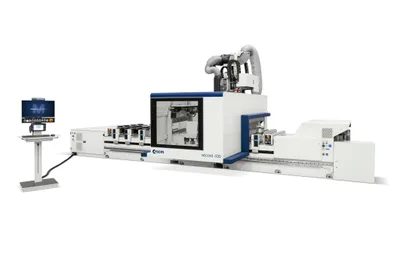
Anderson Genesis 3x
This model was not found in Anderson's current lineup when we checked on 2026-10-03 . It may be a superseded or older model; the specifications below are as we last recorded them.
Key Specifications
Spindle Taper
Rapid Traverse
Spindle Power
machine type
x travel
y travel
How much does the Anderson Genesis 3x cost?
Estimated price range
Our best estimate for a cnc router in this class — not a quote from Anderson. Configuration moves it a long way.
Overview
The Anderson Genesis 3x is listed as a 3-axis CNC router for solid surface fabrication, with 3,050 mm (120 in) of X travel, 1,525 mm (60 in) of Y and 200 mm (8 in) of Z. The model is not in Anderson America's current lineup, so treat this as a page for a possible older machine: the listed figures have not been confirmed with the maker, and a used example should be checked against its own nameplate and manual.
The travels describe a sheet machine. A 120 x 60 in blank sits inside X and Y with nothing to spare, so find out how much of that travel is usable once the cutter radius and any edge stops are counted. With 200 mm (8 in) of Z the work is flat stock: cutouts, pockets and edge profiles fit, thick blocks and deep moulds do not.
The spindle is listed at 11 kW (15 hp) and up to 18,000 RPM on an HSK-63F taper, fed by an automatic 8-position tool changer. That covers a roughing cutter, a finishing cutter and a handful of profile tools, but a shop running many edge profiles will be reloading the changer between jobs. Rapid traverse is 25 m/min (984 ipm). The SELEXX Series is listed at 80 meters/min (3,149”/min) in X and 60 meters/min (2,362”/min) in Y, so repositioning time is where this machine gives ground.
The table is a smooth-face spoilboard with multi-zone vacuum, the control a PC-based CNC with a touch-screen HMI, and the weight is given as approx. 4,200 kg (9,260 lb).
Full Specifications
| Parameter | Value |
|---|---|
| Machine Type | 3-axis CNC router for solid surface fabrication |
| X Travel | 3,050 mm (120 in) |
| Y Travel | 1,525 mm (60 in) |
| Z Travel | 200 mm (8 in) |
| Spindle Speed | Up to 18,000 RPM |
| Spindle Motor Power | 11 kW (15 hp) |
| Spindle Taper | HSK-63F |
| Rapid Traverse Rate | 25 m/min (984 ipm) |
| Tool Changer | Automatic, 8-position |
| CNC Control | PC-based CNC with touch-screen HMI |
| Table | Smooth-face spoilboard with multi-zone vacuum |
| Machine Weight | Approx. 4,200 kg (9,260 lb) |
Specifications compiled from manufacturer literature and industry references. Not independently verified against a published spec sheet — confirm with the manufacturer or an authorised dealer before making a purchasing decision.
Strengths & Limitations
Strengths
- X and Y travels of 3,050 mm (120 in) and 1,525 mm (60 in) take a full 120 x 60 in sheet in one setup
- HSK-63F spindle listed at 11 kW (15 hp) and up to 18,000 RPM
- Automatic 8-position tool changer, so a rough, finish and profile sequence runs without manual changes
- Multi-zone vacuum under a smooth-face spoilboard, so a part-sheet can be held without sealing the whole table
Limitations
- Z travel is 200 mm (8 in), which keeps the machine to sheet and shallow work
- Rapid traverse of 25 m/min (984 ipm) is well below the 80 meters/min (3,149”/min) in X listed for the SELEXX Series
- The changer holds 8 tools, so jobs with many edge profiles need tools swapped by hand between runs
- No accuracy, vacuum pump or power supply figures appear in the table
Best For
Frequently Asked Questions
01
The listed travels are 3,050 mm (120 in) in X and 1,525 mm (60 in) in Y, so a 120 x 60 in sheet matches the travel with no margin. Z travel is 200 mm (8 in). Because travel and sheet size are equal, check on the machine how far the cutter can run past the sheet edge before planning full-perimeter cuts.
02
The listed spindle is 11 kW (15 hp), runs up to 18,000 RPM and takes HSK-63F tooling. It is served by an automatic 8-position tool changer.
03
The table is listed as a smooth-face spoilboard with multi-zone vacuum. Sheets are held by vacuum alone, and the zones let part of the table be shut off for smaller pieces. No vacuum pump size is given, so confirm the pump fitted to a particular machine before planning small parts, where holding force matters most.
04
Machine weight is given as approx. 4,200 kg (9,260 lb), which is the figure to use for rigging and floor checks until the nameplate says otherwise. The control is listed as a PC-based CNC with a touch-screen HMI. The table names no software, so ask what programming package a used machine comes with.
Videos

Lilly Grove Missionary Baptist Church