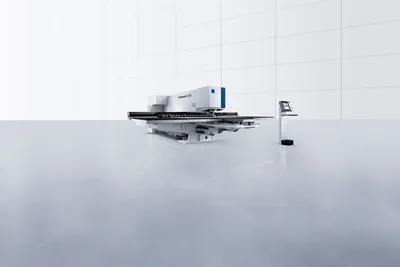
Amada HPN-1003
Key Specifications
Accuracy
punching force
turret stations
max hit rate
max sheet size
max sheet thickness mild steel
Overview
The Amada HPN-1003 is a 30-ton high-speed CNC turret punch press built for production sheet metal fabrication environments that demand maximum throughput. The HPN (High-speed Punch Numeric) series represents Amada's performance-tier punch press platform, featuring a servo-driven ram that delivers significantly faster hit rates than hydraulic equivalents while consuming less energy. At 30 tons of punching force and up to 600 hits per minute, the HPN-1003 targets fabricators running high-volume programs on thin-to-medium gauge mild steel and stainless.
The machine uses a 36-station thick-turret configuration with stations sized for B-station (31.75 mm) and C-station (50.8 mm) tooling. A powered indexing unit allows any station to be rotated to any angle in 0.1-degree increments, enabling complex forms, lance-and-form features, and angled slots without repositioning the sheet. Amada's AMNC-D CNC control manages the servo turret indexing, X-Y axis positioning, and ram stroke in a coordinated motion system designed to minimize dwell time between hits and maximize effective hits-per-minute on real-world programs.
The HPN-1003's servo-electric ram drive is the key differentiator from hydraulic punch presses. Servo drive eliminates the constant-pressure hydraulic pump noise, reduces energy consumption by 50-70% compared to hydraulic machines during normal production, and enables programmable ram speed — operators can set the ram deceleration profile to minimize sheet marking and die vibration on sensitive materials and thin gauges. The servo ram also enables quick-adjust stroke length, reducing cycle time on thin material where full stroke length is unnecessary.
In the turret punch market, the HPN-1003 competes with the Trumpf TruPunch 5000 and the Prima Power Combi Punch. Amada's competitive advantages are the extensive tooling ecosystem (Amada tooling is the most widely available aftermarket tooling globally), the AMNC-D control's programming depth, and the integration with Amada's broader fabrication cell portfolio. Pricing runs $300,000 to $450,000 for base machine configurations.
Full Specifications
| Parameter | Value |
|---|---|
| Punching Force | 30 tons (267 kN) |
| Turret Stations | 36 stations (thick-turret) |
| Max Hit Rate | 600 hits/min (at 1 mm pitch) |
| Max Sheet Size | 1,270 x 4,000 mm (50 x 157 in, with repositioning) |
| Max Sheet Thickness Mild Steel | 6.35 mm (0.25 in) |
| Max Sheet Thickness Stainless | 4.5 mm (0.18 in) |
| X Axis Speed | 120 m/min |
| Y Axis Speed | 80 m/min |
| Positioning Accuracy | ±0.05 mm (±0.002 in) |
| Ram Drive | Servo-electric |
| Turret Indexing | Powered, ±0.1° resolution |
| CNC Control | Amada AMNC-D |
| Machine Weight | 10,000 kg (22,046 lb) |
Specifications compiled from manufacturer literature and industry references. Not independently verified against a published spec sheet — confirm with the manufacturer or an authorised dealer before making a purchasing decision.
Strengths & Limitations
Strengths
- Servo-electric ram drive delivers 50-70% energy savings versus hydraulic punch presses and enables programmable ram speed for damage-free punching on sensitive materials
- 600 hits/min peak rate on dense programs significantly outperforms hydraulic competitors — more parts per shift with the same labor investment
- Industry's largest tooling ecosystem — Amada tooling is available from Amada and dozens of aftermarket suppliers globally, minimizing tooling lead times and costs
- Powered turret indexing with 0.1-degree resolution enables complex angled features and forms without sheet repositioning, expanding part complexity capability
Limitations
- 30-ton capacity limits the machine to thin-to-medium gauge applications — heavy structural punching and thick plate require higher-tonnage machines
- Sheet scratch and marking risk on pre-painted or highly polished surfaces even with servo ram deceleration — delicate finishes may require protective film
- Higher initial cost versus hydraulic punch presses of similar capacity, though servo energy savings typically recover the premium within a few years
Best For
Frequently Asked Questions
01
Servo-electric punch presses use a servo motor to directly drive the ram through a ball screw or crank mechanism, rather than a constant-pressure hydraulic pump. Advantages include 50-70% lower energy consumption (servo only draws power during the actual punch stroke), significantly lower noise levels (eliminating the hydraulic pump constant run), programmable ram speed and deceleration profiles, and faster response times that enable higher hit rates. Maintenance is also simpler — no hydraulic fluid, seals, or pump maintenance required.
02
The HPN-1003 uses a 36-station thick-turret configuration with stations for B-station tooling (31.75 mm max tool diameter) and C-station tooling (50.8 mm max tool diameter). Multiple stations can be fitted with indexable tooling holders that allow the tool to be rotated to any angle, enabling angled slots, louvers, and other directional features without repositioning. Amada's tooling catalog covers thousands of standard punch shapes, and custom tooling is available through Amada's tooling engineering team.
03
The HPN-1003 uses a clamp repositioning (auto-index) system that repositions the sheet clamps without removing the sheet from the machine, enabling processing of sheets longer than the standard X-axis travel. Standard maximum sheet size without repositioning is approximately 1,270 x 2,500 mm. With repositioning, sheets up to 4,000 mm long can be processed. The repositioning is automatic and programmed through the AMNC-D control.
04
Yes. The HPN-1003 is compatible with Amada's AS/R (Automatic Storage and Retrieval) systems and compact automation towers for automatic raw sheet loading and finished part/skeleton unloading. Automation integration enables unattended multi-shift production. The AMNC-D control supports job queuing and automated program scheduling to maximize unattended runtime. Many HPN-1003 installations include a loader for automatic sheet feeding and a conveyor for scrap skeleton removal.
05
The HPN-1003 handles mild steel up to 6.35 mm (1/4 inch) and stainless steel up to 4.5 mm. These limits reflect both the 30-ton punching force capacity and tooling limitations. Punching near the maximum thickness limit requires larger punch-to-die clearances and reduces achievable hole quality. For consistent production punching of thicker materials, a higher-tonnage machine such as the Amada VIPROS 368 or a dedicated heavy punch press would be more appropriate.
Videos

TRICAL New Zealand
evsmetal

clarkmachinery

AMADA MIDDLE EAST FZCO
![AMADA - VPSS Software Workflow [ENG]](https://i.ytimg.com/vi/J_pygQUSh_8/hqdefault.jpg)
CNCMedia
Community Discussions
Troubleshooting and problem-solving — Amada CD2005 Controller HFT 100-3 Issues - Practical Machinist
Capabilities and material handling — Troubles with an Amada saw, the repeat sticks ...
Troubleshooting and problem-solving — AMADA Laser Blanking and Parameter Explorer ...
Community discussion — Used Amada Press Brake controller - Practical Machinist
Pricing and buying discussion — Can you guys explain this please? : r/Machinists - Redditbenchtop lathe/mill recommendations? : r/Machinists - RedditVertical band saw recommendations ? : r/Machinists - RedditWho makes a good drill chuck these days? : r/Machinists - RedditQuiet air compressor recomme
Community discussion — benchtop lathe/mill recommendations? : r/Machinists - Reddit
Pricing and buying discussion — Vertical band saw recommendations ? : r/Machinists - Reddit
Pricing and buying discussion — Quiet air compressor recommendations? : r/Machinists - Reddit
Links to community discussions. Summaries are editorial — visit the original thread for full context.
Related Machines
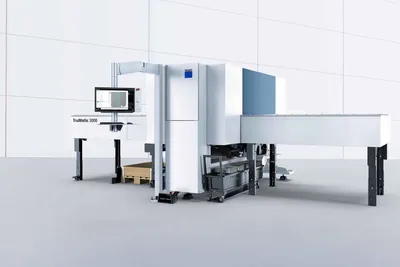
Trumpf TruMatic 3000
Trumpf TruMatic 7000
Trumpf TruPunch 2000
Trumpf TruPunch 3000