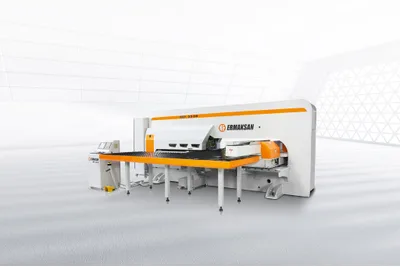
Amada HFB-O 100-3
This model was not found in Amada's current lineup when we checked on 2026-10-03 . It may be a superseded or older model; the specifications below are as we last recorded them.
Key Specifications
punching force
bending force
sheet thickness max
sheet size max
number of tools
hits per minute max
How much does the Amada HFB-O 100-3 cost?
Estimated price range
Our best estimate for a cnc punch presse in this class — not a quote from Amada. Configuration moves it a long way.
Overview
The Amada HFB-O 100-3 is listed as a combined punching and bending machine with approx. 1,000 kN (100 US ton) of punching force and an integrated bending unit, for sheets of approx. 1,000 x 3,000 mm. It is not a model Amada shows in its current lineup, and the listed figures are thin: several rows describe the machine in words where a buyer would want a number.
What is stated with a figure is limited. Sheet thickness runs up to 3.2 mm mild steel for combined punch and bend work, and is material dependent. Machine weight is approx. 12,000 kg. Bending capacity is said to vary by configuration, the turret is described only as multiple station, and the hit rate only as moderate and optimized for the combined punch-bend workflow. Positioning is by a servo-driven X-Y coordinate system, and the control is an Amada AMNC with integrated punch/bend programming.
Anyone looking at a machine under this name should get its nameplate data and tooling list first, because the listed figures do not fix the turret size, the bending force or the speed.
Full Specifications
| Parameter | Value |
|---|---|
| Punching Force | Approx. 1,000 kN (100 US ton) |
| Bending Force | Integrated bending unit (capacity varies by configuration) |
| Sheet Thickness Max | Up to 3.2 mm mild steel (punch+bend); material dependent |
| Sheet Size Max | Approx. 1,000 x 3,000 mm |
| Number of Tools | Multiple station turret (configuration dependent) |
| Hits per Minute Max | Moderate; optimized for combined punch-bend workflow |
| Positioning Speed | Servo-driven X-Y coordinate system |
| CNC Control | Amada AMNC with integrated punch/bend programming |
| Machine Weight | Approx. 12,000 kg |
Specifications compiled from manufacturer literature and industry references. Not independently verified against a published spec sheet — confirm with the manufacturer or an authorised dealer before making a purchasing decision.
Strengths & Limitations
Strengths
- Punching and bending in one machine, with an integrated bending unit
- Approx. 1,000 kN (100 US ton) of punching force
- Amada AMNC control with integrated punch/bend programming
Limitations
- Combined punch and bend work is limited to 3.2 mm mild steel
- The listed figures give no station count, bending force or hit rate
Best For
Frequently Asked Questions
01
The listed figures describe a machine that punches and bends: approx. 1,000 kN (100 US ton) of punching force, an integrated bending unit and an Amada AMNC control with integrated punch/bend programming.
02
Maximum sheet size is approx. 1,000 x 3,000 mm. Sheet thickness is up to 3.2 mm in mild steel for punch and bend work, and depends on the material. Machine weight is approx. 12,000 kg.
Community Discussions
Troubleshooting and problem-solving
Links to community discussions. Summaries are editorial — visit the original thread for full context.