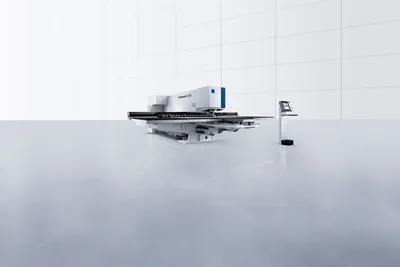
Amada EW-3622
Key Specifications
Accuracy
press force
working length
ram drive
open height
stroke
Overview
The Amada EW-3622 is a servo-electric CNC press brake from Amada's EW series, designed for precision bending of sheet metal parts requiring tight angular tolerances and consistent repeatability across production runs. The EW designation stands for Electric Wing, reflecting the machine's dual servo-motor drive system that independently controls the left and right ram cylinders for active crowning and parallelism compensation without mechanical adjustment. The 3622 designation indicates the 36-ton pressing force and 2,200 mm working length.
The EW-3622's dual servo-electric drive architecture delivers several performance advantages over hydraulic press brakes. The independent left and right drives enable the control system to continuously monitor and correct ram parallelism throughout the bend stroke, compensating for uneven load distribution caused by off-center parts or varying material thickness. This active crowning eliminates the traditional manual crowning table adjustment that hydraulic press brakes require for consistent angles across long bends. The servo drive also enables programmable bending speed — slower approach and punch-through on springback-sensitive materials, faster on robust structural sections.
Amada's AMNC-F control drives the EW-3622 with a database-driven bending parameter system. The control stores material springback compensation values, bend allowances, and tooling geometry for hundreds of material grades and thicknesses, automating the process knowledge that traditionally required experienced operators. The D-value system automatically calculates the required punch depth for a specified bend angle based on material, thickness, and tooling, reducing first-article setup iterations. Back gauge axes (X, R, Z1, Z2) position material accurately for complex multi-bend programs.
The EW-3622 competes with the Trumpf TruBend 3120 and Bystronic Xpert 80 in the mid-range servo-electric press brake segment. For shops heavily invested in the Amada ecosystem, the EW-3622 integrates natively with Amada's AMNC programming environment and V-factory monitoring, simplifying the programming workflow when parts move from an Amada laser or punch press to bending. Pricing runs $200,000 to $300,000, positioning the EW-3622 as a mid-tier servo press brake with premium control and integration capabilities.
Full Specifications
| Parameter | Value |
|---|---|
| Press Force | 36 tons (320 kN) |
| Working Length | 2,200 mm (86.6 in) |
| Ram Drive | Dual servo-electric (independent left/right) |
| Positioning Accuracy | ±0.01 mm (±0.0004 in) |
| Open Height | 430 mm (16.9 in) |
| Stroke | 200 mm (7.9 in) |
| Back Gauge Axes | X, R, Z1, Z2 |
| Back Gauge Speed | 500 mm/sec |
| Active Crowning | Yes (automatic via independent servo drives) |
| Ram Speed Approach | Up to 200 mm/sec |
| Ram Speed Bending | Programmable (1-15 mm/sec) |
| CNC Control | Amada AMNC-F with D-value bending database |
| Machine Weight | 6,500 kg (14,330 lb) |
| E | e |
| Online Order Parts Tooling | Log-in & New Users Registration(opens in new window)Access the Amada Parts Portal for online parts and tooling orders |
| Subscribeview Excerpt | Highlighting AMADA's latest technologies and industry news — all in one convenient email.RegisterView Latest |
Specifications sourced from amada.com — verified 2026-03-28
Strengths & Limitations
Strengths
- Dual independent servo drives provide active crowning and ram parallelism correction throughout each bend stroke — eliminating the manual crowning table setup that consumes setup time on hydraulic machines
- AMNC-F D-value system automates bend angle calculation and springback compensation, reducing first-article iterations and operator skill dependency
- Servo-electric drive eliminates hydraulic oil, seals, and pump maintenance while reducing energy consumption by 50%+ versus hydraulic equivalents
- Programmable ram speed and approach profile enables optimized bending of springback-sensitive materials and delicate finishes without machine modification
Limitations
- 36-ton capacity limits the machine to thin-to-medium gauge and smaller part sizes — heavy structural bending requires higher-tonnage hydraulic or servo machines
- 2,200 mm working length is a moderate capacity — fabricators bending long profiles or large panels need longer bed configurations
- Servo-electric machines have higher initial purchase price than equivalent hydraulic press brakes, though operating cost savings offset this over time
Best For
Frequently Asked Questions
01
The D-value system is Amada's approach to automating bend angle accuracy. The control calculates the exact punch depth (D-value) required to achieve a specified bend angle, accounting for material elastic springback, die opening width, punch radius, and material thickness. Instead of bending and measuring repeatedly to find the correct depth, the D-value system achieves the target angle on the first or second bend. The database includes springback compensation values for hundreds of material grades that Amada has characterized in testing, significantly reducing first-article setup time.
02
Active crowning uses the EW-3622's independent left and right servo drives to compensate for the beam deflection that occurs when press force is applied. In a conventional press brake, the beam bends upward slightly in the center under load — this deflection causes the bend angle to vary across the part length (tighter angle at the ends, more open in the middle). The EW-3622's control monitors ram force and position at both ends and automatically adjusts the left and right positions to maintain uniform punch penetration across the full bending length, resulting in consistent angle without manual crowning table adjustment.
03
Yes. The EW-3622 bends mild steel, stainless steel, aluminum, and other ductile sheet metals within its tonnage capacity. Stainless steel requires approximately 50-60% more bending force than mild steel of equivalent thickness due to its higher tensile strength and greater springback. The D-value system includes stainless steel springback compensation profiles for common grades (304, 316, 430). Maximum stainless steel capacity depends on thickness and part length but is generally around 3 mm at full working length with the 36-ton capacity.
04
The EW-3622 uses Amada's standard segmented tooling system, compatible with both Amada's own tooling catalog and industry-standard European-style punch and die tooling from aftermarket suppliers. Segmented tooling allows the press brake to be set up for a specific bending length by combining tool segments rather than using a single long tool, which simplifies setup and reduces tooling inventory requirements. Amada's quick-change tooling system minimizes changeover time between jobs.
05
The EW-3622 servo-electric drive offers lower energy consumption (draws power only during active bending, not continuously), no hydraulic oil or seal maintenance, better positioning accuracy and repeatability, programmable bending speed profiles, and active crowning through independent drive control. Hydraulic press brakes generally offer higher tonnage per dollar and are often preferred for very heavy structural bending where servo-electric machines become cost-prohibitive at high force levels. For precision fabrication at 36 tons, servo-electric is increasingly the preferred choice.
Videos

Iwana Animations

JigtenYT

Rairdon's Honda of Burien

Stanly Chamber

Investment Property Group - MHC Division
Related Machines
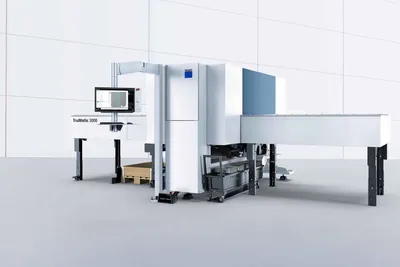
Trumpf TruMatic 3000
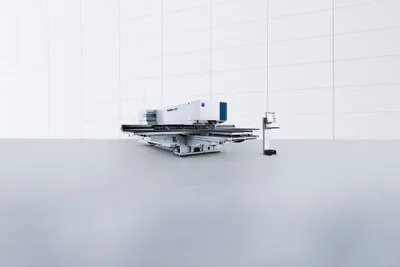
Trumpf TruMatic 7000
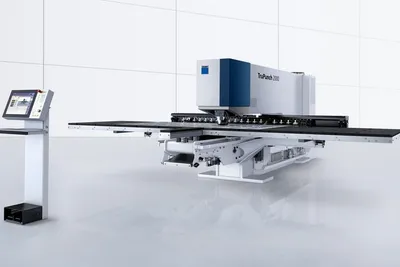
Trumpf TruPunch 2000
Trumpf TruPunch 3000