Amada EM 3612NT
Key Specifications
punching force
punch drive
turret stations
max tool diameter
sheet capacity
sheet thickness mild steel
Overview
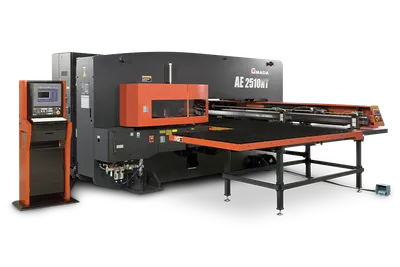
The Amada EM 3612NT is a servo-hydraulic CNC turret punch press from Amada Co., Ltd., headquartered in Isehara, Japan. The EM series represents Amada's standard production turret punch press platform for full-sheet processing, with the 3612NT designation indicating 3-foot (914 mm) Y-axis capacity and 12-foot (3,658 mm) X-axis travel for processing sheets up to 1,270 x 3,660 mm.
The EM 3612NT provides 300 kN (30 tons) punching force with a 45-station turret design including multiple auto-index (AI) stations, large and multi-tool stations. The 45-station capacity significantly exceeds entry-level 25-station machines, enabling complex parts with many punch shapes to be programmed without tool-to-tool setup changes. The servo-hydraulic drive provides programmable punch velocity for forming tool operations while maintaining higher punching force than servo-electric alternatives at similar size.
The EM 3612NT handles full 4 x 12 ft commercial sheets in a single setup, making it particularly effective for shops that work with standard commercial sheet formats without cut-to-size preprocessing. Amada's AP100 programming software integrates with the machine for DXF import, nesting, and automatic tool selection from the defined turret setup.
The EM 3612NT competes with the TRUMPF TruPunch 3000, the Murata Wiedemann Motorum 3048, and the Prima Power Punch Genius in the full-sheet 30-ton punch press class. Amada differentiators are Japanese manufacturing precision, 45-station tooling capacity, and the AP100 software ecosystem with the largest installed base of Amada punch presses in North America. Pricing typically runs $250,000-$500,000.
Full Specifications
| Parameter | Value |
|---|---|
| Punching Force | 300 kN (30 tons) |
| Punch Drive | Servo-hydraulic |
| Turret Stations | 45 stations (with auto-index and multi-tool options) |
| Max Tool Diameter | 88.9 mm in large D station |
| Sheet Capacity | 1,270 x 3,660 mm (50 x 144 in) |
| Sheet Thickness Mild Steel | 0.5-6.0 mm (0.02-0.236 in) |
| Sheet Thickness Stainless | 0.5-4.5 mm (0.02-0.177 in) |
| Sheet Thickness Aluminum | 0.5-6.0 mm (0.02-0.236 in) |
| Positioning Speed X | 90 m/min |
| Max Punch Rate | 550 hits/min (short step) |
| Tapping | Optional tapping unit |
| CNC Control | Amada AP100 CNC programming |
| Machine Weight | 12,000 kg (26,455 lb) |
| Electrical | 400/460 VAC 3-phase 50/60 Hz |
| E | e |
| Online Order Parts Tooling | Log-in & New Users Registration(opens in new window)Access the Amada Parts Portal for online parts and tooling orders |
| Subscribeview Excerpt | Highlighting AMADA's latest technologies and industry news — all in one convenient email.RegisterView Latest |
Specifications sourced from amada.com — verified 2026-03-28
Strengths & Limitations
Strengths
- 45-station turret is among the largest in the production punch press class, minimizing tooling changeovers for complex parts requiring many punch shapes
- Full 4 x 12 ft sheet capacity processes commercial-length sheets without pre-cutting, maximizing material utilization
- 30-ton punching force handles thicker stainless and harder alloys that 20-ton machines cannot punch
- Amada AP100 software is the most widely-trained punch press CAM system in North America, with extensive resources and user community
- Servo-hydraulic drive provides programmable forming tool approach speed with higher force than servo-electric at equivalent machine size
Limitations
- Servo-hydraulic drive requires hydraulic system maintenance (fluid changes, filter replacement, pump inspection) versus maintenance-free servo-electric
- Higher capital cost than 20-25 ton entry-level punch presses - appropriate for shops with production volume justifying the investment
- 30 ton punching force exceeds requirements for most thin-sheet operations - shops primarily processing under 3 mm may be overpaying for force not needed
Best For
Frequently Asked Questions
01
Turret station count determines how many different punch shapes can be mounted and ready for use without changing tooling. At 25 stations: standard setup accommodates round punches (6-8 sizes), rectangular punches (3-4 sizes), square punches (2 sizes), oblong punches (2-3 sizes), and a few forming tools - approximately 20-24 punch types plus 1-5 reserved for the specific part. For parts requiring more punch variety (complex panels with many hole sizes, emboss patterns, multiple louver sizes), tool changes are required mid-job. At 45 stations: most complex panels can be programmed completely without mid-job tool changes. The productivity advantage of 45 stations is greatest on parts with high tooling variety or shops running many different part numbers where re-setup time between jobs is minimized.
02
AP100 is Amada's CAD/CAM software for punch press programming. Workflow: (1) Import DXF part geometry or create part in AP100 CAD; (2) AP100 automatically assigns punch tools from the defined turret setup to features (circles get round punches, rectangles get oblong punches, etc.); (3) Define nesting for multiple parts on a sheet; (4) AP100 generates the punching sequence optimizing tool changes and repositioning; (5) Simulate the sequence to verify; (6) Post-process to the EM 3612NT machine program. AP100 is updated periodically with new capabilities and is compatible with Amada's full punch and laser product line. The AP100 user community is extensive in North America, with training from Amada's North America (headquartered in Buena Park, California) and from independent training resources.
03
Servo-hydraulic (EM 3612NT) vs servo-electric (TRUMPF TruPunch, some Amada models): Servo-hydraulic advantages: higher punching force at equivalent machine size (30 tons vs 20-22 tons for servo-electric in this class); higher force reserve for occasional heavy-gauge operations. Servo-electric advantages: no hydraulic fluid or filter maintenance; quieter operation; faster response for high-speed punching of thin material; generally lower energy consumption. For the EM 3612NT application (production punching of 1.5-6 mm steel with forming operations): the 30-ton servo-hydraulic provides the force margin that thick stainless and harder alloys require. Shops primarily punching 0.5-3 mm mild steel where force is not the constraint might prefer servo-electric for maintenance simplicity.
04
For a standard electrical enclosure back panel (80 holes, 4 louvers, 1,500 x 1,000 mm sheet): cycle time approximately 3-5 minutes including tool changes and repositioning. Output: 12-20 panels/shift. For a simple bracket (25 holes, 600 x 400 mm) with 6 parts per sheet: approximately 40-60 seconds per sheet, 60-90 sheets/shift (360-540 brackets/shift). Simple uniform perforation patterns: up to 8,000-12,000 hits/hour at 550 hits/min short-step rate. The EM 3612NT's 90 m/min axis speed reduces repositioning time versus slower machines, improving throughput on complex parts with many repositioning moves between punch operations.
05
Optional tapping unit for the EM 3612NT: adds a CNC-controlled tapping head that mounts in a designated turret station. The tapping unit pierces and taps threads in one CNC cycle without removing the sheet from the machine. Typical tapping range: M3-M8 (1/8-5/16 NPT equivalent) in mild steel; M3-M6 in stainless. Tapping speed: approximately 600-900 RPM at the tapping spindle. Tapping is most cost-effective for parts requiring many threaded holes (>50 per sheet) where the alternative is secondary tapping operations. For parts with few threaded holes (<10), the setup time for the tapping unit may exceed the benefit. The tapping unit requires specific tooling (tap holders, taps) and periodic maintenance (tap replacement, lubrication).
Videos
Special Products & Mfg., Inc.
RANDY GALVE TV
AMADA GmbH
uksheetmetal
Greg Hamlen
Community Discussions
Community discussion — Press brake talk Trumpf, Amada etc. - Practical Machinist
Community discussion — G-code simulation software for Amada turret punch press and ...
Community discussion — Used Amada Press Brake controller - Practical Machinist
Community discussion — Amada Down-Acting Press Brakes - Practical Machinist
Community discussion — benchtop lathe/mill recommendations? : r/Machinists - Reddit
Community discussion — I took your advice and bought a Mitutoyo : r/Machinists - Reddit
Community discussion — Bench top bandsaw recommendation : r/Machinists - Reddit
Community discussion — End mill coatings? : r/Machinists - Reddit
Links to community discussions. Summaries are editorial — visit the original thread for full context.