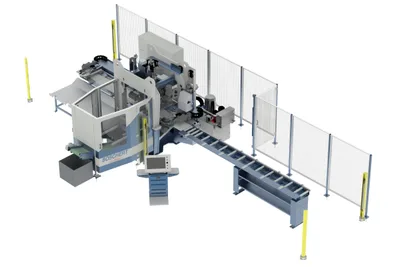
Amada AC 255NT
This model was not found in Amada's current lineup when we checked on 2026-10-03 . It may be a superseded or older model; the specifications below are as we last recorded them.
Key Specifications
punching force
turret stations
max tool diameter
sheet capacity
sheet thickness mild steel
sheet thickness stainless
How much does the Amada AC 255NT cost?
Estimated price range
Our best estimate for a cnc punch presse in this class — not a quote from Amada. Configuration moves it a long way.
Overview
The Amada AC 255NT is a turret punch press listed at 25 tons (222 kN) of punching force with a 48-station turret, 16 of those stations having auto-index rotation. It is not part of Amada's current lineup, which makes this a page for buyers of used machines; confirm the listed figures against the machine itself.
Sheet capacity is 1,270 x 2,540 mm (50 x 100 in), and no-mark repositioning is listed as standard. Thickness runs from 0.5–6.35 mm (0.02–0.25 in) for mild steel and aluminum, and 0.5–4.5 mm (0.02–0.178 in) for stainless. The large station takes tools up to 3.5 in (88.9 mm) across.
The two axes are not equally fast. X positions at 100 m/min (3,937 ipm) and Y at 72 m/min (2,835 ipm), so nests laid out with the long moves along X run quicker. The maximum punch rate is 600 hits/min on a short step. Synchronized tapping up to M12 is listed, which removes a second operation for threaded holes in panels and brackets.
The control is listed as an Amada AMNC controller with Auto Space. The machine weighs 12,000 kg (26,455 lb), and the electrical supply is 208/460 VAC 3-phase 60 Hz, a point to check on any site with a different mains frequency.
Full Specifications
| Parameter | Value |
|---|---|
| Punching Force | 25 tons (222 kN) |
| Turret Stations | 48 stations (16 with auto-index rotation) |
| Max Tool Diameter (full magazine) | 3.5 in (88.9 mm) in large station |
| Sheet Capacity | 1,270 x 2,540 mm (50 x 100 in) |
| Sheet Thickness Mild Steel | 0.5–6.35 mm (0.02–0.25 in) |
| Sheet Thickness Stainless | 0.5–4.5 mm (0.02–0.178 in) |
| Sheet Thickness Aluminum | 0.5–6.35 mm (0.02–0.25 in) |
| Positioning Speed X | 100 m/min (3,937 ipm) |
| Positioning Speed Y | 72 m/min (2,835 ipm) |
| Max Punch Rate | 600 hits/min (short step) |
| Repositioning | No-mark repositioning standard |
| Tapping | Yes (synchronized tapping up to M12) |
| CNC Control | Amada AMNC controller with Auto Space |
| Machine Weight | 12,000 kg (26,455 lb) |
| Electrical | 208/460 VAC 3-phase 60 Hz |
Specifications compiled from manufacturer literature and industry references. Not independently verified against a published spec sheet — confirm with the manufacturer or an authorised dealer before making a purchasing decision.
Strengths & Limitations
Strengths
- 48-station turret with 16 auto-index stations
- Synchronized tapping up to M12 is listed, saving a second operation
- No-mark repositioning is listed as standard
- X axis positions at 100 m/min (3,937 ipm), with a punch rate of up to 600 hits/min on a short step
- Large station accepts tools up to 3.5 in (88.9 mm) across
Limitations
- Stainless capacity stops at 4.5 mm (0.178 in), below the 6.35 mm (0.25 in) listed for mild steel
- Y axis is slower than X at 72 m/min (2,835 ipm)
- Electrical supply is listed as 208/460 VAC 3-phase 60 Hz only
- 25 tons (222 kN) limits large-perimeter punches in thick material
Best For
Frequently Asked Questions
01
48 stations are listed, 16 of them with auto-index rotation. Auto-index stations let a shaped tool be rotated under program control, so one tool can cover a shape used in several orientations. The large station takes tools up to 3.5 in (88.9 mm) across.
02
The listed ranges are 0.5–6.35 mm (0.02–0.25 in) for mild steel, 0.5–4.5 mm (0.02–0.178 in) for stainless and 0.5–6.35 mm (0.02–0.25 in) for aluminum. Punching force is 25 tons (222 kN), so the perimeter of the punch also limits what can be done near the top of each range.
03
Yes. Synchronized tapping up to M12 is listed. Threads are cut in the same setup as the punching, so tapped parts leave the machine without a separate drilling or tapping operation.
04
The listed electrical supply is 208/460 VAC 3-phase 60 Hz. No current or connected-load figure is listed, so read it from the machine's nameplate before sizing the feed. Machine weight is 12,000 kg (26,455 lb).
05
X positions at 100 m/min (3,937 ipm) and Y at 72 m/min (2,835 ipm). The maximum punch rate is 600 hits/min, quoted for a short step between hits; wider hole spacing lowers the rate.
Videos

GINDUMAC GmbH

Exapro

PrestigeEquipment
More from Amada
Other CNC Punch Presses
Salvagnini P2lean
Yawei HPC-2058
TRUMPF TruPunch 2000 S
Salvagnini S4Xe
LVD Strippit VX-1225