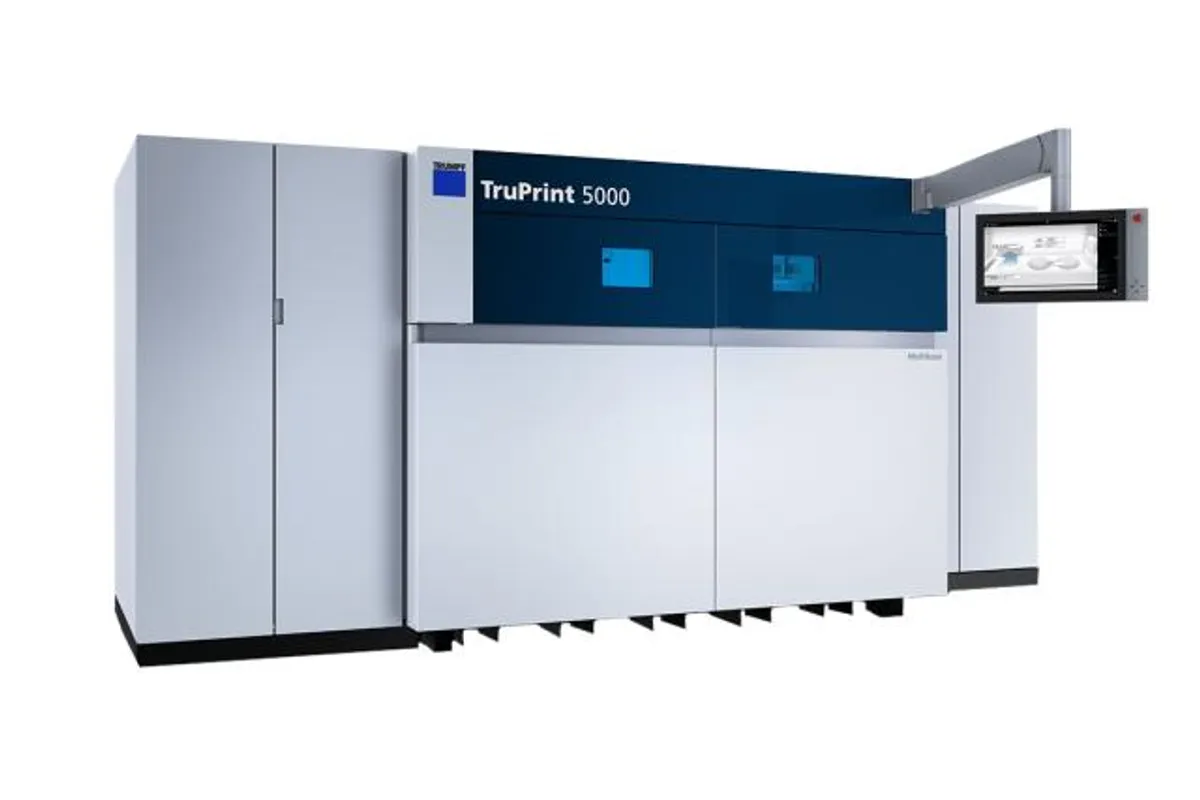
Trumpf TruPrint 5000
ATLIX xBUILD 5000. TRUMPF's additive manufacturing business was carved out as the independent company ATLIX in 2025, and its range now carries the xBUILD name. The xBUILD 5000 is the next-generation machine, with a larger 500 x 500 x 400 mm build volume. (source)
Key Specifications
build volume
laser type
laser power
build rate
layer thickness
preheating
How much does the Trumpf TruPrint 5000 cost?
Estimated price range
Our best estimate for a metal additive manufacturing in this class — not a quote from Trumpf. Configuration moves it a long way.
Overview
The Trumpf TruPrint 5000 is a laser powder bed machine for metal parts, defined by three figures in its listed table: a cylindrical build volume of 300 mm (11.8 in) diameter x 400 mm (15.7 in) height, a laser row of 3x 500 W (Fullfield Multilaser) and preheating up to 500 degrees C. The round build chamber is the first thing to plan around. A rectangular part has to fit inside the 300 mm (11.8 in) circle, so its diagonal decides whether it goes in, not its longest side.
The lasers are Trumpf fiber lasers and the build rate is listed as up to 90 cm³/h (5.5 in³/h). Read that as a ceiling. What a job actually reaches depends on the alloy, on how much of each layer is melted and on the layer thickness, which spans 30 - 150 um (0.0012 - 0.006 in). Thin layers buy detail and surface finish at the cost of hours; the thick end of the range is where the higher rates come from.
Preheating matters most for the crack-prone end of the material list. A hot plate lowers the temperature difference between the melt and the solid metal under it, which reduces the stress built into tool steels and titanium alloys. The listed materials also cover stainless steels, aluminum alloys, nickel-base superalloys, cobalt-chrome and copper alloys, processed under nitrogen or argon.
The remaining rows describe a machine set up for repeat production: automated sieving and recirculation of powder under inert atmosphere, automatic build cylinder exchange, Melt Pool Monitoring on all three lasers, Powder Bed Monitoring and TruTops Print software. For installation the listed figures are approximate, ~4,616 x 2,068 x 2,538 mm (181.7 x 81.4 x 99.9 in) and ~7,500 kg (16,535 lb), on a 400/460 V, 3-phase, 50/60 Hz supply.
Full Specifications
| Parameter | Value |
|---|---|
| Build Volume | Cylindrical: 300 mm (11.8 in) diameter x 400 mm (15.7 in) height |
| Laser Type | Trumpf fiber laser |
| Laser Power | 3x 500 W (Fullfield Multilaser) |
| Build Rate | Up to 90 cm³/h (5.5 in³/h) |
| Layer Thickness | 30 - 150 um (0.0012 - 0.006 in) |
| Preheating | Up to 500 degrees C |
| Inert Gas | Nitrogen or Argon |
| Software | TruTops Print |
| Monitoring | Melt Pool Monitoring (3-laser), Powder Bed Monitoring |
| Powder Management | Automated sieving and recirculation under inert atmosphere |
| Build Cylinder Exchange | Automatic (semi-automated production) |
| Machine Dimensions | ~4,616 x 2,068 x 2,538 mm (181.7 x 81.4 x 99.9 in) |
| Machine Weight | ~7,500 kg (16,535 lb) |
| Electrical | 400/460 V, 3-phase, 50/60 Hz |
Specifications compiled from manufacturer literature and industry references. Not independently verified against a published spec sheet — confirm with the manufacturer or an authorised dealer before making a purchasing decision.
Strengths & Limitations
Strengths
- Three lasers, listed as 3x 500 W (Fullfield Multilaser), with a build rate of up to 90 cm³/h (5.5 in³/h)
- Preheating up to 500 degrees C, which helps with crack-prone tool steels and with distortion in titanium alloys
- Layer thickness adjustable across 30 - 150 um (0.0012 - 0.006 in), so one machine covers fine-detail and high-rate builds
- Automated sieving and recirculation of powder under inert atmosphere, plus automatic build cylinder exchange
- Melt Pool Monitoring on all three lasers and Powder Bed Monitoring are both in the listed table
- Runs under nitrogen or argon across a material list that reaches from aluminum alloys to nickel-base superalloys and copper alloys
Limitations
- The build volume is a cylinder of 300 mm (11.8 in) diameter, so square or rectangular parts lose the corners a box-shaped chamber of the same width would offer
- Build height stops at 400 mm (15.7 in); taller parts have to be reoriented or split
- The 90 cm³/h (5.5 in³/h) build rate is an upper limit, and the listed figures give no rate per material or per layer thickness
- At ~7,500 kg (16,535 lb) and ~4,616 mm (181.7 in) long, floor loading and access need checking, and both figures are only approximate
- The listed table has no rows for laser spot size, accuracy or gas consumption, so those must be asked for before specifying a job
Best For
Frequently Asked Questions
01
The listed build volume is cylindrical: 300 mm (11.8 in) diameter x 400 mm (15.7 in) height. Because the chamber is round, check a rectangular part by its diagonal rather than its width, and remember that supports and any allowance for cutting the part off the plate come out of the 400 mm (15.7 in).
02
The laser power row reads 3x 500 W (Fullfield Multilaser), and the source is a Trumpf fiber laser. The build rate is listed as up to 90 cm³/h (5.5 in³/h). That is a maximum, so expect less on jobs run at the thin end of the 30 - 150 um (0.0012 - 0.006 in) layer range or in alloys that need slower parameters.
03
Laser melting puts a very hot track on top of much cooler metal, and the stress from that difference is what warps parts and cracks hard alloys. Preheating up to 500 degrees C narrows the gap. It is most relevant to the tool steels and titanium alloys on the material list, and less so for stainless steels that build well without it.
04
The material row lists stainless steels, tool steels, aluminum alloys, titanium alloys, nickel-base superalloys, cobalt-chrome and copper alloys. The inert gas is nitrogen or argon. Powder handling is listed as automated sieving and recirculation under inert atmosphere, which keeps reused powder away from air between builds.
05
The listed machine dimensions are ~4,616 x 2,068 x 2,538 mm (181.7 x 81.4 x 99.9 in) and the weight is ~7,500 kg (16,535 lb), both approximate. The electrical supply is 400/460 V, 3-phase, 50/60 Hz. A nitrogen or argon supply is also needed. The table gives no gas consumption or connected load, so get those figures before preparing the site.
Videos

3D Printing Nerd
More from Trumpf
Other Metal Additive Manufacturing
GF Machining DMP Flex 350
DN Solutions DLX 450 D
EOS M 300-1
DMG Mori LASERTEC 30 SLM
SLM Solutions SLM 125