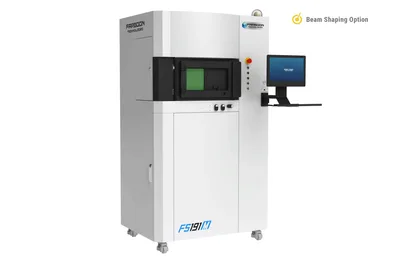
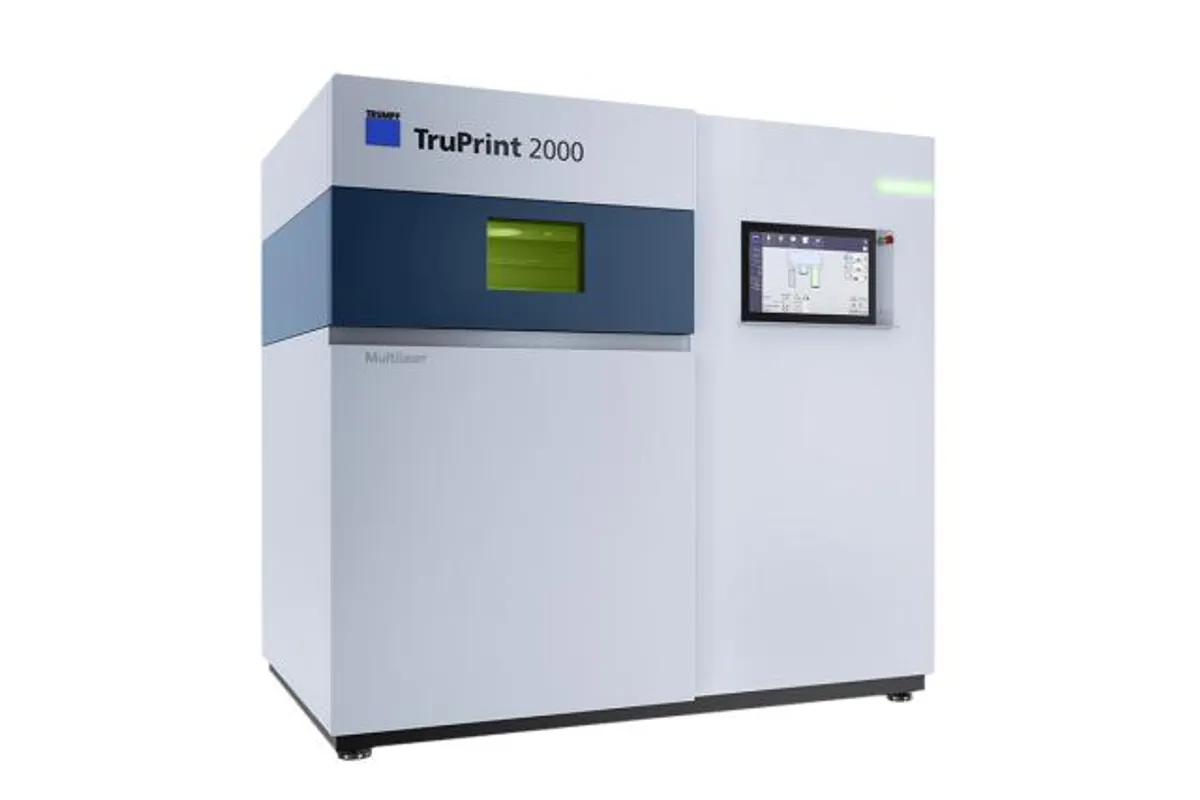
Trumpf TruPrint 2000
ATLIX xBUILD 2000. TRUMPF's additive manufacturing business was carved out as the independent company ATLIX in 2025, and its range now carries the xBUILD name. (source)
Key Specifications
build volume
laser type
laser power
layer thickness
preheating
inert gas
How much does the Trumpf TruPrint 2000 cost?
Estimated price range
Our best estimate for a metal additive manufacturing in this class — not a quote from Trumpf. Configuration moves it a long way.
Overview
The TruPrint 2000 is listed as a metal additive manufacturing machine with a cylindrical build volume 200 mm (7.9 in) in diameter and 200 mm (7.9 in) high. It carries one 300 W Trumpf fiber laser as standard, and the Fullfield Multilaser option brings that to two 300 W lasers.
The row that marks this machine out is powder management. Sieving and recirculation are integrated and take place under inert atmosphere, which means unused powder is recovered inside the machine instead of being handled in open air. That matters for reactive powders such as the titanium and aluminum alloys on the material list, and for the people working around the machine. The inert gas is nitrogen or argon.
Layer thickness is 20 to 100 μm (0.0008 to 0.004 in), and preheating reaches up to 200 degrees C. Besides titanium and aluminum alloys, the listed materials are stainless steels, tool steels, cobalt-chrome and nickel-base alloys. Jobs are prepared in TruTops Print. The monitoring row names Melt Pool Monitoring and Powder Bed Monitoring and marks them optional, so confirm what a specific machine carries.
On site the machine needs about 2,450 x 1,540 x 2,100 mm (96.5 x 60.6 x 82.7 in), weighs about 2,100 kg (4,630 lb) and connects to 400/460 V, 3-phase, 50/60 Hz.
Full Specifications
| Parameter | Value |
|---|---|
| Build Volume | Cylindrical: 200 mm (7.9 in) diameter x 200 mm (7.9 in) height |
| Laser Type | Trumpf fiber laser |
| Laser Power | 1x 300 W (standard) / 2x 300 W (Fullfield Multilaser option) |
| Layer Thickness | 20 - 100 um (0.0008 - 0.004 in) |
| Preheating | Up to 200 degrees C |
| Inert Gas | Nitrogen or Argon |
| Software | TruTops Print |
| Monitoring | Melt Pool Monitoring, Powder Bed Monitoring (optional) |
| Powder Management | Integrated sieving and recirculation under inert atmosphere |
| Machine Dimensions | ~2,450 x 1,540 x 2,100 mm (96.5 x 60.6 x 82.7 in) |
| Machine Weight | ~2,100 kg (4,630 lb) |
| Electrical | 400/460 V, 3-phase, 50/60 Hz |
Specifications compiled from manufacturer literature and industry references. Not independently verified against a published spec sheet — confirm with the manufacturer or an authorised dealer before making a purchasing decision.
Strengths & Limitations
Strengths
- Fullfield Multilaser option gives two 300 W lasers in place of one
- Integrated powder sieving and recirculation under inert atmosphere
- Preheating up to 200 degrees C
- Electrical supply listed for 400/460 V, 3-phase, 50/60 Hz
- Cylindrical build volume of 200 mm (7.9 in) diameter x 200 mm (7.9 in) height
Limitations
- The second 300 W laser is an option; the standard machine has one
- Melt Pool Monitoring and Powder Bed Monitoring are marked optional
- Preheating stops at 200 degrees C
- Parts must fit a 200 mm (7.9 in) diameter, 200 mm (7.9 in) high cylinder
Best For
Frequently Asked Questions
01
One 300 W Trumpf fiber laser is standard. Two 300 W lasers are listed under the Fullfield Multilaser option. Check which configuration a machine has, since the listed figures do not give a build rate for either.
02
Powder management is listed as integrated sieving and recirculation under inert atmosphere. The inert gas is nitrogen or argon. Unused powder is sieved and returned without leaving the inert environment.
03
A cylindrical volume 200 mm (7.9 in) in diameter and 200 mm (7.9 in) in height. Layer thickness is 20 to 100 μm (0.0008 to 0.004 in), and the build can be preheated up to 200 degrees C.
04
The listed supply is 400/460 V, 3-phase, 50/60 Hz. The machine is about 2,450 x 1,540 x 2,100 mm (96.5 x 60.6 x 82.7 in) and weighs about 2,100 kg (4,630 lb). A nitrogen or argon supply is also needed.
Videos

TITANS of CNC MACHINING

TITANS of CNC MACHINING

Icon Machine Tool, Inc.

Ridix S.p.A.
Comparisons
More from Trumpf
Other Metal Additive Manufacturing
GF Machining DMP Flex 350 Triple
DN Solutions DLX 325
EOS M 290
Desktop Metal Studio System+
DMG Mori LASERTEC 30 SLM US