Industrial CNC Machine Directory

Thermwood LSAM-MT (Additive Manufacturing Trim Cell)

$1,500,000 - $4,000,000 Updated 2026-03-17
01

Key Specifications

Print Volume (X × Y × Z)

Up to 10,000 × 3,000 × 1,500 mm (custom)

Deposition Rate

50–100+ kg/hr (material dependent)

Print Head Type

Screw-driven pellet extruder

Materials

CF-ABS, CF-PESU, CF-PEI (Ultem), PPS, PEEK blends

Trimming Axes

5-axis CNC (A/C tilting head)

Trim Spindle Speed

Up to 18,000 RPM

02

Overview

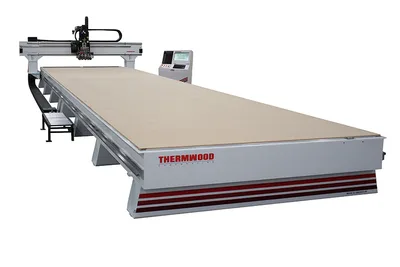
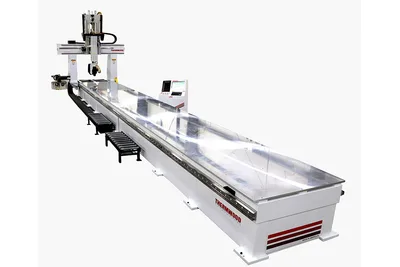
The Thermwood LSAM-MT (Large Scale Additive Manufacturing — Machining Trim) is a hybrid manufacturing system that combines high-rate polymer extrusion additive manufacturing with 5-axis CNC subtractive trimming in a single integrated platform. Developed by Thermwood Corporation in Dale, Indiana, the LSAM-MT represents the industrial production version of Thermwood's large-scale additive technology, designed specifically for the production of near-net-shape aerospace tooling, molds, composite layup tools, and large structural fixtures that would be prohibitively expensive or time-consuming to machine from billet.

The LSAM-MT operates on a dual-gantry principle: one gantry carries the additive print head — a high-output polymer extruder capable of depositing 50–100+ kg of material per hour using reinforced thermoplastic compounds such as carbon fiber-filled ABS, PESU, PEI (ULTEM), and high-temperature PEEK-based blends — while a second gantry carries a 5-axis CNC spindle for in-process and finish trimming of the printed structure. The two gantries operate on a common rail system and can work sequentially or, in some configurations, concurrently on different zones of the same part, dramatically reducing the total time-to-finished-tooling compared to print-then-transfer-to-machine workflows.

The LSAM-MT is engineered around aerospace tooling requirements: the machine's heated print environment and controlled cool-down protocols produce parts with minimized residual stress and predictable coefficient of thermal expansion (CTE). Parts printed in carbon fiber-reinforced ABS or PESU closely match aluminum tooling CTE, making them suitable as layup mandrels, trim fixtures, and drill jigs for composite aircraft structures. Boeing, Airbus, and their Tier 1 suppliers have evaluated and deployed Thermwood LSAM technology for production tooling applications.

The system is controlled by Thermwood's Q-Core CNC platform, which manages both the additive and subtractive processes with a unified G-code interface. The additive process parameters — layer height, bead width, extrusion temperature, platen temperature — are programmed alongside conventional machining toolpaths in a single setup, and Thermwood's slicing and CAM post-processing software generates combined print-and-trim programs from standard CAD models.

03

Full Specifications

Parameter Value
Print Volume (X × Y × Z) Up to 10,000 × 3,000 × 1,500 mm (custom)
Deposition Rate 50–100+ kg/hr (material dependent)
Print Head Type Screw-driven pellet extruder
Materials CF-ABS, CF-PESU, CF-PEI (Ultem), PPS, PEEK blends
Trimming Axes 5-axis CNC (A/C tilting head)
Trim Spindle Speed Up to 18,000 RPM
Trim Spindle Power 11–15 kW (15–20 hp)
Layer Height Range 3–10 mm (bead scale)
Control Thermwood Q-Core (unified additive + subtractive)
Footprint Custom to print volume — systems typically 15–25 m in length
Name Name
Spiders spiders
Readmemd README.md
Itemspy items.py
Middlewarespy middlewares.py
Pipelinespy pipelines.py
Settingspy settings.py
Github Copilot Write better code with AI
Github Spark Build and deploy intelligent apps
Github Models Manage and compare prompts
Mcp Registrynew Integrate external tools
Actions Automate any workflow
Codespaces Instant dev environments
Issues Plan and track work
Code Review Manage code changes
Github Advanced Security Enterprise-grade security features
Code Security Secure your code as you build
Secret Protection Stop leaks before they start
Github Sponsors Fund open source developers
Enterprise Platform AI-powered developer platform
Copilot For Business Enterprise-grade AI features
Premium Support Enterprise-grade 24/7 support
Manufacturer Kentwood

Specifications sourced from machinio.com — verified 2026-03-28

04

Strengths & Limitations

Strengths

  • Hybrid print-and-trim in one system eliminates part transfer and datum re-establishment between additive and machining operations
  • Extremely high deposition rate (50–100 kg/hr) makes large aerospace tooling economically viable compared to machined-from-billet alternatives
  • Carbon fiber-reinforced thermoplastics (CF-ABS, CF-PESU) produce tooling with aerospace-compatible CTE for layup and autoclave applications
  • Unified Q-Core control manages both print and trim programs from a single interface, simplifying operator training and program management
  • Demonstrated deployment by Boeing, NASA, and Tier 1 aerospace suppliers for production tooling validation

Limitations

  • Very high capital cost — entry price exceeds $1.5M, limiting accessibility to large aerospace OEMs and well-capitalized Tier 1 shops
  • Bead-scale layer resolution produces near-net shapes requiring subtractive finishing — not suitable for fine-feature direct-to-use parts
  • High-temperature materials (PEEK, PPS) require advanced extruder hardware and careful thermal management, increasing process complexity
05

Best For

Aerospace tooling fabricators producing large composite layup mandrels, mold tools, and autoclave-capable fixtures faster than machined billet Defense prime contractors and NASA centers manufacturing large structural fixtures, test articles, and tooling masters at reduced lead time Composite mold shops replacing expensive machined aluminum or Invar tooling with printed CF-reinforced thermoplastic alternatives Research institutions and universities exploring large-scale hybrid additive-subtractive manufacturing process development
06

Frequently Asked Questions

01 What materials can the Thermwood LSAM-MT print?

The LSAM-MT is designed for large-format pellet extrusion of engineering and high-performance thermoplastics. Standard materials include carbon fiber-filled ABS (most common for tooling), carbon fiber-filled PESU, carbon fiber-filled PEI (Ultem), PPS, and high-temperature PEEK-based compounds. Thermwood works with material suppliers including Techmer PM and Solvay to qualify new formulations for specific aerospace tooling requirements.

02 Can LSAM-MT parts survive autoclave cure cycles?

Parts printed in CF-PESU and CF-PEI (Ultem) have demonstrated capability in autoclave environments at temperatures up to 177°C (350°F) and pressures up to 690 kPa (100 psi), which covers the standard cure cycle for epoxy-matrix CFRP. The parts must be appropriately designed with sufficient wall thickness and sealed against vacuum bag leakage. Boeing has publicly demonstrated autoclave tooling produced on LSAM systems.

03 How does the dual-gantry hybrid workflow operate?

The additive gantry prints the near-net-shape part layer by layer. Depending on the program, the trim gantry can perform in-process machining of selected surfaces between print layers, or the full print can be completed before the trim gantry machines all critical surfaces to final dimensions. The Q-Core controller coordinates both gantries on the shared rail to prevent collision and to sequence operations optimally.

04 What is the typical lead time reduction for aerospace tooling vs. conventional fabrication?

Thermwood and its aerospace customers have reported lead time reductions of 60–80% for large composite layup tools compared to conventional machined aluminum tooling. A tool that might take 20–30 weeks to machine from an aluminum billet can often be produced on the LSAM-MT in 4–8 weeks from CAD to finished, qualified tool, including print, trim, and surface sealing operations.

05 Does the LSAM-MT require special facility infrastructure?

Yes. The LSAM-MT requires a reinforced concrete foundation, three-phase high-amperage power (typically 480V at 200+ amps depending on system size), and controlled ambient temperature to support the thermal management of the print environment. A dedicated electrical and mechanical infrastructure package is included in the Thermwood installation scope. Large system sizes may also require crane or forklift access for material loading.

07

Videos

Take a Tour of the Thermwood LSAM

Take a Tour of the Thermwood LSAM

Thermwood Corporation

Thermwood Introduces the LSAM MT

Thermwood Introduces the LSAM MT

Thermwood Corporation

Thermwood LSAM Time Lapse Video 3D Printing and Trimming Mold

Thermwood LSAM Time Lapse Video 3D Printing and Trimming Mold

CNCAutomation

Thermwood and General Atomics Partner on Additive Tool with Significant Cost Savings

Thermwood and General Atomics Partner on Additive Tool with Significant Cost Savings

Thermwood Corporation

VERICUT Simulation of Thermwood LSAM Additive & Subtractive Heads

VERICUT Simulation of Thermwood LSAM Additive & Subtractive Heads

Vericut

08

Community Discussions

09

Related Machines