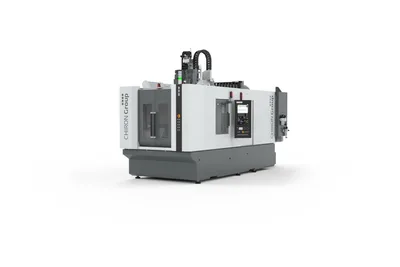
Stama MC 730/Plus
This model was not found in Stama's current lineup when we checked on 2026-10-03 . It may be a superseded or older model; the specifications below are as we last recorded them.
Key Specifications
X Travel
Y Travel
Z Travel
Max Spindle
Spindle Taper
Tool Capacity
How much does the Stama MC 730/Plus cost?
Estimated price range
Our best estimate for a vertical machining centers (vmc) in this class — not a quote from Stama. Configuration moves it a long way.
Overview
The Stama MC 730/Plus is listed as a large-envelope twin machining center: two independent units with 730 mm of X each (1,460 mm combined), 530 mm (20.9 in) of Y and 430 mm (16.9 in) of Z, and HSK-A63 spindles of 30 kW (40 hp) and 200 Nm (148 ft-lb) each. Stama's current lineup does not include this model. The maker has not confirmed the table, so the numbers are the listed figures.
The spindle is what sets it apart from the smaller twins. HSK-A63 with 200 Nm per spindle takes larger face mills, drills and taps in steel, and the top speed of 12,000 RPM reflects that bias toward torque. The MC 422/Twin, for comparison, is listed with HSK-A50, 95 Nm (70 ft-lb) and 15,000 RPM.
Work capacity follows the same pattern. Each station takes a workpiece of 500 × 400 × 350 mm and a table load of 400 kg, which leaves room for a substantial fixture as well as the part. With Z at 430 mm (16.9 in), a 350 mm tall part leaves little clearance for long tools, so check tool lengths against the tallest setup.
Rapids are 50 m/min (1,969 ipm), each unit carries 40 tools for 80 in total, and positioning accuracy is listed as ±0.005 mm. The table has no rotary axis rows and no machine weight, floor space or supply figures.
Full Specifications
| Parameter | Value |
|---|---|
| Spindle Count | 2 (twin independent units) |
| X-Axis Travel | 730 mm per station (1,460 mm combined) |
| Y-Axis Travel | 530 mm (20.9 in) |
| Z-Axis Travel | 430 mm (16.9 in) |
| Max Spindle Speed | 12,000 RPM |
| Spindle Taper | HSK-A63 |
| Spindle Motor Power | 2 × 30 kW (2 × 40 hp) |
| Spindle Torque Max | 2 × 200 Nm (2 × 148 ft-lb) |
| Rapid Traverse Rate | 50 m/min (1,969 ipm) |
| Tool Capacity | 2 × 40 (80 total) |
| Workpiece Size Max | 500 × 400 × 350 mm per station |
| Table Load Max | 400 kg per station |
| Positioning Accuracy | ±0.005 mm |
| CNC Control | Siemens Sinumerik 840D sl |
Specifications compiled from manufacturer literature and industry references. Not independently verified against a published spec sheet — confirm with the manufacturer or an authorised dealer before making a purchasing decision.
Strengths & Limitations
Strengths
- HSK-A63 spindles with 30 kW (40 hp) and 200 Nm (148 ft-lb) each
- 730 mm of X per station, with 530 mm (20.9 in) of Y and 430 mm (16.9 in) of Z
- Table load of 400 kg per station and workpieces up to 500 × 400 × 350 mm
- 40 tools per unit, 80 in total
- Listed positioning accuracy of ±0.005 mm
Limitations
- Top spindle speed is 12,000 RPM, which limits small-tool work in aluminium
- Rapid traverse of 50 m/min (1,969 ipm) is below the 60 m/min (2,362 ipm) listed for the MC 422/Twin
- Z travel of 430 mm (16.9 in) leaves limited tool clearance over a 350 mm tall workpiece
- No rotary axis, machine weight or footprint is listed
Best For
Frequently Asked Questions
01
Workpiece size is listed as 500 × 400 × 350 mm per station with a table load of 400 kg per station. Travels are 730 mm in X per station, 1,460 mm combined, 530 mm (20.9 in) in Y and 430 mm (16.9 in) in Z.
02
Two HSK-A63 spindles, each listed at 12,000 RPM maximum with 30 kW (40 hp) and 200 Nm (148 ft-lb) of torque. The figures are listed figures and are not confirmed by the maker.
03
The MC 730/Plus is the larger and stronger machine: 730 mm of X per station, HSK-A63, 200 Nm (148 ft-lb) and 400 kg per station. The MC 422/Twin is listed with 420 mm of X per station, HSK-A50, 95 Nm (70 ft-lb) and 150 kg per station, but a higher 15,000 RPM.
04
Tool capacity is listed as 2 × 40, or 80 in total, so each of the two units has 40 tools of its own. The table does not state maximum tool dimensions for the HSK-A63 magazine.
More from Stama
Other Vertical Machining Centers (VMC)
Haas VM-5-50
Dener TDC 2112
Accuway UM-160S
Johnford DMC-2100H
FANUC Robodrill α-D21SiB Plus