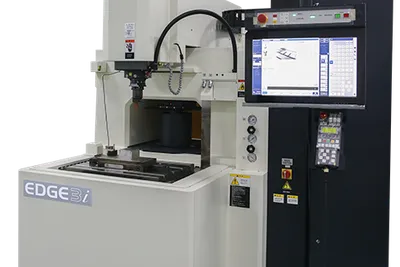
Sodick K3L-C
This model was not found in Sodick's current lineup when we checked on 2026-09-24 (lineup page). It may be a superseded or older model; the specifications below are as we last recorded them.
Key Specifications
X Travel
Y Travel
Z Travel
Accuracy
work table size
max workpiece weight
How much does the Sodick K3L-C cost?
Estimated price range
Our best estimate for a sinker edm (ram edm) in this class — not a quote from Sodick. Configuration moves it a long way.
Overview
The Sodick K3L-C is listed as a small linear-motor sinker EDM with 350 mm (13.8 in) of X, 250 mm (9.84 in) of Y and 250 mm (9.84 in) of Z travel, a 500 x 350 mm (19.7 x 13.8 in) table, and limits of 300 kg (661 lb) on the workpiece and 30 kg (66 lb) on the electrode. It is not in Sodick's current lineup and may be an older model, and its table could not be checked against Sodick's documents. Treat everything below as the listed figures.
The listed equipment is that of a die-sinker: linear motors on X, Y and Z, a Sodick LN1W adaptive discharge generator, hydrocarbon oil as dielectric, and a Sodick LQ controller with NC orbiting in 3D orbital, circular, helical and user-defined patterns. Orbiting lets one electrode rough and then finish a cavity by widening its path, which reduces the number of electrodes a job needs.
The same listing claims ±0.001 mm positioning accuracy, 0.1 µm resolution and VDI 0 (mirror) finish on final passes. Those are demanding figures for any machine, so ask for them to be demonstrated on the actual machine rather than taken from a listing. The machine weighs approx. 2,200 kg (4,850 lb).
Full Specifications
| Parameter | Value |
|---|---|
| X-Axis Travel | 350 mm (13.8 in) |
| Y-Axis Travel | 250 mm (9.84 in) |
| Z-Axis Travel | 250 mm (9.84 in) |
| Work Table Size | 500 x 350 mm (19.7 x 13.8 in) |
| Max Workpiece Weight | 300 kg (661 lb) |
| Max Electrode Weight | 30 kg (66 lb) |
| Drive System | Linear motors (X, Y, Z axes) |
| Generator | Sodick LN1W adaptive discharge generator |
| Surface Finish | VDI 0 (mirror) achievable on final finish passes |
| Positioning Resolution | 0.1 µm |
| Positioning Accuracy | ±0.001 mm |
| Dielectric | Hydrocarbon oil (Sodick EDM fluid) |
| CNC Control | Sodick LQ controller with NC orbiting |
| Orbital Motion | 3D orbital, circular, helical, and user-defined |
| Machine Weight | approx. 2,200 kg (4,850 lb) |
Specifications compiled from manufacturer literature and industry references. Not independently verified against a published spec sheet — confirm with the manufacturer or an authorised dealer before making a purchasing decision.
Strengths & Limitations
Strengths
- Linear motors on X, Y and Z with a 350 x 250 x 250 mm (13.8 x 9.84 x 9.84 in) working envelope
- NC orbiting in 3D orbital, circular, helical and user-defined patterns on the Sodick LQ controller
- Electrodes up to 30 kg (66 lb) and workpieces up to 300 kg (661 lb)
- At approx. 2,200 kg (4,850 lb) it is light for its 500 x 350 mm (19.7 x 13.8 in) table
Limitations
- Not in Sodick's current lineup, and the listed figures have not been checked against Sodick's documents
- The listed ±0.001 mm accuracy and VDI 0 finish should be proven on the machine before purchase
- Z travel of 250 mm (9.84 in) limits electrode length plus part height
- Hydrocarbon oil dielectric needs fire precautions and fluid disposal planning
Best For
Frequently Asked Questions
01
No. The K3L-C is not in Sodick's current lineup and may be an older model. Its table could not be checked against Sodick's documents, so confirm the travels, the controller fitted and the generator on the machine itself before buying.
02
The listed table gives a Sodick LQ controller with NC orbiting in 3D orbital, circular, helical and user-defined patterns. On a used machine, check that the orbit functions are enabled in the control and run a test cavity before relying on them.
03
The table is 500 x 350 mm (19.7 x 13.8 in), the workpiece limit is 300 kg (661 lb) and the electrode can weigh up to 30 kg (66 lb). The electrode reaches 350 x 250 mm (13.8 x 9.84 in) of the part, with 250 mm (9.84 in) of Z for electrode length and part height combined.
04
That is the listed positioning accuracy, alongside 0.1 µm resolution. Neither has been checked against Sodick's documents, and figures this tight depend on temperature control and machine condition. Ask for a measured positioning test on the machine you are buying.
More from Sodick
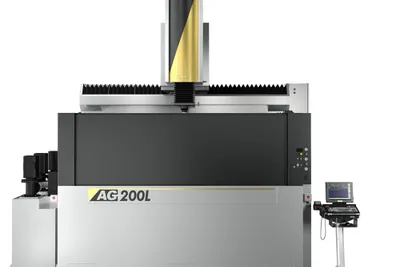
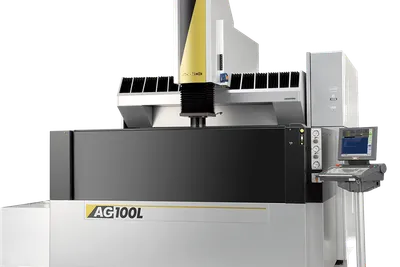
Other Sinker EDM (Ram EDM)
Excetek ED800C CE
Mitsubishi Electric EA8 Advance
Makino EDNC-15
Kent CNC KEB-600L CNC
GF Machining AgieCharmilles FORM P 350