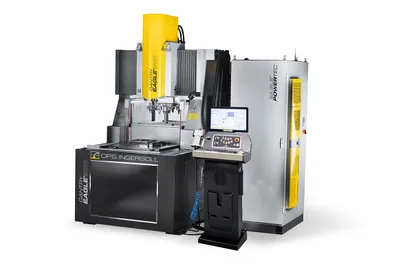
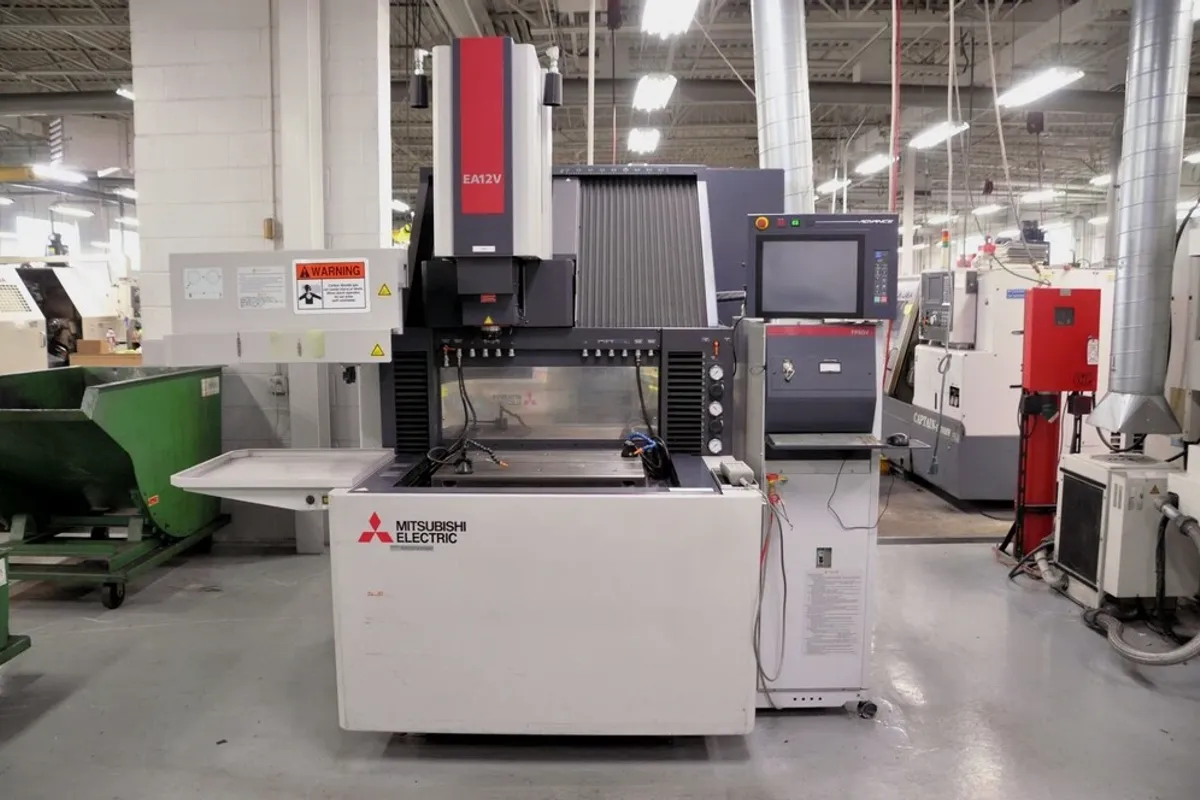
Mitsubishi EA12V
This model was not found in Mitsubishi Electric's current lineup when we checked on 2026-10-03 (lineup page). It may be a superseded or older model; the specifications below are as we last recorded them.
Key Specifications
X Travel
Y Travel
Z Travel
work table size
work tank dimensions
max workpiece weight
How much does the Mitsubishi EA12V cost?
Estimated price range
Our best estimate for a sinker edm (ram edm) in this class — not a quote from Mitsubishi Electric. Configuration moves it a long way.
Overview
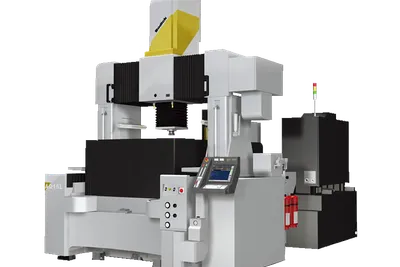
The Mitsubishi EA12V is a sinker EDM with 400 mm (15.7 in) of X travel and 300 mm (11.8 in) each of Y and Z, a three-sided drop tank and a C-axis listed as standard. It is not in Mitsubishi Electric's current lineup. The listed figures for it are detailed, but a few rows disagree with each other, notably table size and machine weight, and those are left out here.
Inside, the tank measures 850 x 600 x 350 mm (33.5 x 23.6 x 13.8 in) and takes a workpiece up to 800 x 550 x 250 mm and 700 kg, with dielectric up to 300 mm deep. The head carries electrodes up to 50 kg, and with a 3R-MACRO chuck the distance from table to C-axis chuck runs from 135 to 435 mm. The column is described as a saddle-less design on a combined linear motion way system.
Motion is where it differs most from the EA12PS, which shares the travels. Rapid travel is 2000 mm/min and the maximum high-speed jump is 10 m/min, where the EA12PS is listed with a 275.5 in/min (7 m/min) rapid traverse. Resolution is fine all the same: 0.05 µm servo resolution and a minimum command unit of 0.0001 / 0.00005 mm.
The generator is the FP80V with Fine Pulse 2 (FP2), 80 A peak, and an FP120V supply also appears in the table. Control is an M700 CNC, PC-based with a touchscreen, with 10 MB of program storage on a hard drive and Ethernet, DNC and FTP connections. An electric chiller is standard. The machine system occupies 1750 x 2050 mm of floor.
Full Specifications
| Parameter | Value |
|---|---|
| X-Axis Travel | 400 mm (15.7 in) |
| Y-Axis Travel | 300 mm (11.8 in) |
| Z-Axis Travel | 300 mm (11.8 in) |
| Work Table Size | 700 x 600 mm (27.6 x 23.6 in) |
| Work Tank Dimensions | 850 x 600 x 350 mm (33.5 x 23.6 x 13.8 in) |
| Max Workpiece Weight | 700kg |
| Chuck to Table Clearance | 200 - 500 mm (7.9 - 19.67 in) |
| Servo Resolution | 0.05 um (0.000002 in) |
| C Axis | Standard (3R Macro compatible) |
| Generator | FP80V with Fine Pulse 2 (FP2) |
| CNC Control | M700 CNC (PC-based, touchscreen) |
| Program Storage | 10 MB on hard drive |
| Connectivity | Ethernet / DNC / FTP |
| Chiller | Electric chiller (standard) |
| Machine Weight | 3,856 kg (8,500 lb) |
| Column Design | Saddle-less combined linear motion way system |
| Machine Travels X X Y X Z | 400 x 300 x 300mm |
| Maximum Workpiece Size W X D X H | 800 x 550 x 250mm |
| Max Dielectric Fluid Level | 300mm |
| Power Supply Peak Current | FP80V (80 Peak) FP120V (120Peak) |
| Internal Worktank Dimensions W X D X H | 850 x 600 x 350mm |
| Worktank Door Type | 3-Sided Drop Ttank |
| Table Dimensions W X D | 600 x 450mm |
| Max Electrode Weight | 50kg |
| Table to C Axis Chuck Distance Min Max | 135 ~ 435mm 3R-MACRO Chuck |
| Minimum Command Unit Resolution | 0.0001 / 0.00005mm |
| Rapid Travel Speed | 2000mm/min |
| High Speed Jump Maximum | 10m/min |
| Machine System Dimensions W X D | 1750 x 2050mm |
| Machine System Weight | 3725kg |
Specifications sourced from machinio.com — verified 2026-03-28
Strengths & Limitations
Strengths
- C-axis is listed as standard and is 3R Macro compatible
- Three-sided drop tank measuring 850 x 600 x 350 mm (33.5 x 23.6 x 13.8 in) inside
- Workpieces up to 800 x 550 x 250 mm and 700 kg, electrodes up to 50 kg
- 0.05 µm servo resolution with a minimum command unit of 0.0001 / 0.00005 mm
- Electric chiller is standard, and the M700 CNC has Ethernet, DNC and FTP connectivity
Limitations
- Rapid travel is 2000 mm/min, against 275.5 in/min (7 m/min) on the EA12PS
- High-speed jump tops out at 10 m/min, so deep, narrow cavities may still need flushing through the electrode or the workpiece
- The 700 kg workpiece limit is below the 2,200 lb (1,000 kg) table load of the EA12PS
- Table size and machine weight rows in the listed figures conflict, so both need confirming on the machine
Best For
Frequently Asked Questions
01
Travels are 400 mm (15.7 in) in X, 300 mm (11.8 in) in Y and 300 mm (11.8 in) in Z. The three-sided drop tank is 850 x 600 x 350 mm (33.5 x 23.6 x 13.8 in) inside, the maximum workpiece is 800 x 550 x 250 mm, and the maximum dielectric fluid level is 300 mm.
02
Yes. The listed figures show the C-axis as standard and 3R Macro compatible. With a 3R-MACRO chuck the table to C-axis chuck distance is 135 to 435 mm, and the maximum electrode weight is 50 kg.
03
The travels match: the EA12PS also has 15.7 in (400 mm), 11.8 in (300 mm) and 11.8 in (300 mm). The EA12PS is listed with a 275.5 in/min (7 m/min) rapid traverse and a 2,200 lb (1,000 kg) table load, against 2000 mm/min and a 700 kg workpiece limit in the listed figures for the EA12V. Both have an M700 control.
04
An M700 CNC, PC-based with a touchscreen, storing 10 MB of programs on a hard drive and connecting by Ethernet, DNC or FTP. The generator is the FP80V with Fine Pulse 2 (FP2), rated 80 A peak, and the table also names an FP120V power supply.
05
Rapid travel speed is 2000 mm/min and the maximum high-speed jump is 10 m/min. Servo resolution is 0.05 µm and the minimum command unit is 0.0001 / 0.00005 mm, so the slow rapid rate does not mean coarse positioning.
Videos

MTDCNC

HitechMachinery

KD Machinery

HK Ltd
Comparisons
More from Mitsubishi Electric
Mitsubishi Electric EA12 ADV
Mitsubishi Electric EA8PV Advance
Mitsubishi Electric EA12PS
Mitsubishi Electric EA12 Advance
Mitsubishi Electric SV12P
Mitsubishi Electric EA12V
Other Sinker EDM (Ram EDM)
Oscar EDM ZX 550
GF Machining Solutions AgieCharmilles FORM P 900
Sodick AQ15L