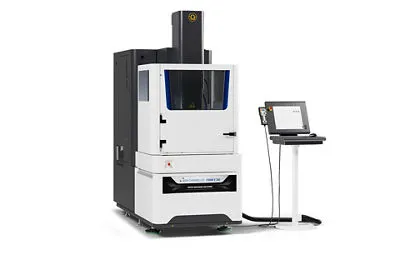
Sodick AL1000G
This model was not found in Sodick's current lineup when we checked on 2026-09-24 (lineup page). It may be a superseded or older model; the specifications below are as we last recorded them.
Key Specifications
X Travel
Y Travel
Z Travel
work table size
work tank inner
max workpiece weight
How much does the Sodick AL1000G cost?
Estimated price range
Our best estimate for a sinker edm (ram edm) in this class — not a quote from Sodick. Configuration moves it a long way.
Overview
The Sodick AL1000G is a large linear-motor sinker EDM with 1,000 mm (39.4 in) of X, 800 mm (31.5 in) of Y and 500 mm (19.7 in) of Z travel, a 1,250 x 1,000 mm (49.2 x 39.4 in) table and a 4,000 kg (8,818 lb) workpiece limit. It is not in Sodick's current lineup and may be an older model, and its table has not been checked against Sodick's own documents. Read the figures below as the listed figures, to be confirmed on any machine offered for sale.
For mould work the tank and the clearance decide more than the travels. The work tank measures 1,500 x 1,200 x 600 mm (59.1 x 47.2 x 23.6 in) inside, and electrode-to-table clearance runs from 200 to 700 mm (7.9 to 27.6 in). A plate has to fit between the tank walls with the burn area under dielectric, and the workpiece plus the longest electrode has to fit inside that clearance range.
X, Y and Z are driven by linear motors, with an axis feed of 36,000 mm/min (1,400 ipm) and 1.2G acceleration listed. In sinking that speed is spent on electrode jumps, the repeated lift and plunge that clears debris from the gap, so a fast axis keeps deep ribs flushing without long pauses. The generator is listed as TMM3 with a zero-wear circuit and e-pack fine-pulse, giving VDI 4 / Ra 0.10 µm with e-pack and near-zero electrode wear on finishing. The control is the Sodick LQ.
The AL100G lists 1,200 mm of X, 650 mm of Y and 500 mm of Z on a 1,600 × 1,000 mm table at 12,500 kg, so the AL1000G gives up X stroke for more Y on the same Z. Plan the site carefully: the AL1000G is listed at 4,100 x 3,800 x 3,200 mm (161 x 150 x 126 in) and 18,000 kg (39,683 lb).
Full Specifications
| Parameter | Value |
|---|---|
| X-Axis Travel | 1,000 mm (39.4 in) |
| Y-Axis Travel | 800 mm (31.5 in) |
| Z-Axis Travel | 500 mm (19.7 in) |
| Work Table Size | 1,250 x 1,000 mm (49.2 x 39.4 in) |
| Work Tank Inner | 1,500 x 1,200 x 600 mm (59.1 x 47.2 x 23.6 in) |
| Max Workpiece Weight | 4,000 kg (8,818 lb) |
| Electrode to Table Clearance | 200 - 700 mm (7.9 - 27.6 in) |
| Axis Feed Rate | 36,000 mm/min (1,400 ipm) |
| Acceleration | 1.2G |
| Drive System | Linear motors (X, Y, Z) |
| Generator | TMM3 with zero-wear and e-pack fine-pulse |
| Surface Finish | VDI 4 / Ra 0.10 um (with e-pack fine-pulse) |
| Electrode Wear | Near-zero on finishing (zero-wear circuit) |
| CNC Control | Sodick LQ controller |
| Machine Dimensions | 4,100 x 3,800 x 3,200 mm (161 x 150 x 126 in) |
| Machine Weight | 18,000 kg (39,683 lb) |
Specifications compiled from manufacturer literature and industry references. Not independently verified against a published spec sheet — confirm with the manufacturer or an authorised dealer before making a purchasing decision.
Strengths & Limitations
Strengths
- 1,000 x 800 x 500 mm (39.4 x 31.5 x 19.7 in) of travel with a 4,000 kg (8,818 lb) workpiece limit for large mould plates
- Linear motors on X, Y and Z with 36,000 mm/min (1,400 ipm) axis feed and 1.2G acceleration for fast electrode jumps
- Electrode-to-table clearance of 200 - 700 mm (7.9 - 27.6 in) for tall electrodes over thick plates
- Listed finish of VDI 4 / Ra 0.10 µm with e-pack fine-pulse, and near-zero electrode wear on finishing with the zero-wear circuit
- Work tank of 1,500 x 1,200 x 600 mm (59.1 x 47.2 x 23.6 in) inside
Limitations
- Not in Sodick's current lineup, and the listed figures have not been checked against Sodick's documents
- At 18,000 kg (39,683 lb) and 4,100 x 3,800 x 3,200 mm (161 x 150 x 126 in) it needs a prepared floor and crane or rigging access
- X travel of 1,000 mm is shorter than the 1,200 mm of the AL100G
Best For
Frequently Asked Questions
01
The AL1000G is not in Sodick's current lineup and may be an older model. Its table has not been checked against Sodick's documents, so a buyer should confirm the travels, tank size and weight on the machine and ask for its service history before relying on the listed figures.
02
The table is 1,250 x 1,000 mm (49.2 x 39.4 in), the tank is 1,500 x 1,200 x 600 mm (59.1 x 47.2 x 23.6 in) inside and the workpiece limit is 4,000 kg (8,818 lb). The electrode reaches 1,000 x 800 mm (39.4 x 31.5 in) of the plate, and the workpiece and electrode together must fit within the 200 - 700 mm (7.9 - 27.6 in) electrode-to-table clearance.
03
The AL100G lists 47.24 in (1,200 mm) of X, 25.60 in (650 mm) of Y and 19.69 in (500 mm) of Z on a 63.0 in × 39.37 in (1,600 × 1,000 mm) table, at 27,557.78 lb (12,500 kg). The AL1000G lists 1,000 x 800 x 500 mm (39.4 x 31.5 x 19.7 in) on a 1,250 x 1,000 mm table at 18,000 kg (39,683 lb), so it is shorter in X, longer in Y and much heavier.
04
The listed table gives a TMM3 generator with a zero-wear circuit and e-pack fine-pulse, and the Sodick LQ controller. With e-pack fine-pulse the listed finish is VDI 4 / Ra 0.10 µm, and electrode wear on finishing is described as near-zero. Check that a used machine has the e-pack circuit fitted.
05
The machine is listed at 4,100 x 3,800 x 3,200 mm (161 x 150 x 126 in) and 18,000 kg (39,683 lb). That calls for a floor rated for the load, access for a crane or heavy rigging, and headroom above the 3,200 mm height for opening and service.
More from Sodick
Other Sinker EDM (Ram EDM)
CHMER CM A53C
GF Machining Solutions Form 400 Sinker EDM
Mitsubishi Electric EA12V
GF AgieCharmilles FORM P 350
Makino EDNC-6