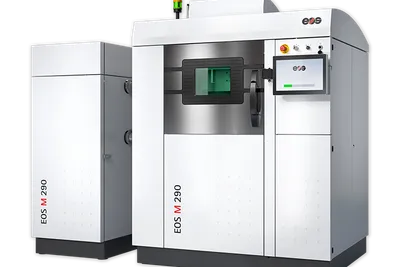
SLM Solutions SLM 280
Key Specifications
model designation
build envelope
laser configuration
variable layer thickness
theoretical build rate
minimum feature size
How much does the SLM Solutions SLM 280 cost?
Estimated price range
Our best estimate for a metal additive manufacturing in this class — not a quote from SLM Solutions. Configuration moves it a long way.
Overview
The SLM 280 covered here is the Production Series machine in its Twin configuration: two 700 W lasers with 3D optics over a 280 x 280 x 365 mm (11.0 x 11.0 x 14.4 in) build envelope. SLM Solutions quotes that envelope before the substrate plate, so the tallest printable part is somewhat short of 365 mm.
Two lasers on a square plate is the point of this configuration. The theoretical build rate is up to 173 cm³/h, worked out as layer thickness x scan speed x hatch distance x number of lasers. That formula assumes both lasers melt all the time at the thickest layer, so a single slender part will see much less of it than a full plate of nested parts where each laser has its own share of the area. Layer thickness is variable from 20 – 90 µm, with more on request, and the maximum scan speed is 10 m/s.
For detail, the beam focus diameter is 80 – 115 µm and the minimum feature size is 150 µm. Those two figures set the thinnest wall and smallest hole worth designing in.
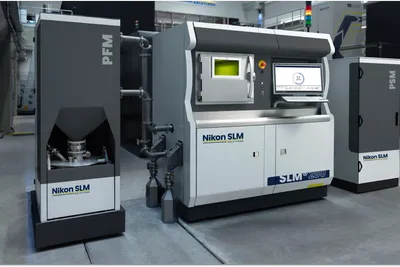
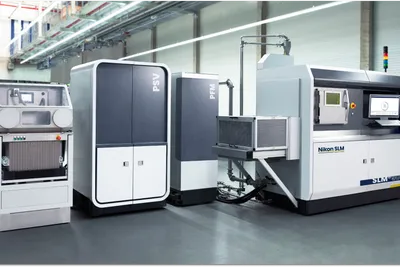
The machine is long and narrow: 4,150 x 1,170 x 2,525 mm (163.4 x 46.1 x 99.4 in). It needs a 400 V 3NPE supply at 63 A, 50/60 Hz, and compressed air at 7 bar to ISO 8573-1:2010 [1:4:1]. Argon consumption is 13 L/min in process and 160 L/min in purging, which is worth sizing a bulk supply around if builds run back to back. Gas filtration is a PFM (Permanent Filter Module); ask what service it needs and at what interval.
Within the range, the SLM 500 Quad keeps the same depth and height but lengthens the plate and doubles the laser count: 500 x 280 x 365 mm (19.7 x 11 x 14.4 in) with 4 x 700 W fiber lasers, at approx. 4,200 kg (9,259 lb).
Full Specifications
| Parameter | Value |
|---|---|
| Model Designation | SLM 280 Production Series, Twin (2 x 700 W) 3D optics configuration |
| Build Envelope | 280 x 280 x 365 mm (11.0 x 11.0 x 14.4 in), reduced by substrate plate thickness |
| Laser Configuration | Twin, 2 x 700 W |
| Variable Layer Thickness | 20 – 90 µm (more on request) |
| Theoretical Build Rate | up to 173 cm³/h (theoretical: layer thickness x scan speed x hatch distance x number of lasers) |
| Minimum Feature Size | 150 µm |
| Beam Focus Diameter | 80 – 115 µm |
| Max Scan Speed | 10 m/s |
| Inert Gas Consumption | 13 L/min argon in process; 160 L/min argon in purging |
| Gas Filtration | PFM (Permanent Filter Module) |
| Compressed Air Requirement | ISO 8573-1:2010 [1:4:1], 7 bar |
| Power Input | 400 V 3NPE, 63 A, 50/60 Hz |
| Machine Dimensions Lxwxh | 4,150 x 1,170 x 2,525 mm (163.4 x 46.1 x 99.4 in) |
Specifications sourced from nikon-slm-solutions.com — verified 2026-09-24
Strengths & Limitations
Strengths
- Twin 2 x 700 W lasers with a theoretical build rate of up to 173 cm³/h
- 365 mm (14.4 in) of build height over a square plate, less the substrate plate thickness
- Layer thickness can be set anywhere in 20 – 90 µm, and thicker on request
- 150 µm minimum feature size with an 80 – 115 µm beam focus diameter
- Gas filtration is handled by a PFM (Permanent Filter Module)
Limitations
- The 173 cm³/h build rate is theoretical and counts both lasers melting continuously; real throughput depends on how the plate is filled
- Purging uses 160 L/min of argon and the process another 13 L/min, so the gas supply needs planning
- A 4,150 mm (163.4 in) long machine needs a long bay, and the 63 A, 400 V 3NPE supply must be in place before delivery
- Parts longer than the square plate point to the SLM 500 Quad, with 500 x 280 x 365 mm (19.7 x 11 x 14.4 in)
Best For
Frequently Asked Questions
01
The SLM 280 Production Series in its Twin configuration, which is two 700 W lasers with 3D optics. The build envelope, the theoretical build rate of up to 173 cm³/h and the gas and power figures on this page are the ones SLM Solutions publishes for that configuration.
02
The build envelope is 280 x 280 x 365 mm (11.0 x 11.0 x 14.4 in), reduced by the substrate plate thickness. In practice, subtract the plate from the 365 mm height and leave room for supports and for the cut that separates the part from the plate.
03
It is an upper bound. SLM Solutions defines it as layer thickness x scan speed x hatch distance x number of lasers, so it is reached only if both lasers melt without pause at the top of the 20 – 90 µm layer range. Recoating and jumps between parts are not in the calculation, and a plate with little scan area per layer will fall well below it.
04
13 L/min in process and 160 L/min in purging. Purging is the short, high-flow phase that makes the chamber inert, while the 13 L/min runs for the length of the build. Compressed air at 7 bar to ISO 8573-1:2010 [1:4:1] is also required.
05
400 V 3NPE, 63 A, 50/60 Hz. The machine measures 4,150 x 1,170 x 2,525 mm (163.4 x 46.1 x 99.4 in), so it is over four metres long but little more than a metre deep. Allow space beyond that outline for operator access and powder handling.
Videos
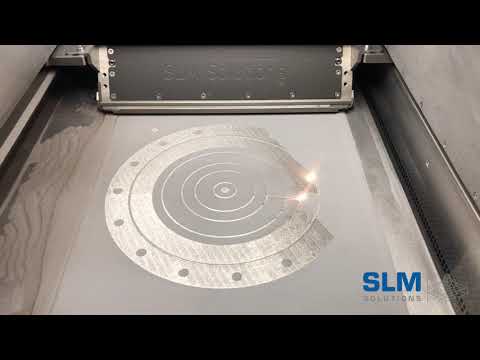
Nikon SLM Solutions

SLM Solutions NA, Inc.
Community Discussions
Comparison and buying advice
Links to community discussions. Summaries are editorial — visit the original thread for full context.
More from SLM Solutions
Other Metal Additive Manufacturing
Markforged Metal X System
Farsoon FS422M
Concept Laser M1 Cusing