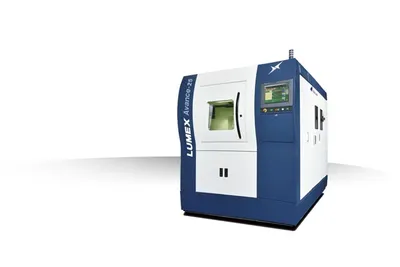
SLM Solutions SLM 125
Key Specifications
build envelope
build volume reduction
laser configuration
theoretical build rate
variable layer thickness
minimum feature size
How much does the SLM Solutions SLM 125 cost?
Estimated price range
Our best estimate for a metal additive manufacturing in this class — not a quote from SLM Solutions. Configuration moves it a long way.
Overview
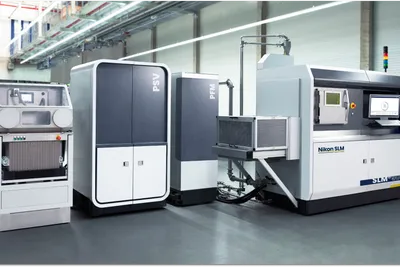
The SLM 125 is a small-format laser metal additive machine: a single 400 W laser working over a 125 x 125 x 125 mm (4.9 x 4.9 x 4.9 in) build envelope, in a cabinet that measures 1,400 x 900 x 2,460 mm (55.1 x 35.4 x 96.9 in). SLM Solutions gives a theoretical build rate of up to 33 cm³/h. Those figures point to development work, material trials and small parts, not to volume production.
The envelope is quoted before the substrate plate, and the table says so: usable height is the 125 mm less the thickness of the plate the part is built on. A second row lists a build volume reduction to 50 x 50 x 50 mm (2.0 x 2.0 x 2.0 in), again less the plate. A reduced volume needs far less powder to fill, which is the practical way to try a new or scarce alloy without loading the full cylinder. The table does not say whether the reduction is part of the base machine, so confirm that when quoting.
Resolution is where a machine this size earns its place. The beam focus diameter is 80 – 100 µm, the minimum feature size is 140 µm, and layer thickness is variable from 20 – 75 µm with more on request. Maximum scan speed is 10 m/s. The 33 cm³/h rate is explicitly theoretical, calculated as layer thickness x scan speed x hatch distance x number of lasers, and with one laser that last term is one. Recoating and the scan pattern of a real part are not in that product, so treat it as a ceiling when estimating build times.
Site requirements are light for a metal machine. Power input is 400 V 3NPE, 32 A, 50/60 Hz, 3 kW. Argon consumption is 0.6 L/min in process and 70 L/min in purging, so gas use is driven by how often the chamber is purged more than by build hours. Compressed air must meet ISO 8573-1:2010 [1:4:1] at 7 bar. At 2,460 mm tall, the cabinet needs door and ceiling clearances checked along the delivery route. For scale, the SLM 500 Quad builds in 500 x 280 x 365 mm (19.7 x 11 x 14.4 in) with 4 x 700 W fiber lasers and weighs approx. 4,200 kg (9,259 lb).
Full Specifications
| Parameter | Value |
|---|---|
| Build Envelope | 125 x 125 x 125 mm (4.9 x 4.9 x 4.9 in), reduced by substrate plate thickness |
| Build Volume Reduction | 50 x 50 x 50 mm (2.0 x 2.0 x 2.0 in), reduced by substrate plate thickness |
| Laser Configuration | Single, 1 x 400 W |
| Theoretical Build Rate | up to 33 cm³/h (theoretical: layer thickness x scan speed x hatch distance x number of lasers) |
| Variable Layer Thickness | 20 – 75 µm (more on request) |
| Minimum Feature Size | 140 µm |
| Beam Focus Diameter | 80 – 100 µm |
| Max Scan Speed | 10 m/s |
| Inert Gas Consumption | 0.6 L/min argon in process; 70 L/min argon in purging |
| Compressed Air Requirement | ISO 8573-1:2010 [1:4:1], 7 bar |
| Power Input | 400 V 3NPE, 32 A, 50/60 Hz, 3 kW |
| Machine Dimensions Lxwxh | 1,400 x 900 x 2,460 mm (55.1 x 35.4 x 96.9 in) |
Specifications sourced from nikon-slm-solutions.com — verified 2026-09-24
Strengths & Limitations
Strengths
- Beam focus diameter of 80 – 100 µm and a 140 µm minimum feature size suit fine detail and thin walls
- Layer thickness is variable from 20 – 75 µm, with more on request
- A listed build volume reduction to 50 x 50 x 50 mm (2.0 x 2.0 x 2.0 in) lets small powder quantities be run
- Small cabinet: 1,400 x 900 x 2,460 mm (55.1 x 35.4 x 96.9 in)
- Light utility demand: 400 V 3NPE, 32 A, 3 kW and 0.6 L/min of argon in process
Limitations
- The 125 x 125 x 125 mm (4.9 x 4.9 x 4.9 in) envelope is reduced further by the substrate plate thickness, so parts near the limit need checking against the real usable height
- One 400 W laser and a theoretical build rate of up to 33 cm³/h make it slow for anything beyond small batches
- The build rate is a calculated product of layer thickness, scan speed, hatch distance and laser count, not a measured throughput
- Purging draws 70 L/min of argon against 0.6 L/min in process, so frequent short builds use a disproportionate share of gas
- The table gives no machine weight, so floor loading has to be confirmed separately
Best For
Frequently Asked Questions
01
125 x 125 x 125 mm (4.9 x 4.9 x 4.9 in), reduced by the thickness of the substrate plate. The table also lists a build volume reduction to 50 x 50 x 50 mm (2.0 x 2.0 x 2.0 in), likewise reduced by the plate, for work that should not fill the whole cylinder with powder.
02
SLM Solutions states a theoretical build rate of up to 33 cm³/h with the single 400 W laser and a maximum scan speed of 10 m/s. The figure is defined as layer thickness x scan speed x hatch distance x number of lasers, so it leaves out recoating and any time the laser is not melting. Real builds will come in under it.
03
The minimum feature size is 140 µm, with a beam focus diameter of 80 – 100 µm. Layer thickness is variable from 20 – 75 µm, and SLM Solutions notes that more is available on request. Thinner layers give a finer step in the build direction at the expense of build time.
04
Electrical supply is 400 V 3NPE, 32 A, 50/60 Hz, 3 kW. Argon consumption is 0.6 L/min in process and 70 L/min in purging. Compressed air must be at 7 bar and meet ISO 8573-1:2010 [1:4:1]. The gas rows give argon figures only.
05
They sit at opposite ends of the scale. The SLM 125 has one 400 W laser over 125 x 125 x 125 mm (4.9 x 4.9 x 4.9 in). The SLM 500 Quad has 4 x 700 W fiber lasers over 500 x 280 x 365 mm (19.7 x 11 x 14.4 in) and weighs approx. 4,200 kg (9,259 lb). One is a machine for trials and small parts, the other for production plates.
Videos

ALTEM TECHNOLOGIES
Community Discussions
Links to community discussions. Summaries are editorial — visit the original thread for full context.
More from SLM Solutions
Other Metal Additive Manufacturing